Reporting on priestly celibacy in Germany … sort of

All Things Considered,” NPR’s evening news program, ran an interesting segment on Wednesday about how some Roman Catholics in Germany “pray” that the church will rethink its teaching about celibacy for priests. Here’s the start of the text story on NPR.org., which follows the audio closely:

In Germany, calls are going out for the Catholic Church to rethink some of its basic principles, including the rule of celibacy for priests.

Many say the German church is experiencing a period of crisis. It’s been rocked by sex and abuse scandals and no longer even has enough priests to serve its parishes. These days, even more traditional-minded Catholics in Germany have begun calling for far-reaching reform.

That’s fine for a general summary lead. The problem is that the rest of Kyle James’ story doesn’t dig much deeper than that. Aside from hearing the voices of four individuals, we get very little information about what is really going on over there.

There’s no indication of who are the “many” making these calls or who say the church is in crisis, or if there’s been some recent development in this controversy. The story mentions surveys and projections, but doesn’t offer specifics about the surveys, not even percentages.

As it turns out, more than 140 Catholic theologians in Germany, Austria and Switzerland issued a petition in early February, calling for changes in the church, including celibacy. But we didn’t learn that on NPR.

The  individuals who are quoted apparently represent various segments within the church: a former priest, now married with children and still in the church; a theologian; a Religion News Service correspondent who covers the Vatican; and a “well-known conservative Catholic politician.”

The four are unanimous about how clerical celibacy — among other “rules” — is an albatross around the church’s neck, sure to drag it down.

They may be right about that, but the story would be stronger if there were more evidence that these voices run the gamut of German Catholic opinion, which seems unlikely. No one in Germany, not even a bishop, was available to offer a different view? How about more detail on where these “calls” for change are coming from? How about a little background or explanation?

“Celibacy rules were originally introduced on practical grounds, and so I think that they can be changed for practical reasons as well,” claims the politician in the story, Hermann Kues.

Really? What’s that about? Is he correct? I thought there was actually some doctrine involved, but we’d never know from this story. A little historical background would have helped — not to mention hearing from a church leader or  theologian who could explain Roman Catholic teaching and the Vatican’s position. (In case you’re wondering, I’m not arguing for or against priestly celibacy right now. I’m just talking about how this story was covered.)

This was an anomaly. NPR usually airs stronger religion stories, especially when Barbara Bradley Hagerty is on the case. (She was busy on Wednesday, reporting on the Supreme Court free-speech decision, providing listeners with a closer-than-usual look at the Westboro Baptist Church of Topeka, Kan., which was at the enter of the court’s ruling.) But this story from Germany, sorry to say, was an example of how news media — even the Normally Pretty Reliable news media — can get the reporting not … quite … right.

By the way, this gives me a chance for a shout out* to Get Religion, a blog by journalists that looks at how mainstream news media** cover religion and how they can get it right … or not. You might want to check it out.

* Do people still say “shout out”?

** Are there really any “mainstream media” anymore, or is that just an old concept?
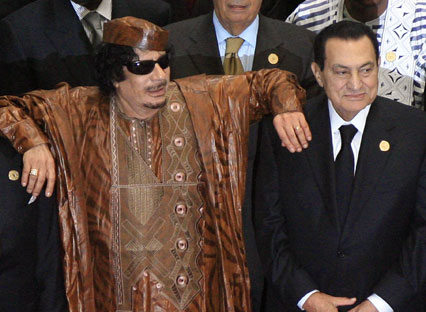
The cost of liberty and the price of oil


Those were the days: Libya's Muammar Qaddafi, now under siege, (left) and former Egyptian President Hosni Mubarak in happier times.

What’s the price of liberty?


It spiked to about $100 per barrel on Wednesday. (The cost of crude oil in the U.S. settled down by the end of the day, closing at $98.) The average price for a gallon of gasoline in the U.S. has climbed to $3.19 in the last few weeks, and it’s likely to go still higher.

The revolutions in the Middle East make oil production and delivery uncertain, which makes commodity markets nervous. Libya, the most recent and so far most dangerous scene of popular uprising, produces only about 2 percent of the world’s oil supply, but its high quality makes it particularly valuable, according to analysts quoted in the New York Times and Wall Street Journal. Several large oil companies, such as France’s Total, have already started reducing their output from Libya.

Some analysts predict the price of oil could climb to $150 per barrel if Libyan production is entirely shut down, and maybe $220 if another major oil-producing nation in the region shuts down too.

Developed nations and particularly democracies like the U.S. may soon face a crisis — or actually two crises. There’s the potential economic crisis as the price of oil pushes up the cost of virtually everything: manufacturing, agriculture (compounding a growing food-cost problem that already haunts most of the world), distribution and so on. Virtually every segment of the economy may be touched. A more expensive tank of gas for the car is only the beginning and might be the least of our worries in the U.S. All of this, of course, would be just piling on, severely slowing down if not stalling the world’s recovery from the so-called Great Recession that’s dogged us since 2008.

But there’s another kind of crisis — more philosophical or ideological — if we take the word literally, back to its Greek root of krinein: “to separate, decide, judge.” We face some serious decisions, we who (a) live in democracies and think other people should live in democracies too, and (b) depend on oil for our way of life. We could start by asking this question: How much are we willing to alter our “way of life” and even sacrifice for the sake of others’ political freedom?

Or to put it roughly: When will the drive for liberty and justice for all in oil-producing nations get too rich for our blood? Is there a point — a price point, that is — when we might decide that we can live with repressive regimes like Qaddafi’s in Libya after all, and choose to not support democratic movements? We haven’t reached that point this time around — and I hope we don’t — but the temptation certainly exists and is no doubt being argued in offices around Washington, Geneva and New York.

American foreign policy is built first and foremost on keeping the U.S. “secure” economically, politically and militarily. The Middle East regimes teetering and falling like dominoes almost weekly are creating complicated and unpredictable scenarios. None of this is easy or simple.

But taking the long view, the U.S. may gain greater security if we help people in other nations gain the liberty we say we value so much, and choose to not literally sell them out over the cost of oil. (It wouldn’t hurt our national security to push harder to develop alternative forms of energy either, but that’s another post.)

Resisting the temptation to sell out will be hard to resist, even at the most basic level. So far most Americans haven’t felt the impact of the events in the Middle East and North Africa, but who knows? Some people on Main Street, not to mention Wall Street, are already getting nervous and maybe even a little impatient.

I was chatting on Tuesday with a self-employed guy whose job puts him on the road literally hundreds of miles each week. We talked a little while about the day’s headlines, including the news coming out of Libya, Bahrain and Saudi Arabia.

“It’s amazing what’s happening over there,” he said. Then he shook his head and added, “But, man, these gas prices are starting to kill me. I hope we can do something about that pretty soon.”

The future is now – really, really now

By strange conjunction of media, the future came knocking rapping banging pounding on the door of my consciousness on Wednesday:

1. Borders, the nation’s second-largest bookstore chain, filed for Chapter 11 bankruptcy today. The company will close about 200 of its 674 Borders and Waldenbooks stores in the U.S. The reasons for the failure aren’t mysterious: Buyers have migrated to Amazon.com and to Barnes and Noble, which dived into new media more aggressively than Borders, which apparently wasn’t hard to do. Borders may survive, thanks to an injection of almost $500 million from investors, but it won’t be the same. Think digital. Think new media. Think the end of bookstores as we’ve known them, although I could imagine the survival of the very small, very local boutique-like stores.

Time, Feb. 21, 2011

2. My Feb. 21 issue of Time magazine arrived in the mail today. (Two old-media words in that sentence alone: magazine, mail.) The cover was a stark image of a bald human head with a wire coming out the back of the neck, a la Matrix. Cover line: “2045: The Year Man Becomes Immortal.*” The asterisk directs us to the small type at the bottom of the cover: “*If you believe humans and machines will become one. Welcome to the Singularity movement.”

“Singularity,” the cover story explains, is “the moment when technological change becomes so rapid and profound, it represents a rupture in the fabric of human history.” I haven’t read the entire story yet, but this “movement” promises — or threatens, depending on your point of view — to change us to the core, right down to what it means to be human. It even raises the prospect of what might be called eternal life, but not the way we find it described in the Bible or Koran.

3. Today’s “Fresh Air” program (NPR) featured Biz Stone, one of the co-founders of Twitter. (I love the name. Well, both of them: the network and the guy.) Stone joined host Terry Gross for “a wide-ranging discussion about the service, including how it was used recently in Egypt to help organize the revolution and how it has been used to spread democracy movements in other countries,” as the “Fresh Air” website says. It was a terrific, informative and, at some moments, inspiring interview.

My estimation of Twitter’s value as a social medium pretty much quadrupled,, especially listening to Stone talk about how the network has dealt with playing a major role in several major events in its five-year existence. (Five years!) But at some point during the interview, I realized in a deeply profound way that what Twitter and other social networks is doing is — pardon the cliché — the new normal.

It hit me at a gut level as never before: This is it. Unless we somehow throw ourselves back into a tech-less dark age (cf. Canticle for Leibowitz), we’re living in a new world and we’re not going back to the old one. It hasn’t been too long — less than six months — that I’ve said something like this: “Twitter is cool, and I see some good uses for it. But what’s the big deal?” I’ll never say that again.

4. Two words: Jeopardy. Watson. (In case you’re wondering: Watson, the IBM computer, easily outscored two human champions in a three-day match on the 25,000-year-old game show.)

5. And finally, in local news, WETS-FM, the public radio station for northeast Tennessee, where I live, announced it’s launching digital broadcasts in the autumn. It is probably the first radio station in this area to go digital, adding three HD channels to its existing analog broadcast. The station radically changed its format last year. It used to air a widely varied mix of NPR news and weekend programming, classical music and local “Americana” programming. Then last February it switched to all-news-and-talk during the week, with some NPR programming and Americana music on the weekends. Classical was gone. Were many listeners ticked off? You could say that. But going digital will let WETS-FM add a station just for Americana and another for jazz and classical.

Good timing for the announcement, by the way: East Tennessee State University, the station’s owner, received a $70,000 grant from the Corporation for Public Broadcasting to install the equipment. The CPB is in Congress’ budget-cutting line of fire this year. Maybe this served as a not-so-subtle message from the station that federal funding for NPR and PBS can actually add value to the community.

In Egypt: So many questions, so few answers — and so little time

I was working on a post that would ask a couple of questions that I haven’t seen addressed much, if at all, about the likely outcome of the drive for democracy in Egypt. Several commentators fear that Egypt 2011 will become another Iran 1979, which started out as a democratic movement but then metastasized into a hard-line theocracy.

I was wondering if (a) will it make a difference that Iran is mostly Shi’ite while Egypt, by far, is predominantly Sunni, and (b) will it make a difference that, compared to Iran, Egypt has been much more cosmopolitan, with closer ties to other nations (including the West), more tourism and more accessibility to international travel. Some friends who lived in Egypt for five years in the late 1990s think those cultural (and economic) differences are deeply rooted enough to keep a  post-Mubarak Egypt from becoming another Iran, even with Islamic groups like the Muslim Brotherhood in the mix.

I had some ideas about this, but today’s (Thursday’s) remarkable and disturbing events shelved them for now. I don’t have a clue where to begin. Today has raised other, more immediate questions, including urgent ones about the military: what will the army do?  Answers may start emerging tomorrow — or even by the time I publish this. Despite Mubarak’s best efforts to slow down the train, it’s still moving fast.

Even so, if you have ideas or good answers for either of those questions above, please share them in the comments section.

Postscript, Friday, Feb. 11: President Mubarak has stepped down and the Egyptian military council is reportedly taking over.

Coincidentally, on this date in 1979, the Iranian revolution won control of that country when prime minister went into hiding, effectively ceding power to Ayatollah Khomeini, who had returned to Iran from exile 10 days earlier.

Sex and the church (Hooray for Hollywood)

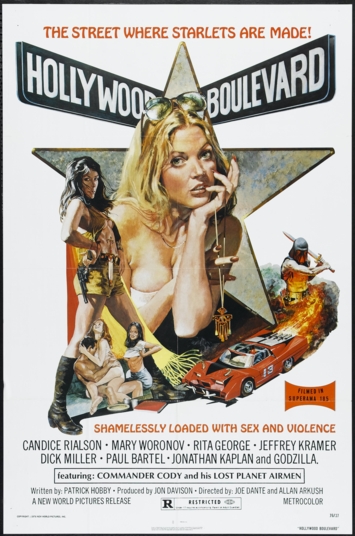
Hollywood Boulevard, from the Kodak Theater

It’s a safe guess that only a few pastors can utter the following sentence: “They do casting for porn films in our building.”

In fact, I wouldn’t be surprised if Pastor Joseph Barkley of Ecclesia Hollywood is the only one who can. Just to be clear: the church hasn’t sold its soul to supplement its offerings. It leases space in a building two blocks from the famous corner of Hollywood and Vine, and the skin-flick casting company happens to be in the same building.

The church is also next door to Ultra Vixen Vampwear, a lingerie shop that counts strippers among its customers. (“We have a wonderful relationship” with the store, Barkley said. “They put up signs for our Christmas Eve service. We give them cards.” He doesn’t personally walk in; he leaves that to women church members.)

Ecclesia (from the Greek word for “church”) Hollywood was planted five years ago; Barkley and his wife were among the first leaders, and he became the lead pastor a year ago. It’s a theologically conservative nondenominational church that was running about 500 last December. Now it’s closer to 800.

Why the growth? You might call it sexual attraction.

At the start of January, the church started “Skin,” a series of Sunday sermons and weekly study groups that deal frankly with sex. It started with the first three chapters of Genesis and moved into the apostle Paul’s first letter to the Corinthians (chapter 5, 6 and 15, if you’re keeping score). Last week Barkley talked about homosexuality.

This Sunday – known in some remote regions as Super Bowl Sunday – he will talk about pornography, one of about 300 churches participating in “Porn Sunday.” The timing was providential, Barkley said. Ecclesia planned the “Skin” series months ago, but when a friend of his, who leads the xxxchurch.com, put together the Porn Sunday program, it fit nicely in to Ecclesia’s schedule. (NPR ran a segment about Porn Sunday on Thursday’s “All Things Considered.”)

So let’s think about this: a conservative church in the middle of Hollywood, talking about sex. A lot.

Pastor Joseph Barkley of Ecclesia Hollywood

“I think it’s shocking to most of the city that there’s a church here,” Barkley told me on Thursday. “There’s an assumption that the rest of the city might make. They have this paradigm that what we have to say about sex is anemic, inadequate, judgmental.”

Try again.

“They’re surprised to find out Christians have fun talking about sex. Look, the whole account of creation in Genesis ends up with two people standing in a garden, buck naked,” he said. “We take that as a signal that God wants us to talk about it with freedom.”

Barkley’s elevator speech to explain “Skin” goes like this:

“In a culture where we no longer think the choices we make have any significance, we wanted to teach the revolutionary thought that your bodies actually matter, that they have eternal significance. Your body has a purpose … it’s not an accident. You were handcrafted. The fulfillment of that purpose is the privilege we have. So we’re trying to offer a recalibration of how we value our own bodies and what we’ve chosen to do with them.”

So “Skin” really isn’t about sex. It’s bigger than that, Barkley said, either standing Sigmund Freud on his head or spinning him in his grave.

“The biggest issue, the most nagging disease we deal with, is isolation,” he explained. “We minister to orphans and dreamers. Most people moved here from somewhere else both to chase a dream and to get away from something. They have no roots, no tradition, no sense of family. After a while they realize what that vacuum is doing to their soul. Sexual brokenness is directly linked to that sense of fear, of isolation.”

So the teaching about sex, he said, is in some ways “ancillary, a device that God is using to get to the root of the problems.”

Something’s clicking, if numbers mean anything. Maybe sex really does sell, even for church. But Barkley spoke more about all the conversations he’s been having since the series began, including a constantly ringing phone and 70-plus daily e-mails he’s been getting, a load that’s “off the charts.”

He’s especially glad that people who disagree with him say they’re going to stick around and keep listening.

“Generally, people are appreciative for us being honest,” he said. “A huge value of ours is vulnerability. People are almost surprised at the transparency with how we’re talking about sex. … We try to be honest, with as much plain language as possible. I’ve given the PG-13 disclaimer for parents from the pulpit.”

Barkley is convinced everyone in the room has some kind of sexual dysfunction. Easily half of the congregation on any given Sunday is struggling with addiction to porn in some way, he said. Honesty is the only option, considering where the church is situated and that about 90 percent of its members work in the movie industry (including some whom we’d probably recognize, if he were to name them).

“We’re trying to build a strong church, not a safe church,” he said. “I don’t want to spoon-feed people; I want us to think like grownups, to have the equipment to make theological decisions about life. How is my sexuality a demonstration of the image of God? We’re not helping anybody if we’re not having honest conversations about this.”

Egypt: The police, the army and the people

All eyes are on Egypt today, and by the time I post this note, the political situation may have radically changed. Tens of thousands of protesters are pressing President Mubarak to leave office, not satisfied by his half-hearted stalling tactic of firing his cabinet. As Saturday ticks away (Cairo is seven hours ahead of U.S. Eastern time), the wind seems to be blowing against his staying for long. Only a handful of people know what’s being said behind closed doors in government offices in Cairo, Washington, the U.N., Jerusalem and elsewhere.

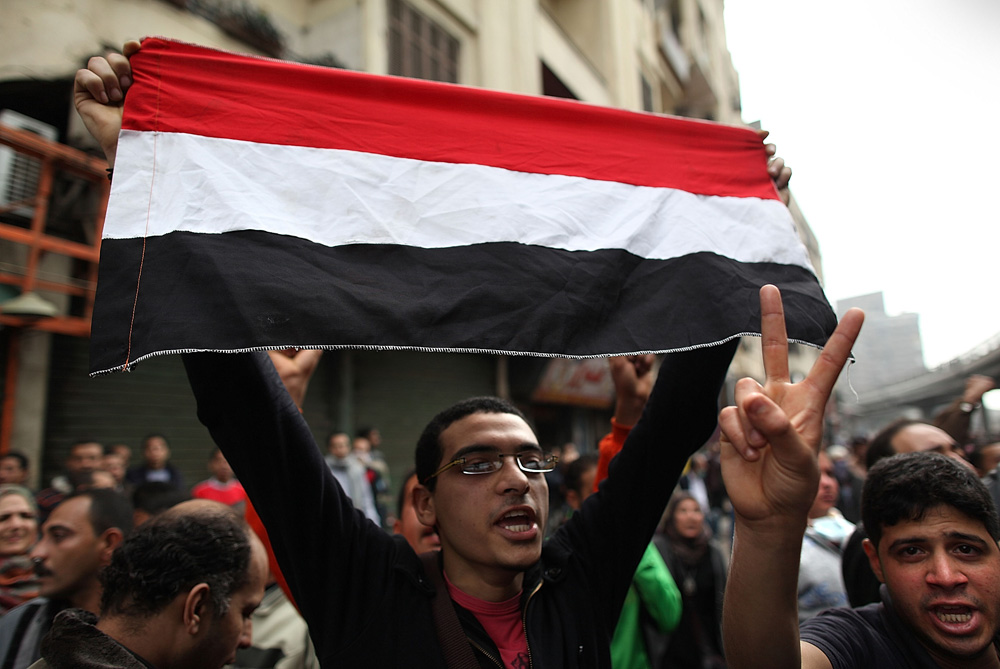
The street battles between protesters and police have been well documented and shown around the globe, especially on Friday, despite the Egyptian government’s shutdown of the Internet, cell-phone service and social media in an attempt to cut off communication between groups of protesters and between Egypt and the rest of the world. By contrast, the protesters are welcoming the Egyptian army when soldiers are dispatched to Cairo, Alexandria and other cities. Compare and contrast this image, taken  yesterday, with this one, from today. (Hover over the links to see photo credits.)

I’ve been wondering why the difference: Why welcome the soldiers and fight the police since they are both controlled by the same government, at least in theory? It turns out, not surprisingly, that there’s a history. Thanks to Wikileaks‘ release of diplomatic cables, we can get a sense of what the Egyptian people have had to deal with during Mubarak’s three-decade-long rule.

First, the Egyptian police. A cable from the American embassy in Cairo to the U.S. State Department on Jan. 15, 2009 summarized:

Police brutality in Egypt against common criminals is routine and pervasive. Contacts describe the police using force to extract confessions from criminals as a daily event, resulting from poor training and understaffing. Brutality against Islamist detainees has reportedly decreased overall, but security forces still resort to torturing Muslim Brotherhood activists who are deemed to pose a political threat. Over the past five years, the government has stopped denying that torture exists, and since late 2007 courts have sentenced approximately 15 police officers to prison terms for torture and killings.
Independent NGOs (non-governmental organizations) have criticized GOE (Government of Egypt)-led efforts to provide human rights training for the police as ineffective and lacking political will. The GOE has not yet made a serious effort to transform the police from an instrument of regime power into a public service institution.

The cable provided numerous examples, including this and this.

The Egyptian military, by contrast, has been more benign or at least less terrifying to its own people. The army lost some stature after the Arabs’ failed 1967 war with Israel, but in the time since then, the military has re-fashioned itself in other ways, possibly being overlooked because of its diminished role. Whatever the reason, to put it roughly, it looks like the military has been going along to get along with the Mubarak regime (and profiting handsomely as they did so) — and biding its time. This week, maybe, its time has come. The Egyptian civilians in the streets of Cairo, Alexandria, Suez and other cities are certainly acting as if the army is on their side.

From a Sept. 23, 2008 cable from the American embassy:

Recently, academics and civilian analysts painted a portrait of an Egyptian military in intellectual and social decline, whose officers have largely fallen out of society’s elite ranks. They describe a disgruntled mid-level officer corps harshly critical of a defense minister they perceive as incompetent and valuing loyalty above skill in his subordinates. However, analysts perceive the military as retaining strong influence through its role in ensuring regime stability and operating a large network of commercial enterprises.

Later in the same cable:

The military still remains a potent political and economic force. Its recent interventions, using the MOD’s (Ministry of Defense’s) considerable resources, to produce bread to meet shortages in March and extinguish the Shoura Council (upper house of Parliament) fire in August (2008) demonstrate that it sometimes can successfully step in where other government agencies fail. The military helps to ensure regime stability and  operates a large network of businesses as it becomes a  “quasi-commercial” enterprise itself. While there are  economic and political tensions between the business elite and the military, the overall relationship between the two still appears to be cooperative, rather than adversarial.

As of Saturday morning in the U.S., at least for amateurs like me it’s too early to know how things will go in Egypt, but the military is the big wild card. For the time being, however, it’s clear that the Egyptian protesters — and probably most Egyptians — know who are their internal institutional enemies and who, they hope, may turn out to be their best friends.

Photo: Gallo/Getty image, via Al Jazeera (English).

Don’t be surprised: An Alabama governor, Irish bishops, and a certain Florida pastor

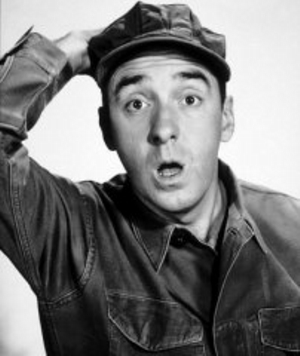
You remember Gomer Pyle, don't you? "Surprise, surprise, surprise!"

From this week’s news, file the following under “Don’t Be Surprised”:

1. The newly inaugurated governor of Alabama, Robert Bentley, shouldn’t be surprised if he finds himself immediately in public-relations hot water after telling a church audience on Martin Luther King Day that only Christians were his brothers and sisters. The new governor, who’s a Southern Baptist, apologized to his constituents two days later. Theologically, he’s very much in line with mainstream evangelical theology — that is, that Christians have been uniquely adopted into God’s family through Jesus Christ. But any suggestion of being exclusive or of favoring one group of constituents over another is not politically savvy — or even that advisable at the duly elected leader of all the people of Alabama.

2. The Vatican shouldn’t be surprised (and most likely isn’t) that the disclosure of a confidential letter from a Vatican official in 1997 to Irish bishops re-opened wounds, sparked yet more controversy about clerical abuse and was mostly misunderstood if not altogether falsely reported. The letter, obtained by an Irish TV network and released to the Associated Press, warned the bishops of likely consequences if they followed through with their proposed policy of reporting all charges of child abuse to police. Victims groups and at least one American lawyer who is working to sue the Vatican on behalf of a victim, said the letter was a “smoking gun” that proved the Holy See was encouraging a cover-up.

The Vatican said the letter simply alerted Irish clerics that their proposed policies had implications under both civil and church law, but it never advised them not to report abuse. Reading the one-and-a-half page letter, it looks like the Vatican has a point. To judge by the coverage, especially when it first hit the headlines, some of the reporters on this story either didn’t understand “Vaticanspeak” and the workings of Roman Catholic Church machinery — or they didn’t want to. (To read about the problems with the reporting on this story, check out this post, which gives me a chance for a shout-out to friends at the Get Religion blog, a good place to find critique of how the mainstream media covers religion.)

3. Terry Jones, the Florida pastor who drew worldwide attention last fall when he pledged to burn copies of the Koran on Sept. 11, should not be surprised that the British government denied him entry into its country. He planned to speak at a February rally protesting the rise of Islam in the UK as well as visit his daughter who lives there. The British government said he was denied a visa because it “opposes extremism in all its forms” and  thinks his views would “foster hatred that might lead to inter-community violence in the UK.”.Jones, of course, protested the decision, calling it “sabotage of the basic human rights of freedom of speech and freedom of expression” as well as proof of “the effectiveness of the threat of militant Islam in the UK.” About 2.7 percent of the UK’s 62.3 million people are Muslim (compared to 0.6 percent in the US), according to the CIA World Factbook. When I lived in England in the 1980s, we could already say, accurately, that there were more Muslims than Methodists in Britain.

Are there any other threads running through these stories? Maybe, to paraphrase the most famous line from Cool Hand Luke, what we’ve got here is a failure to communicate … well.

Singing that other anthem

I attended a local prayer breakfast honoring Martin Luther King Jr. last Saturday (Jan. 15). It was a fine, enjoyable and inspiring event, attended by a few hundred people from a variety of church and ethnic backgrounds, including a healthy representation of civic and church leaders. A couple of  choirs sang and a couple of local young African-American leaders spoke.

One of the first things the gathering did was sing “Lift Every Voice and Sing,” described as the “African-American National Anthem.” But I have to confess that as I stood there singing, I felt bothered by the idea of an “alternative” national anthem. 

The notion of “hyphenated Americans” has always bothered me. E pluribus unum: I’m a fan. (I’ve got Teddy Roosevelt and Woodrow Wilson on my side, for whatever that’s worth.) But there I was, singing an alternative anthem. I appreciated the spirit and intent of the breakfast, and so I wasn’t thinking “Bah, humbug.” But I wasn’t thinking, “Hip-hip-hooray!” either. Wasn’t the kind of separation this song implied exactly opposite of what the good Dr. King preached?

But when I stopped mentally stroking my chin and wagging my finger long enough to focus on the words, a few lights turned on.

For instance: If someone wanted to compare this “anthem” and the official American national anthem, it would be a religious slam dunk for “Lift Every Voice and Sing,” which is wall-to-wall biblical allusions and expressions of faith in a God who promised to redeem captives. “The Star-Spangled Banner,” by contrast, describes a battle scene. That difference alone should give folks a moment’s pause. If we want to think of  the U.S. as a Christian, peace-loving nation, we couldn’t guess that from our national anthem. Taken at face value, the lyrics of “Lift Every Voice” are much more biblical and universal.

But there’s more to songs than lyrics, of course. These anthems carry almost two centuries of emotional and symbolic baggage. “Lift Every Voice,” written at the start of the 20th century, spoke specifically about the black experience in the U.S., less than a generation after slavery had been abolished. So when I sing or hear that song, I hear it differently than someone who can trace his or her family back to a slave or to a lynching victim or to a Selma marcher. That history doesn’t make the song a good candidate for an actual national anthem. Even so, it’s healthy for me to hear it and sing it. It’s a song that is deeply rooted in is piece of American history that is both shameful and noble.

I still wish it weren’t nicknamed a “national anthem” — we have only one of those. On the other hand, African-Americans and other minorities were treated as a separate nation within our borders for so long, I shouldn’t be too harsh and not at all surprised. History is hard to escape.

Here’s the first stanza; you can click here to read all the lyrics.

“Lift every voice and sing,
‘Til earth and heaven ring,
Ring with the harmonies of Liberty;
Let our rejoicing rise
High as the listening skies,
Let it resound loud as the rolling sea.
Sing a song full of the faith that the dark past has taught us,
Sing a song full of the hope that the present has brought us;
Facing the rising sun of our new day begun,
Let us march on ’til victory is won.”

The video is not of our prayer breakfast. (We sang well, but nothing like that.) It’s the Metropolitan Baptist Church in Washington, D.C., Jan. 18, 2009.

Welcome to RPM

Welcome to RPM: Religion, Politics, Media.

When I showed the template for this new blog to my friend Jose, he laughed.

“Why don’t you  just name it ‘All the Things You’re Not Supposed to Talk About’?” he asked.

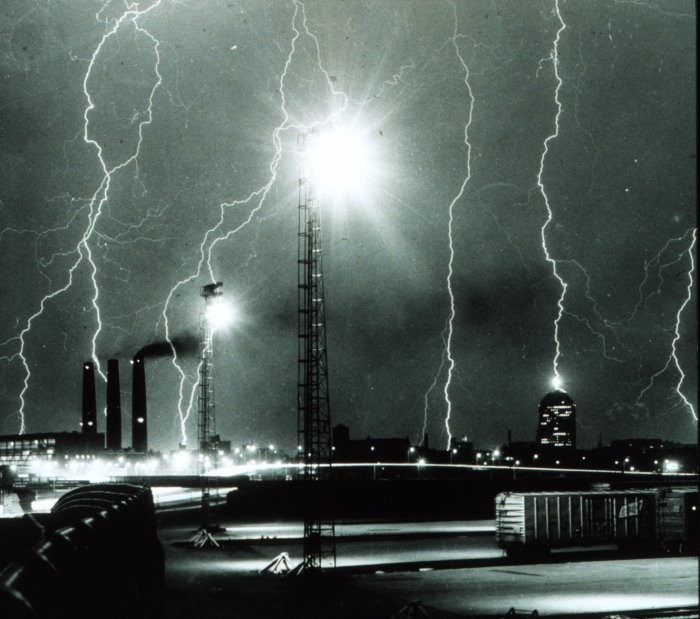
I hadn’t thought about it that way, but I see his point. Not the stuff of traditionally polite conversation. So thanks to Jose, I might adopt a lightning rod as the official RPM icon.

It’s no secret that religion, politics and media are magnets for controversy — especially when two or more of those topics intersect. And do they ever intersect, maybe more than ever. Other blogs, columns and sites deal with these topics, and I’m glad for them. (Well, most of them.) I hope RPM contributes high-quality information and insight as well, and provides a platform for good discussion and debate. With that goal in mind, RPM will include a variety of content, adding new material at least twice a week: Commentary. Reporting. Interviews. Long pieces and short ones. Video and audio. And, I hope, your comments, suggestions and critiques. Your views will add breadth and depth to the conversations here, so please feel free to join in (but on topic and with respect and good manners, of course).

In short, I hope RPM grows to be an enjoyable, helpful and regular part of your read-and-response diet. Let me know what you think. If this is a valuable site, please pass the word to friends. Best wishes.

Watch this space in 2011

The old year is almost over, and so is a kind of self-imposed sabbatical from the blogosphere.

In January 2011, this old blog will get a new name (well, it already has one), new content and a new focus. To play with the new name, the blog will be revving up in the new year.

RPM is Religion, Politics, Media — three topics that frequently meet and sometimes collide. I hope this blog contributes to the thinking and talking that happens around that intersection. I’ll post new reporting, brief articles, comments, links and other information at least twice a week, and will of course welcome your comments. I hope you’ll come back and visit often. Feel free to spread the word to friends, acquaintances, relatives and anyone else you think might be interested.

Bookmark the address: www.religionpoliticsmedia.com.

The planned launch date: Jan. 17, 2011. (Advance comments, suggestions, ideas and dire warnings are welcome.)

See you soon. In the meantime, a happy Christmas and blessed new year to you.