With Hispanic ministry, ‘potenciamos unos a otros’*

If we were just counting numbers, then it would not make much sense for congregations in Northeast Tennessee to invest much effort and money in Spanish-language ministry.

Compared to the rest of the country, the region has a small Hispanic population: only 2.2 percent of Washington County’s residents, compared to 15.4 percent nationwide, according to a 2008 Census Bureau estimate.

Yet at least three area churches are making that investment. It’s not about numbers.

“Where two or three are gathered, God is there,” says Danilo Olivares, Spanish minister at First Christian Church. “We serve a niche inside the Spanish-speaking population, and we decided to give to this population. But our rolls are not fat.”

Olivares, 39, has been shepherding this flock-within-a-flock since 2006. More than 70 people are regulars in the Spanish ministry; about 55 typically attend worship on Sundays. Besides Spanish-language worship services, the ministry also offers Sunday school classes, a women’s ministry (led by his wife, Priscila), children and teen programs, midweek Bible studies and a leadership-training course.

The ministry reaches even more people in the community, such as by offering English classes and translation for hospitals and courtrooms, and sponsoring occasional registration days for immigrants.

The ministry, which started nine years ago, is integrated with First Christian Church, with Olivares a full-time minister. While other Spanish-language ministries in the area draw mostly Mexicans, more than 80 percent of the people in First Christian’s ministry come from other countries – at least 13 different nationalities. That diversity has proven to be one of the ministry’s biggest challenges.
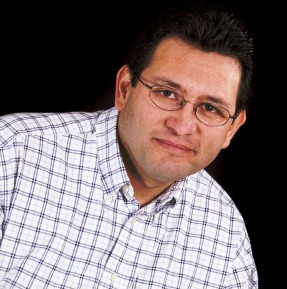
Danilo Olivares

“I’m preaching and teaching to all these cultures at once,” explained Olivares, who is originally from Santiago, Chile. “Some words can mean different things, and South American style is different from Mexican style.”

For English speakers, it would be like working with a congregation that includes people from New York, Alabama, Wyoming, England, Jamaica and South Africa. Everyone may speak the same basic language, but so much else – from accents to cultural assumptions – is vastly different.

American culture is layered on top of all that besides, since most Hispanic members at First Christian are second- or third-generation Americans.

“They live here; they’re not in transit,” Olivares said. “A high percentage are in professions, like banking or medicine, and 95 percent are bilingual.”

That blend makes it easy to combine with the rest of the congregation, but it also raises the question of why offer a Spanish ministry at all.

Olivares explained by telling about one member, a local bank officer, who said he feels “contact with God” during a Spanish service in a way he never felt at other churches.

“Our relationship with God starts with the spirit,” Olivares said. “I feel closer to God when I sing or pray in Spanish rather than English. There’s something intimate in speaking, praying and worshiping in our own native language.”

In its early years the ministry probably attracted a large number of undocumented workers, although no one knew for sure because no one was asking. But that proportion has completely reversed, according to Olivares, with more than 90 percent being legal residents today. (In 2006, Oscar Olivares, the congregation’s first Spanish minister and Danilo’s uncle, thought most members were undocumented, a piece of old information I mistakenly repeated last October.)

Part of the reason for the turnaround is Danilo’s commitment to encouraging and helping immigrants to become legal residents.

“As Christians we need to respect the laws of this country,” he said. “We are here to help everyone, and I don’t care if they are legal or not. But if someone doesn’t have papers, part of my ministry is to help them do the right thing.”

Olivares himself never planned to move to Johnson City, a place he hadn’t even heard of until six years ago. But he comes from a family of church leaders, and he moved to Miami in 2004 to help a Spanish-speaking church there, intending to stay a few years before returning to Chile. Then the call came – literally, a phone call from his uncle – to East Tennessee.

He’s thankful for the unforeseen move, glad to experience firsthand how much good can come when North American and South American Christians work together.

“It’s not, ‘Give us this, give us that,” he said. “It’s what we can do for each other. It’s like there’s a good car engine in this room and a fine car body in that room. We put them together. We empower one another.”

* ‘We empower each other.’

First published in the Johnson City (Tenn.) Press, 9 Jan 2010.

You’ve seen one holiday, you’ve seen them all. Not so much.

I took a bit of vacation this week, and so this week’s column updated and adapted material from one published on Dec. 20, 2003.

If an alien dropped in on us right now, he (she? it?) would find us sorting through the remnants of holidays stacked up for more than a month: Thanksgiving, Hanukkah, the winter solstice, Christmas, Kwanzaa, New Year’s. (We’re not quite finished yet. The Christian feast of Epiphany is Jan. 6.)

Our other-worldly visitor might think all these festivities shared a common origin, that they were only variations on the theme of brightening dark and cold nights, of finding comfort in the winter chill as we wait for spring’s eventual return.

But he (she? it?) would be wrong. Similarities and even shared traditions don’t mean these holidays are the same. (A movie star and I share a birthday and we both eat cake, but that doesn’t make us brother and sister.)

For instance: Christmas – the Christian celebration, not the social and economic spectacle – marks the birth of Jesus Christ in a Palestinian village around the year 4 B.C.

Hanukkah, the Jewish “festival of lights,” observes the rededication of the Jerusalem temple after it was recovered from Greek occupiers in 165 B.C. The feast lasts eight nights because the story says that after the victory, a small vial of oil miraculously provided light for that length of time.

The winter solstice, the longest night of the year, marks the northern hemisphere’s turn toward spring as days start to lengthen again. The anticipation of warmer weather was reason enough to celebrate in ancient societies, and among pagans these seasonal changes took on religious significance.

Not surprisingly, with the rise of the Christian church in Europe, seasonal rites as such were abandoned or reinterpreted with Christian teachings. But in our more diverse time, solstice is making a comeback.

Then there’s Kwanzaa, a modern American invention, created during the 1960s as a week-long celebration of African culture and heritage.

You get the idea: similar timing, similar observances (gifts and candles galore), but vastly different meanings.

These various holidays don’t only mark different events. As a local theologian points out, they also reflect different ways of thinking about the world and how it works. The contrasts are especially noticeable when we compare holidays like Christmas and Hanukkah, which claim unique historical events as their basis, with the solstice, which marks a recurring natural cycle.

“I think you can argue that those who celebrate solstice understand time to be cyclical,” according to Philip Kenneson, professor of theology and philosophy at Milligan College. That is, a pagan view sees time like a wheel, constantly revolving alongside the cycles of nature.

It’s an idea about the world shared by ancient pagan societies and many Eastern religions. In this view, “any particular moment in time is not any more important than another,” Kenneson said. “There’s no sense of movement to history.”

By contrast, Judaism and Christianity – the religions most influential in Western cultures – typically view history as an unfolding “story” made up of unique events. In this view, said Kenneson, time takes on a different kind of significance.

“History as we understand it in the West is rooted in a more linear view of time,” he said. “Specific events have meaning. They contribute to or thwart a certain movement in history.”

While he won’t go so far as to call this a biblical view of time, he does say “a lot of this is assumed in Jewish and Christian understanding.”

There is overlap, of course. Christians and Jews observe natural cycles – look at the church calendar or the Jewish feasts – and those who observe the solstice don’t deny that new events occur.

Even so, Kenneson thinks a fundamental difference exists between those who find meaning mainly in the recurring cycles of nature and those who find it in a developing story.

 “Those cycles by themselves don’t tell the whole story. They are real, but they don’t shape our whole lives,” Kenneson said. “(In the linear view) there’s something above and beyond that. The direction of history has been forever altered.”

Maybe that’s why we wish each other a happy new year. We not only anticipate the year to be different. We expect it to be literally meaningful – to truly mean something.

 First published in the Johnson City (Tenn.) Press, 2 Jan 2010.

The Top 10: Religion news in 2009

President Barack Obama’s speech in Cairo last June, when he declared his desire to “seek a new beginning between the United States and Muslims around the world,” was the biggest religion story of the year, according to a survey of the Religion Newswriters Association.

In his wide-ranging address, Obama said that the U.S. and Islam “overlap and share common principles … of justice and progress, tolerance and the dignity of all human beings,” focusing those themes on seven specific issues. The president quoted the Qur’an, the Bible and the Talmud as he held out the prospect of a relationship “based on mutual interest and mutual respect (and) based upon the truth that America and Islam are not exclusive and need not be in competition.”

The speech was well received by local Muslims, according to Taneem Aziz, leader of the Muslim Community of Northeast Tennessee.

“On the whole, it was a very positive speech,” Aziz recalled this week. “The general perception of the U.S. (by most Muslim countries) was negative, and I think the president was trying to improve that. I think it’s a good step.”

It was significant that the president delivered the speech at a highly regarded university in a historic Muslim capital, he said.

“Using the greeting of ‘Assalamu Alaykum’ (Peace be unto you) was a nice touch,” Aziz added. ”I liked the way he said would like to deal with issues and conflicts in the world today.”

But how Obama’s words will ultimately translate into policy is not yet clear, and so members of the Muslim community also feel wary, particularly about the Palestinian-Israeli conflict, which the president addressed at length.

“(Obama’s) bias towards Israel was very evident,” according to Aziz. “On the one hand he said, ‘Given our interdependence, any world order that elevates one nation or group of people over another will inevitably fail. So whatever we think of the past, we must not be prisoners of it. Our problems must be dealt with through partnership; progress must be shared.’ And then he went onto speak about the Israelis and the elevated status they had with the U.S.”

So Aziz doubts that the U.S. can act as an honest broker in the Middle East, “and that is what is needed.” On the other hand, American Muslims understand “that if he does not toe the Israeli line, he may stand to lose the next election.”

Here is the complete list of the year’s Top 10 Religion Stories, as selected by active members of Religion Newswriters Association:

1. President Obama pledges a new beginning in Muslim-U.S. relations and reaches out to the world’s Muslims during a major speech at Cairo University.

2. Health-care reform, the No. 1 political topic for most of the year, involves faith-based groups appealing strongly for action to help “the least of these,” and others, such as the Roman Catholic bishops, for restrictions on abortion funding.

3. Because Army Maj. Nidal Hasan, the accused gunman in the Fort Hood massacre, was considered a devout Muslim, the role of that faith in terrorism again comes under review.

4. Dr. Carl Tiller of Wichita, Kan., regarded as the country’s leading abortion provider, is gunned down in his Lutheran church.

5. Mormons in California come under attack from some supporters of gay rights because of their lobbying efforts in the November 2008 election on behalf of Proposition 8, which outlawed gay marriage. Later in the year, Iowa, Vermont and New Hampshire approve gay marriage, but it is overturned by voters in Maine.

6. Obama receives an honorary degree and gives the commencement speech at Notre Dame after fierce debates at the Roman Catholic university over Obama’s views on abortion.

7. The Evangelical Lutheran Church in America votes to ordain gay and lesbian clergy living in a committed monogamous relationship, prompting a number of conservative churches to move toward forming a new denomination.

8. The recession forces cutbacks at a variety of faith-related organizations.

9. The Episcopal Church Triennial Convention votes to end a moratorium on installing gay bishops, ignoring a request from the archbishop of Canterbury not to do so. In December the Los Angeles diocese chooses a lesbian, Mary Glasspool, as assistant bishop.

10. Obama’s presidential inauguration includes a controversial invocation by Rick Warren and a controversial benediction by Joseph Lowery, as well as a pre-ceremony prayer by Gene Robinson, the Episcopal Church’s first openly gay bishop.

First published in the Johnson City (Tenn.) Press, 26 Dec 2009.

Memo to would-be Bible translators: A little humility, please

The launch of a new online Bible version has been in the news lately: the Conservative Bible Project. The project’s overseer, Andrew Schlafly, even scored an interview this week on the current-events place to be, Comedy Central’s “Colbert Report.”

This “translation”  is being spotlighted because it differs from other Bible versions in at least two important ways. First, it’s written by readers. In Internet jargon, the content is open source, a “wiki.”

The theory is that, over time, the best version will emerge. It’s literary Darwinism, the survival of the textual fittest – which is ironic because the host site, Conservapedia, isn’t fond of evolution.

The other major difference is that the editors diligently impose a point of view on the text, vetting passages according to 10 “conservative guidelines.” Renderings must fit into the “framework against liberal bias … utilize powerful conservative terms … express free-market parables” and other criteria.

The results are mixed. Many changes are harmless. Others, however, mangle the meanings. For example, a straightforward translation of Acts 2:44 describes the earliest church in Jerusalem: “All who believed were together and had all things in common.”

According to the “proposed conservative” translation, however, “Everyone who believed was together and shared values, faith, and the truth.”

That last phrase simply isn’t in the actual text, Greek or otherwise. But as a note of “analysis” helpfully informs us, the original could be “misread as socialistic,” and so the Conservative Bible adds the gloss.

Likewise, when a rich man asked Jesus how to gain eternal life, Jesus replied, “You still lack one thing. Sell everything you have and give it to the poor, and you will have treasure in heaven. Then come, follow me.”

But the conservative version waters down Jesus’ words, almost doubling the word count in the process: “You lack one thing, you need to rid yourself of the desire for earthly treasure to the point that if you were destitute you would still rejoice in the Lord. For doing so will give you the greatest treasure of all, the glory of heaven. Do this and follow my teachings.”

This, despite the Conservative Bible’s claim to favor “conciseness over liberal wordiness” and “not … diluting the intellectual force and logic of Christianity.”

Apparently, any guideline is trumped by the risk of Jesus actually challenging conservative policies.

And that’s the point. The problem isn’t about being conservative or liberal. For people who take scriptures – any scriptures – seriously, a more important principle is at stake.

The Conservapedia approach turns translation on its head. Instead of coming to Scripture as students to learn what God might be saying, translators turn into dictators, forcing the text to fit their preset ideas.

But the folks at the Conservative Bible Project are not alone in this sort of ideological narcissism. They’re just more obvious. We all want to see what we want. We’re all prone to emphasize some points and then neglect or even bend others that make us squirm.

We can see it on the right, this case in point. We can see it on the left as well when, for example, interpreters go through verbal gymnastics over those thorny passages about, say, homosexual relations, war or the exclusive claims of Jesus. But if we read the texts honestly, we’ll find plenty to upset everyone.

That’s inevitable. We’re all shaped by culture, by personal experience, by the company we keep, by a dozen other factors that affect our reading of Scripture and our response to it. The key is to keep that in mind – humility is the word – and try to compensate. (That is one reason most reliable translations are done by committees of people from various backgrounds, with scholars.) This is not easy work and perfect reading is impossible, but open eyes and open minds can get us closer.

One message of the Christmas story is that God isn’t bound by our assumptions about how the world works. God is clear on that point, according to the prophet Isaiah: “My thoughts are not your thoughts, neither are your ways my ways.”

Jesus came by stealth, the story says, born to obscure working-class parents, which is not what most people expected. The ones who first recognized Jesus’ birth for what it was (at least without the help of singing angels) were traveling foreigners, probably pagan astrologers, who kept their eyes open. We still sing about them.

First published in the Johnson City (Tenn.) Press, 12 Dec 2009.

Are we fighting a just war? I’m just asking.

President Obama’s speech on Tuesday, which laid out his plans for Afghanistan, Pakistan and al Qaeda, left me feeling conflicted, uncertain, even a little queasy. Apparently I’m not alone.

There’s only marginal agreement among Americans about the military buildup, with 51 percent supporting Obama’s plan, according to a USA Today-Gallup survey taken the day after his speech. But almost all of us are fretful. By an almost three-to-one margin (73 percent to 26 percent), Americans said they are worried that the costs of the war will make it more difficult to deal with problems close to home. That is besides the normal anxiety that comes with any major conflict.

In making his case, Obama declared that “in the midst of these storms … our cause is just,” echoing words from last year’s campaign, when he said that destroying al Qaeda is “a cause that could not be more just.” (Anyone who is surprised that Obama is focusing on Afghanistan hasn’t been paying attention.)

“Just” is a significant word when talking about war, hearkening to a way of thinking that dates back to the Romans and found its most enduring expression through Christianity. When we talk about a “just war,” we’re talking ethics and theology.

There’s irony here, since Jesus told his followers to pray for their enemies and “turn the other cheek” when insulted. For the first three centuries after he walked the earth, most Christian teachers steered followers away from military service.

But this pacifist position softened as the Christian faith gained respectability in the Roman Empire, especially after it was legalized in the early 300s and made the official state religion in 380.

The question was how Jesus’ instructions to his followers applied in a wider society. Christ taught peace, the reasoning goes, but people and nations – sinners all – must still deal with the world as it is. Part of that challenge is to determine what conditions must be met for a war to be justifiable, even while recognizing that war is a result of sin.

Augustine, a North African bishop and considered one of the church’s greatest teachers, framed a “just war” doctrine through his writings in the fourth and fifth centuries, as the collapsing Roman Empire was coming under siege from northern European “barbarians.” His teaching has formed the basis for most Christian thinking about war ever since.

In its current Catechism, the Roman Catholic Church summarizes just-war doctrine, saying that, “at one and the same time,

  • the damage inflicted by the aggressor on the nation or community of nations must be lasting, grave, and certain;
  • all other means of putting an end to it must have been shown to be impractical or ineffective;
  • there must be serious prospects of success;
  • the use of arms must not produce evils and disorders graver than the evil to be eliminated.”
President Barack Obama greets cadets after speaking about the war in Afghanistan at West Point on Dec. 1.

Those who govern, “those who have responsibility for the common good,” are burdened with evaluating “these conditions for moral legitimacy,” the catechism says. In other words, war must be declared by legitimate authorities.

This being theology, of course, the answers aren’t as simple as this list suggests. Libraries are full of books that tease out various interpretations.

So does the war against al Qaeda via Afghanistan qualify as a just war? I’m no theologian and even less of a military expert, but a few answers seem clear.

It’s obvious that al Qaeda inflicted “lasting, grave and certain” damage on the U.S. and other places. (But how lasting?) Also, while success is never guaranteed – Vietnam is a harsh reminder – there seems to be “serious prospects” of success. The government has indeed approved the use of force. (An interesting footnote: Americans have not engaged in an officially declared war since 1945.)

When we beyond these few certainties, however, the answers grow murky.

For now, maybe it’s enough to make sure we ask ourselves questions like these – ethical and theological questions – if only to remind ourselves of what is at stake, even more than economics, politics or national security. As we should know by now and as Augustine and other theologians knew a long time ago, we don’t risk only the lives of soldiers when we go to war. We risk our souls.

First published in the Johnson City (Tenn.) Press, 5 Dec 2009.

More mouths to feed: ‘Food insecurity’ grows to record numbers

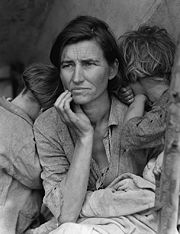
Dorothea Lange, "Migrant Mother" (1936)

One of the benefits for which we can give thanks this year is that a growing number of signs say we’re pulling out of our deep economic recession.

But it’s no secret that recovery is a slow train coming for millions of Americans. Last week the U.S. Department of Agriculture reported that record numbers of people in the U.S. had trouble getting enough food in 2008.

“Seventeen million households, or 14.6 percent, were food insecure,” meaning they “lacked consistent access to adequate amounts of nutritious food,” according to the USDA Economic Research Service. That’s an increase of more than 1.5 million homes in one year and the highest figure since such statistics started in 1995.

Tennessee’s food insecurity for 2008 was slightly below the national average, at 13.5 percent of households. But if history is any guide, the Appalachian counties are likely to show above-average rates when detailed figures are released in January. Poverty is typically more prevalent in Appalachia than in other regions, and the lack of enough resources to obtain basic needs is “the fundamental cause of food insecurity and hunger in the United States,” according to the USDA.

Children are especially vulnerable. Virtually every measure of poverty or food insecurity reveals that children fare worse than adults. For instance, while Tennessee’s overall food insecurity rate in 2007 was 12.8 percent, the rate was 20.5 percent among children. The general poverty rate was 14.8 percent; for children it was 20.2 percent.

In the eight counties of Northeast Tennessee, 52 percent of schoolchildren were considered “economically disadvantaged” in 2008, according to the Tennessee State Report Card. That is, more than 37,000 schoolchildren were eligible to participate in the federal free and reduced-price lunch program or other public assistance.

Of the 49.1 million people in the U.S. who lived in food-insecure households in 2008, more than one-third – 16.7 million – were children.

Such numbers are almost overwhelming, obviously too big for even the most generous individual to make a dent. The good news is that we have ways to work together to feed neighbors in need.

In this area, more than 200 nonprofit organizations work with Second Harvest Food Bank of Northeast Tennessee. This nonprofit clearinghouse, part of a nationwide network of food banks known as Feeding America, gathers food in bulk directly from manufacturers, grocery stores and restaurants – which helps keep costs down – and distributes it to congregations, food pantries and other nonprofits. Second Harvest distributed 6.5 million tons of food last year.

The organization itself isn’t faith based, but 75 percent of the organizations that work with it are, according to Communications Director Kathy Smith. The biggest partners for Second Harvest in at least six of the region’s eight counties are churches or church-related ministries.

Certainly we’re in the best season for food banks. The message of Thanksgiving and the warmth of Christmastime apparently make people feel more generous than other times of the year. Just this week, listeners of WCQR, a Christian radio station, donated $27,000 to Second Harvest in one of several food drives this season.

Still, the gap between supply and need is never far away.

“We’ve been able to keep up with the increased need at this point,” Smith reported on Wednesday. “But it appears to be an ever-growing need. Donations are up compared to last year, but not significantly. The food is going out the door as fast as it comes in.”

Food banks like Second Harvest welcome and rely on the extra efforts at Thanksgiving and Christmas. But then comes January. Then February, March and April. The Second Harvest Web site lists at least 17 events in November and December. But between January and April 2010? Five.

The need for food doesn’t end when the holidays are over and, as the USDA reports, more Americans are hungry now than in any recent time.

But individuals, families and small groups can help feed hungry people year-round.

“They can organize food drives through their churches, businesses or in their neighborhoods,” Smith suggested. “They can consider holding a fundraising drive on our behalf, like a dinner. And of course they can volunteer with Second Harvest. We have various opportunities through the year.”

And of course, we can donate money. The Web sites for Second Harvest  and Feeding America even include secure links for making donations online.

That’s something to chew on, all year long.

First published in the Johnson City (Tenn.) Press, 28 Nov 2009.

With Ethiopia in turmoil, a calm commitment

1236953537p_h_ethiopia
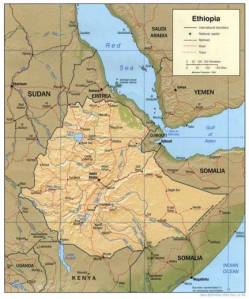
image from CMF International

Ray Giles had reason to be nervous. It was Ethiopia in the 1970s and he was an American missionary in a strained land.

With a few colleagues, he had traveled to a small town miles from his own home base to visit three Ethiopian evangelists who had been jailed on false accusations of branding converts. Local authorities were agitating the townspeople.

Ray and his companions stayed at a friend’s house, and a large, menacing crowd started gathering there. Missionaries had been attacked elsewhere, and people seemed primed for violence. The homeowner went out and offered himself to the mob. “Take me,” he pleaded. “Please don’t hurt my friends!”

“It got dark and things quieted down,” Ray recalled this week. “Nothing happened, but it could have easily erupted into violence. People went home after a while, and the next day we went about our business.”

Such calm commitment is fairly typical of Ray and Effie, his wife of 55 years. In 1968, they and their four young children left a church ministry in Greenville, N.C., for the Ethiopian highlands, after being gradually convinced by the Holy Spirit, they say, to join a team from Indianapolis-based Christian Missionary Fellowship. First with the Oromo people and later with the Gumuz people in the lowlands, they offered general education, basic medical care, Bible teaching and leadership for the new congregations.

“The time I most delighted in was a village meeting at night,” said Ray, now 74. “I’d often walk about 20 miles and go into a smoke-filed house to have a meeting of eight to 12 people. I’d do that on a regular basis, week by week.”

They moved to Africa during the turbulent post-colonial period, when dozens of nations on the continent were gaining independence and the Cold War was at its height. Unlike most African nations, Ethiopia avoided colonial rule almost completely, but resentment of the West could cross borders. Politicians and war lords exploited suspicions about Western domination.

Ethiopia mapAll the missionaries in Ethiopia were evacuated when the Marxists took power in 1977. The Gileses briefly assisted with relief efforts during a 1985 famine. They finally returned in 1992, a year after the regime was pushed out, and stayed seven more years. When they retired in 2000, they settled in Johnson City, where they had connections through Milligan College and Emmanuel School of Religion.

“Our experience in Africa gave us an appreciation for the many different ways of life and of understanding reality,” Ray said. “As a visitor, you see the poor people and think how unfortunate they are. But you see more laughter there than in the U.S.”

They were also impressed by the ingenuity of the people and their ability “to live within the environment without changing the environment.” Ray and Effie’s dedication to a simple life was a gift from Africa.

 “People haven’t heard that being content with what you have is what you should pursue,” Ray said. “Family and friends are more important than things. Hospitality is important.”

He fondly recalled visits in homes, where drinking coffee – in the land where coffee was first cultivated – was a once- or twice-daily ritual that allowed time for long conversations.

“We have gained more than we have been given,” said Effie, 73. “We have been accepted by people even though we are so different, really in spite of our differences.”

Not that the Gileses idealize Ethiopia. Governmental corruption and a deep-seated culture of nepotism still cause problems, not to mention regular threats of drought, famine or regional conflicts.

But they look past those troubles. What motivated them, Effie said, was to see people transformed. In animistic societies, she explained, people will do almost anything to appease the spirits that control their lives, even sacrificing humans.

“It was exciting to see the change,” she said, “to see their freedom from fear.”

Their days are still full. There’s family: 11 grandchildren and 11 great-children (“with four more on the way,” Effie noted). There’s Lone Oak Christian Church, where Ray serves as an elder. They often teach in seminars and at colleges as guest lecturers. They are mentoring a new generation of missionaries, including some of their own children and grandchildren.

And as of July, there has been Ray’s cancer.

So that typically calm commitment, which has served them so well before, is being tested in a new way. That’s the story for next week.

First published in the Johnson City (Tenn.) Press, 14 Nov 2009.

A support group for Christian profs

This is the ETSU Buccaneer mascot. This is not a professor who is hostile to religion.
This is the East Tennessee State University Buccaneer mascot. This is not a professor who is hostile to religion.

Dr. Andrea Clements teaches psychology at East Tennessee State University. She is also an active member of Heritage Baptist Church, where she and her husband sponsor a group for college students and other young adults.

Sometimes her academic life and her religious life fit together well. Sometimes they don’t.

“When I’m teaching, I know my students have needs or crises, and I also know in my head there’s a better answer for them than the academic one,” she said this week in a phone conversation. “I don’t proselytize, but I want them to know what I think. It’s separating that out that can be challenging.”

For example, she recalls the first day of classes after the Sept. 11 attacks. Facing her students, she realized this was probably the biggest collective crisis they might ever face.

“I’m taking off my professor hat,” she told them. “I’m going to be a person, and I’m going to tell you how I’m dealing with this. Then I’ll put my professor’s hat back on.”

 Clements, who has taught at ETSU for 15 years, is always careful to distinguish between her professional role and her profession of faith in the classroom (“I’m good at being objective”), and she hasn’t encountered any serious criticism “for a lot of years.” A complaint from a colleague early in her career was resolved quickly and peacefully.

“I think everybody here knows what I believe,” she said. “It’s live and let live. I’m sure there are universities that are far worse.”

Andrea Clements
Andrea Clements

Even so, she doubts that professors who are atheists or agnostics feel similar pressure to detach their personal beliefs from their teaching, and students tell her that some faculty members are belittling of Christianity or even “downright hostile.”

“I think (Christians) are a minority on campus,” she said. “It tends to be largely secular. Most professors or staff keep their Christianity to themselves.”

That’s one reason she thinks a kind of support group on campus for Christian faculty members, administrators and staff is a good idea. She helped launch one at ETSU last spring.

Faculty Commons is part of Campus Crusade for Christ International, one of the world’s largest evangelical Christian organizations, and it is designed to help Christians working in higher education to meet and help each other. Faculty Commons groups are located on about 100 campuses around the nation, according to Rich McGee, the national director of development. He estimates about a thousand people are actively involved in the U.S.

Earle Chute, the local director for Faculty Commons, has worked full-time with Campus Crusade for 30 years, supervising the organization’s efforts among ETSU undergraduate students until last year, when he switched to faculty ministry.

“My love for college students hasn’t diminished,” he said, “but I see the strategic role that faculty can play. Students will come and go, but the tenure of faculty is much longer. They could have greater impact on the culture and climate of the campus. That’s why I changed.”

Faculty Commons at ETSU meets monthly at luncheons that usually feature guest speakers, focused discussions or long periods of prayer. (Last month, a psychology professor talked about handling stress.) The luncheons, which are open to any faculty or staff member, are attracting about 20 people each month so far. Smaller groups also meet every week for prayer.

A little history
A little history

As the group gets off the ground, the emphasis is on networking, service and support, but other kinds of work may be waiting. A university, after all, provides a crossroads for ideas, where any topic can be fodder for discussion and debate, including perennial hot-button issues that can divide Christians – sexuality, abortion, the nature of the family, evolution, war, economics – but this won’t be a debate club.

“It’s not that we’re ducking controversial issues,” Chute said. “There may be a good place for that in our lunchtime discussions, but our primary purposes are to strengthen each other and provide opportunities to share the love of Christ with others.”

Clements can imagine the group co-sponsoring events for the university in the future, such as film series or debates, but Faculty Commons has other priorities for now.

“As the Lord leads, we’ll come up with things we’re supposed to do,” she said. “But so far, the direction has been more how we can support Christian faculty and impact students, more of a way to be a Jesus presence on campus.”

Johnson City (Tenn.) Press, 24 Oct 2009.

A student prays. Can controversy be far behind?

Yes, that really is the name of the high school mascot.

It’s been a busy three weeks for Greg Ervin as principal of Gate City (Va.) High School. He’s been fielding phone calls almost every day from parents or the press about a church-state storm that unexpectedly boiled up after a student said a simple, heartfelt prayer at a football game.

“Somewhere lost in all this was the fact that a kid died,” Ervin said this week. “No one ever intended to sensationalize this. It was a simple act of kindness and respect.”

The story started on the night of Sept. 11, when the Sullivan South High School football team played at Gate City. Not only was it the eighth anniversary of the terrorist attacks, but the folks from Sullivan were still grieving the death of Jake Logue, one of their players who suddenly collapsed and died during a game in Knoxville on Aug. 21.

Before the game began at Gate City, a brief ceremony remembered the 9/11 victims and Logue, including a moment of silence. A student who was allowed to speak said a prayer, concluding “in Jesus’ name.”

At least one parent in the stands took offense and contacted the Virginia chapter of the American Civil Liberties Union. A few days later, Ervin received a letter from the organization, advising him that a “sectarian prayer delivered over the public address system” before a football game violated a U.S. Supreme Court ruling. Such prayers, the letter noted, carry “the impermissible endorsement of the school and coerce participation” in a religious exercise.

The ACLU had been told that Gate City regularly opened its games with prayers – but that is not the case.

Photo: Kingsport (Tenn.) Times-News Web site

Ervin shared the letter’s contents with teachers and the Scott County school board and then responded to the ACLU, describing what happened and correcting the wrong information.

In its reply to Ervin, the ACLU pronounced itself satisfied: Case closed.

The story could have ended there, if a little more patience and a little less readiness to be angry had ruled the day.

“We don’t go looking around for incidents,” said ACLU of Virginia Executive Director Kent Willis in a phone interview this week, “but when someone calls and says this is what they witnessed, we respond. We usually resolve these matters quietly. We write a letter, and the official writes back to explain or clarify. That’s OK. That’s our standard procedure.”

The ACLU did not make its first letter public, but apparently someone in Scott County was upset enough to notify the press about it. Reporters soon arrived, and as word about the ACLU’s concern spread, anger flared. People wrote furious letters to local newspapers and posted unfounded accusations on Web sites.

Photo: Ned Jilton II, Kingsport Times-News.

Some Gate City students printed about 1,000 T-shirts to hand out at their Oct. 2 football game, taking a swipe at the ACLU. “I still pray…” the shirt fronts read, and on the back: “In Jesus’ name.” When the Virginia ACLU heard about that protest, it publicly affirmed the students’ rights to distribute the shirts, saying they were only exercising their constitutional right to free speech and religious expression.

While the ACLU has a long record of controversial crusades and debatable pronouncements, Willis insists it is not “anti-religion.” Any list of religion-related cases that the ACLU has handled, he said, will include as many defending the free exercise of religion as those challenging unconstitutional “establishment” of religion.

Last week in Nashville, for example, the ACLU of Tennessee completed a successful negotiation on behalf of Christian students from Belmont, Middle Tennessee State and Tennessee Tech universities who were barred from holding worship services for homeless people in a city park. The Metro Board of Parks and Recreation had “unfairly blocked religious groups’ regular use of park space,” according the ACLU, and helped to revise the policy.

“We’re not the prayer police,” Willis said this week. “The original plan at Gate City (on Sept. 11) was for a moment of silence, and there’s no problem with that. We’re down to a really minor (legal) issue that happened one time. The principal was put on the spot. … This was something spontaneous. What was he supposed to do?”

What Principal Ervin wants to do now is move past the controversy and just “remember the spirit” when two communities shared a moment of sadness and sympathy and “a student reached out and spoke as best she knew how.”

Johnson City (Tenn.) Press, 17 Oct 2009.

The URI tries on its Bible Belt

coexistPat Griggs of Johnson City, a self-described activist, traces her “call” to a quarter century of interfaith involvement.

In the early 1980s, she helped organize people of different faiths to protest nuclear arms. On the morning of Sept. 12, 2001, she sat in a school parking lot to make sure the children of Muslim friends made it to class without incident.

So joining the effort to re-launch a local chapter of the United Religions Initiative? No question.

The URI is a worldwide network designed to encourage cooperation among people of different faiths, whether Christian or Jewish or Muslim or Hindu or Buddhist or Wiccan or agnostic. The ultimate goal is world peace, based on the idea that before the world can find harmony, the religions of the world must learn to live together.

URI was born in 2000, the brainchild of Bill Swing, the Episcopal bishop of California, who dreamed of an organization that would serve as a kind of United Nations for religions. Today, URI claims more than one million people from 120 faith traditions are involved in more than 320 local self-governing organizations, or “cooperation circles,” in 60 nations. The U.S. and Canada comprise 44 circles, including the one in Johnson City, the only circle in Tennessee.

The local “CC” was formed in 2000, but small membership limited its efforts mainly to hosting an interfaith dinner each Thanksgiving.

Last spring, however, the Rev. Jacqueline Luck, who moved to the area in 2007 as the new minister of the Holston Valley Unitarian Universalist Church, gathered the few CC members for lunch, and they decided the time was right for a new start.

With Luck acting as coordinator, a dozen people from at least five faith traditions gathered at the Johnson City public library on Aug. 31 to gauge interest in interfaith cooperation and discuss what a revitalized CC might do.

“There was a lot of energy in developing a circle,” Luck said in a phone conversation this week. “The roots are already planted. We just need to nurture it a little bit.”

Since CCs are self-governing, there is not one model. Some emphasize environmental issues; others focus on educating about religions; still others work to help poor people. Whatever shape the local group takes, Luck thinks it can make a big impact.

“I think the main thing is learning to work together,” she said. “Anything to help with this community, to work on local issues that cut across faith boundaries. That’s why I think it’s a natural to do justice work. In this area, caring for the earth is a strong possibility too. It’s trying to love our neighbor in one way or another. That’s common ground too.”

URI logoThese goals sound praiseworthy, but the URI has been the object of criticism from its start. Various religious groups, including the Roman Catholic and Eastern Orthodox churches and several evangelical Christian bodies, keep the URI at arm’s length. (For examples, go here and here.)

They suspect that the URI is promoting a philosophy that artificially erases distinctions between faiths or dilutes doctrine to a hodge-podge of vague spiritual clichés. Many Christians, for example, find it hard to reconcile the URI’s goals with Scriptures that teach Jesus is “the only name under heaven by which we might be saved.” They point out that the URI’s charter is written with such broad strokes that it never even uses the word “god.”

But seeking common ground, say URI supporters, is not the same as asking believers to abandon their own faith.

“The URI is a bridge-building organization, encouraging mutual respect among all faiths, with domination by none,” according to Sandy Westin, technology and communications coordinator for the URI in North America. “It in no way encourages homogenization of religious belief, but rather encourages respect for the sacred wisdom of each religion, spiritual expression and indigenous tradition.” The URI charter, Westin pointed out, encourages members to deepen their roots in their own traditions.

“We’re trying to learn to communicate with each other, trust each other and work together toward this ideal of hoping all religions can exist together,” Luck said. “I’d like us to be visible in the community as an example of what’s possible, to be standard bearers for harmony among religious people.”

Johnson City (Tenn.) Press, 12 Sept 2009.