Science, religion and the NIH

Francis Collins: MD, PhD, Christian, guitar player, NIH director designate

It should come as no surprise that applause mostly greeted President Obama’s nomination of Dr. Francis Collins as the new director of the National Institutes of Health last week.

Collins, almost certain to be confirmed in the post, cemented his reputation as a first-rate scientist when he led the NIH-based effort to map the human genetic code, an achievement that’s been compared to the Apollo space program. Collins’ lab also found the genetic keys for several diseases, such as Parkinson’s and Huntington’s, providing essential breakthroughs to develop cures.

He also happens to be a Christian – famously so as the author of The Language of God: A Scientist Presents Evidence for Belief, a 2006 bestseller in which he described his conversion from atheism as a graduate student and his belief in a “wonderful harmony in the complementary truths of science and faith.”

Language book cover“I am a scientist and a believer, and I find no conflict between those world views,” he summarized for a commentary on CNN.com. “As a believer, I see DNA, the information molecule of all living things, as God’s language, and the elegance and complexity of our own bodies and the rest of nature as a reflection of God’s plan.”

Some scientists have a problem with that kind of thinking. “You clearly can be a scientist and have religious beliefs,” wrote Peter Atkins, a high-profile chemist at Oxford University. “But I don’t think you can be a real scientist in the deepest sense of the word because they (religion and science) are such alien categories of knowledge.”

Dr. Gene Rudd, executive vice president of the Bristol-based Christian Medical and Dental Associations, thinks such views are “biased” and “shameful.”

“A generation or so ago, a scientist’s faith would have been an asset,” he said. “Historically, science has prospered in cultures that understood there was a god who created an order of things, and people tried to understand that order. You will find some anti-science thinking among a minority of people in the Christian faith, but science historically flourished among Christianity and Islam.”
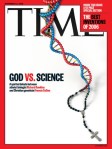
Time, 1996
Time, 2006

On the other hand, not all Christians are thrilled with Collins. His views on hot-button science issues – evolution, abortion, stem-cell research – run counter to typical conservative Christian positions. For example, he accepts Darwinian evolution as fact, and while he opposes abortion in most cases, he doesn’t explicitly rule it out.

Also, while he opposes producing embryos for research, he believes it is morally defensible to use embryos that had been created for fertilization but would otherwise remain unused.

“In the process of in vitro fertilization, you almost invariably end up with more embryos than you can reimplant safely,” he explained in a 2006 interview with Salon. “Is it more ethical to leave them in those freezers forever or throw them away? Or is it more ethical to come up with some sort of use for those embryos that could help people?”

Rudd realizes that Collins’ positions will “irritate” many Christians, and his organization “will have discussions” with Collins about embryonic stem-cell research. Still, he sounded optimistic about Collins.

“He is routinely accepted as an exceptional scientist, and he’s proven to be an exceptional administrator, which can be a rare combination,” Rudd said.

Dr. William Duncan, vice provost of research at East Tennessee State University, agrees with that assessment. Collins, he said, is a “world-class scientist,” and his faith is a non-issue for Duncan.

“Religious beliefs are very private, personal decisions for all individuals,” said Duncan, an immunologist who worked at the NIH from 1987 to 2004. “I’ve known many scientists who were religious, and religion never prevented any of them from pursuing their research. Each scientist needs to balance their religious beliefs and moral values with their career objectives and daily choices.”

The stakes are high: The NIH, the world’s most significant source of research money, will distribute about $37 billion in research grants over the next 14 months. The priority is to gain good data, according to Duncan, and he thinks the institutes’ review and decision-making process is “very transparent.”

“The NIH and the funding agencies in this country are primarily based on not on what your belief is but what is your proposal, the data, your plans,” Duncan said. “Scientists pursue knowledge, and the best science is done in an unbiased fashion. It’s really evidence-based data that drives the good science.”

Johnson City (Tenn.) Press, 25 July 2009.

Christian retailing: Buyer beware

Xn retailThousands of Christians gathered out West this week, making decisions that could affect millions of believers, with the potential both to strengthen their faith and to ruin it.
I’m not talking about the triennial General Convention of the Episcopal Church, which met in Anaheim, Calif.

Instead I’m referring to the International Christian Retail Show, which drew thousands of religious retailers to Denver for a kind of commercial pilgrimage. The convention is “the largest annual gathering in the world of anyone and everyone involved in the creation and distribution of Christian products,” according to CBA, the world’s foremost trade association for Christian stores and the event organizer.

Every year retailers roam among displays of more than 235 publishers, music producers, church-supply distributors, jewelry designers, clothing manufacturers and game makers, looking for new merchandise to feed their customers’ faith. Last year’s convention in Orlando, Fla., attracted almost 7,500 people, representing more than 1,700 stores, from small, independent shops to large chains owned by denominations or multinational corporations.

shoes_focusedslipon_200
These shoes are made for walkin' with Jesus: A "witness wear" sample

Christian retail is big business. Sales of Christian products by CBA suppliers totaled $4.63 billion in 2006, and one-third of all Americans made at least one purchase in a Christian bookstore during 2005, according to a Baylor University survey.

But I have never met anyone who works in a Christian store mainly for the money. People who work at local stores say they want to help customers find a book, a CD or something that might provide fresh insight or offer personal help. They use words like “ministry” and talk about “making a difference.” Years ago an independent store owner told me his business was “just another wrench in God’s toolbox.”

Like any human endeavor that holds heavenly ambitions, however, Christian retailing comes with its own special, sometimes subtle dangers, besides the temptations that usually follow the money. Selling a Bible is not like selling a novel, much less a hot dog. Advertising slogans become theological statements, for better or worse.

Jim Street, pastor of North River Church, a small congregation in the Atlanta suburbs, and a former psychology professor at Milligan College, is sensitive to the issue of marketing among Christians. A dozen years ago, he and Milligan theology professor Phil Kenneson co-wrote a book with the self-explanatory title of Selling Out the Church: The Dangers of Church Marketing. Their target was not marketing per se but the problems that come when the church, the mystical body of Christ, is treated like a commodity.

This isn’t an abstract concern to Street. More than 100 other congregations are located within five miles of his church building, he told me in a phone conversation this week, and he’s watched several families depart for churches that offer more goods and services.

“The issue … is not our commitment to one another and to Christ, but ‘what are my needs and desires and which of these buildings can I go to have them met?’” he explained. “I understand the pressures. As the economy gets worse, the temptation to marketing will increase.”

He thinks selling religious merchandise to Christians carries similar risks.

“The fundamental problem with marketing the church and the business surrounding the church is the elevation of the consumer,” he said. “Selling Christian products puts the consumer at the center of attention. We try to understand him and then shape products to meet his needs. There has to be some amount of consumption to be production, but we’ve elevated the consumer to be a kind of idol in and of himself. The consumer is very much in the driver’s seat.”

That may not be a problem when selling cars, but it can be if someone is trying to walk with God. It’s always been easy enough to let social trends, politics, economics, or just the passing “vanity fair” distort Christian messages (and not just Christian ones). Add the power of modern retail marketing and we can end up with merchandise that creates a house of mirrors more than a window into heaven.

“The story of God is about God, and the Bible is about the works of God,” Street said. “We’re participants in the story of God. But marketing looks at consumers and says we have to shape this to fit what we think they need. Marketing wants to make the consumer into a god. That turns the whole biblical narrative on its head.”

Let the buyer beware. Amen.

Johnson City (Tenn.) Press, 18 July 2009.

The 1,600-year-old online Bible

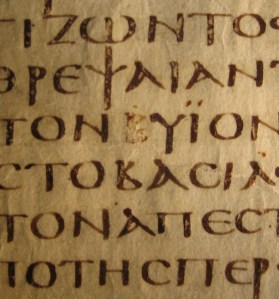
  1. from I Maccabees 6, Codex Sinaiticus. Note the faint erasure mark.
  2. from I Maccabees 6, Codex Sinaiticus. Note the erasure on the third line. 

Robert Hull, professor of New Testament at Emmanuel School of Religion, has spent much of his three-decade academic career studying ancient biblical texts, how they were first written down and how they changed from copy to copy. What was added? What was deleted? Maybe most important: why?

Such work, formally known as text criticism, might seem like an obscure exercise in eggheadism, but the findings trickle down to the Bibles people read and even to what they believe.

“Studying the early texts presumably gives us a better idea of what the original text said,” Hull said as we sat in the Emmanuel library this week, looking at facsimiles of ancient Bibles. “It also gives us an insight into the early church’s handling and thinking about the texts.”

Scholars like Hull, whose doctoral work at Princeton specialized in text criticism, were given a new tool this week when a Web site was launched that presents the entire text of one of the most important ancient Bibles.

The Codex Sinaiticus – literally “the book of Sinai” – dates from about the year 350 and contains the earliest complete copy of the New Testament as well as most of the Old Testament. About 800 pages of the original 1,400 pages remain, all handwritten in Greek.

The book got its name from its earliest home, the Orthodox monastery of St. Catherine’s, at the base of Mount Sinai in Egypt. The manuscript came to the world’s attention 150 years ago when a Russian scholar named Constantine Tischendorf obtained pages from the monastery and had them published. While some pages remained in the monastery, most eventually landed at institutions in Russia, Germany and England.

So until now, scholars wanting to study the text had to undertake long and difficult travels, perhaps to all four locations and with no way to directly compare passages housed in different countries.

But in 2005, the four institutions agreed to put the entire text online, digitally reuniting the book. That project was unveiled last week (www.codex-sinaiticus.net/en/).

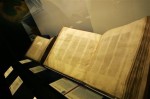
A Codex Sinaiticus manuscript displayed at the British Library in 2007.

The site not only includes detailed photos of the pages, but transcriptions of the text, translations into four languages, including English, a search engine, and even different types of lighting, which allows viewers see page textures, faint notations or flaws – all hints about the history of the text.

The site is a boon to scholars, letting them see details they may have missed before, if they ever had a chance to see them at all.

“Remember that until now, when someone looked at a lot of these pages, they were limited to using natural light or candles,” Hull said. “With digitizing (Sinaiticus) on the Web, paleographers (scholars of ancient texts) possibly can confirm a reading that was dubious or challenge something we thought was established. It will give us a clue about the history of the passage.”

No absolutely original texts of the Bible, or autographs, are known to exist, only copies of copies, and just a few of them the size and scope of Sinaiticus. Many fragments are the size of a postage stamp.

While some pieces date from close to the originals, with each copy scribes could mistakenly introduce an error, or someone might add comments that worked their way into the text.

Scholars estimate that the Greek New Testament as we now have it contains about 300,000 variations. About 90 percent of them are trivial, Hull said, such as misspelled names or grammatical errors.

But that still leaves thousands of more substantial differences. Variant readings in the story of Jesus’ last supper with his disciples, for instance, can affect the theological overtones of the Christian communion service. Does it matter that the earliest copies of Revelation say the number of the mysterious beast is 616, not 666?

Is the Christian message compromised because the earliest texts of the Gospel of Mark, including Sinaiticus, end with the women who visit Jesus’ empty tomb “afraid”? (Scholars are convinced the familiar final dozen verses were added later, perhaps to harmonize with the later books of Matthew and Luke.)

Not at all, according to Hull.

“No single variation by itself would overturn Christian doctrine,” Hull said. “The Gospel of Mark still has Jesus raised from the dead.”

But studying the ancient texts – a task made immensely easier with the online Sinaiticus – can help clarify Christian history and thought, and perhaps even help believers better understand what is essential to their faith.

Johnson City (Tenn.) Press, 11 July 2009.

George and Martha and Adam and Eve … and other problems with a patriotic Bible

adam_and_eve_2george-and-martha-washington_small

Thanks to a marketing video that compares George and Martha Washington to Adam and Eve, I’m trying not to think about the nation’s first First Lady walking around a garden without her petticoats.

But what really sets my teeth on edge is how the advertisement equates Jesus and his disciples with the Continental Congress as “founding fathers,” with its closing line: “Sometimes history does repeat itself.”

The ad is for the American Patriot’s Bible, released last month by Thomas Nelson, with Atlanta megachurch pastor Richard G. Lee serving as general editor. Nelson won’t disclose sales figures, but it is already preparing for a second printing of the hefty, colorful book.

AmericanPatriots_Bible8
“You will find a great volume of both information and inspiration revealing the ‘strong cord’ of the Bible’s influence that runs through the colorful fabric of our nation’s past and present,” Lee wrote in the introduction. “Joining with the sacred text are stories of American heroes, quotations from many of America’s greatest thinkers, and beautiful illustrations that present the rich heritage and tremendous future of our nation. If you love America and the Scriptures, you will treasure this Bible.”

Maybe so, but I mostly just felt annoyed. It’s not the emphasis on the role of religion in the American story, particularly a certain strain of Christianity. That’s old news.

It’s true, after all, that the majority of revolutionary leaders were Christians of some kind and many were motivated by their religious convictions, often arguing from the Bible against tyranny. There’s no question that the nation’s founders, not to mention later leaders, were shaped by their beliefs, which of course influenced their ideas and actions.

Even unorthodox deists like John Adams, Thomas Paine and Thomas Jefferson (who literally cut the miracles out of his Bible) used religious rhetoric and biblical imagery.

But then there’s the matter of what is often called civil religion, a kind of ecumenical devotion to the ideal of the United States. The nation itself becomes the object of veneration and Uncle Sam is dressed in priestly garments.

It’s a common impulse. People throughout history have considered their kingdoms on earth to be special outposts of heaven: Italy, Poland, Spain, England, France, Japan – the list goes on.

Many Americans can keep their belief in their country distinct from their religious faith. We can love the U.S., they say, and we can love God and remember the two are different.

But others forget the distinction, entwining American ideals so tightly with a Christian identity that they become confused, usually with bad results. That is the trap where the American Patriot’s Bible falls.

John Quincy Adams thought Christmas and American Independence were "indissolubly linked."

A full-page sidebar uses a story from Abraham’s life to illustrate … the right to bear arms? That seems like a stretch. John Quincy Adams is quoted saying that “in the chain of human events, the birthday of the nation is indissolubly linked with the birthday of the Savior” – and that notion isn’t challenged?

Then there’s the irritating historical revisionism that comes from leaving out uncomfortable details. Adams, Jefferson and Paine are all favorably quoted, for instance, but the details of their beliefs – or lack of beliefs – are glossed over. It would be easy to make the mistake of thinking they were Christians.

Likewise, the book frequently presents wartime sacrifice as supreme examples of Christlikeness, but ignores the significant tradition of Christian pacifism.

Then there is the two-page essay that rightly discusses how Christians led in the women’s suffrage and civil rights movements, but does not explain how other Christians opposed those rights, quoting Scripture to justify sexism, segregation and slavery.

"Declaration of Independence," by John Trumbull, 1817

Such myopia isn’t only annoying. It’s unnecessary. Honest historians know that biblical ideas (along with Greek philosophy, rationalism and other worldviews circulating in the 18th century) helped the founders craft the Declaration of Independence and the Constitution. It’s no secret that men and women of faith are among this nation’s chief architects.

We can admire leaders like George Washington and Abraham Lincoln without confusing them with Adam, Moses or Jesus (much less imagining Martha Washington as a new Eve). I can believe the U.S. fills a distinct role in the world without casting it as God’s singular chosen nation.

And today I can certainly celebrate what the nation’s founders did without believing their sacrifices repeated the history of Christ’s sacrifice. Believing that wouldn’t make me a patriot. It might only make me a heretic.

Johnson City (Tenn.) Press, 4 July 2009.

Leaping from tall poles in a single bound and other tales of Christian camp

superman-shieldThis week in a cove near Elizabethton, Tenn., some kid is going to jump off a 30-foot utility pole and live to tell about it.

No need to be alarmed. It’s a safety-harnessed gut check for youngsters (and the occasional adult). They put on a safety helmet, tie on a harness with an assistant holding the other end of the rope, and climb to the top of the pole. As they stand there, teetering, a trapeze bar hangs about six feet away.

The goal is simple: To launch themselves into the air and grab the bar. The hard part, the first time, comes just before jumping. Will the rope hold? Will the guy holding the rope do his job? Will I look stupid if I miss the bar? The answer to all is yes.

LeapOfFaithWeb
The leap of faith (but this one isn't at Doe River Gorge)

But why do it? The name of the activity offers a clue: the Leap of Faith. It’s one of the outdoorsy and out-of-the-ordinary activities featured at Doe River Gorge, a Christian ministry center.

“Our goal is to bring young people to maturity in their character, in their skills, in their understanding of God,” according to Director Terry Maughon. “We get kids who come for fun and adventure, but we want to expose them to Christ in a positive way, and we gear our programming to that.”

That kind of mission is shared by at least 10 Christian camping and conference centers within a 50-mile radius of Johnson City and hundreds more nationwide. The Christian Camp and Conference Association claims about 1,000 member facilities. (There are also about 300 Jewish camps, a dozen Muslim camps and a handful of other religious camps nationwide.)

Camps have changed from their heyday in the 1950s, ‘60s and ‘70s, when they were rustic and simple in every respect, from sleeping quarters (bunk beds in barracks-like dorms) to food (hot dogs and Tater Tots were typical) to programming (Bible classes, chapel, swimming and softball). These days, a camper is likely to find air-conditioned housing, salad bars, and options like high ropes challenge courses and wilderness expeditions.

“People want the experience of the woods, but require more stuff for that to happen,” said Jason Onks, executive director of Buffalo Mountain Camp and Retreat Center. It’s a challenge, he said, “to balance meeting those needs but not take away the experience of being outside. It’s partly the result of changes in expectations from campers, but mostly from parents.”

Faced with a different culture and shifting expectations, camps and conference centers need to be more creative than ever, said Mike Staires, director of communications and marketing services at the Christian Camp and Conference Association. While some facilities are thriving, average nationwide attendance is shrinking. CCCA members report about 6.5 million participants every year, down from 8 million earlier this decade.

Ramsey5
Ramsey Falls, at Buffalo Mountain Camp. Photo by Mark Peacock.

The campers themselves are changing too. More kids than ever grow up around cities, live with electronics and participate in organized activities, and so fewer feel at ease living close to nature. (“Our staff jokes about kids having ‘nature deficit disorder,’” Onks said.) Camp leaders see more spiritual diversity too.

 “Most kids who came 20 or 30 years ago didn’t question the Bible,” according to Brett Forney, promotions and development director at Appalachian Christian Camp in Unicoi. “But for the generation now, that’s not the thing. We’re not assuming they believe. A good number don’t go to church. Their parents just want them out of the house, and Christian camp is a safe, relatively economical option. So we’re getting back to basics, including more evangelistic aspects with some of them.”

Even so, she and other camp leaders say the constants of the camp setting make a unique impact on children and teens. It’s not about air conditioning or water slides.

“Kids may come the first time because of the toys,” Staires said, “but when they leave they say the most important part was talking with their counselors, meeting friends – those relational kinds of things.”

Camp provides a kind of “greenhouse environment,” he said. “Kids are in the Bible, having some quiet time, playing hard, spending the day together, not distracted by TV. But through the heat and exhaustion they are pushed together, faced with how to figure out how God fits in all this. They’re able to stop and think. It’s like someone pushes a pause button.”

Except when they jump off a very tall pole.

Johnson City (Tenn.) Press, 27 June 2009.

Southern Baptists in Louisville: Listening for a call. Maybe.

ear_guards_ear_plugs_33691Earplugs are available at the Believers Church, in case the band plays too loud.

The seven-year-old congregation, which attracts about 150 worshippers weekly, meets in a rented building, a former gymnastics studio at 213 E. Springbrook Drive, using an intentionally broad-brush name.

At first glance, you’d never guess this is a Southern Baptist congregation. That’s by design, according to Lead Pastor Mike Friday.

“We’re not running from who we are, but at the same time, Southern Baptists are not all the same,” he said in a phone conversation this week. “We don’t push the denomination. We push Jesus.”

He insisted that it doesn’t take long for visitors to discover the Southern Baptist connection, and he discusses it in the required membership class. But while he values the cooperation of the denomination, his time is limited, with him being the one full-time staff member.

“It’s not a lack of interest (in the denomination) as such,” he said, “but it’s hard to give that time.”

Even so, when Friday and his wife launched the church in 2002, they gave it a name and took an approach to ministry that would fly under the radar of people who may have been soured on church in the past. The phrase “Southern Baptist” is nowhere to be found on any of the church’s signs or on its Web site.

“There have been a lot of people hurt in the past from various denominations, unintentionally,” he explained. “We wanted to take out that hurdle for someone looking to get back in.”

The church has been growing, he said, with new members joining regularly since moving to its new location last November. That fact alone makes the Believers Church unusual among the 42,000 Southern Baptist congregations in the U.S.

Membership is shrinking in the nation’s largest Protestant denomination, which claims more than 16 million members. The number of baptisms has sunk to a 20-year low. Giving is down. More than a few leaders wonder about the overall health of the SBC.

Danny Akin, president of Southeastern Baptist Theological Seminary, recently wrote that Southern Baptists “are fractured and factionalizing. … We have tragically devolved into ‘a giant movement now in decline,’” quoting a professor at his school.

These concerns will be high on the agenda next week during the annual denominational meeting, the literal Southern Baptist Convention, when thousands of SBC leaders and “messengers,” delegates from congregations, area associations and state conventions, gather in Louisville, Ky.

In advance of the convention, Johnny Hunt, a pastor from Woodstock, Ga., who is completing his first one-year term as SBC president, published a 10-point declaration titled “Great Commission Resurgence” in April. (The title refers to the last words of Jesus in the Gospel of Matthew, directing his followers to “go into all the world, making disciples.”)

The document mostly reaffirms historic Southern Baptist beliefs and values, particularly their concern for evangelism. But it also addresses some thorny issues, such as the denomination’s racist past. Hunt would like to see the convention vote to adopt the document next week and set up a task force to study how to implement it. So far, more than 3,700 church members, including seminary presidents and past SBC presidents, have signed in support.

But one section, which calls for an examination of the structure and workings of the denomination “at every level,” set off alarm bells among other leaders. Some read it as an implied but unjust criticism of state conventions and other organizations. Others wonder if it opens the door to merging two of the SBC’s most important institutions, the North American Mission Board and the International Mission Board.

In a rare moment of public disagreement among top denominational leaders, Morris Chapman, president of the SBC executive committee, issued a statement to explain why he opposes the resolution as long as it contains the offending section, calling it “distracting” and “divisive.”

Mike Friday of the Believers Church certainly cares about the outcome of the convention. He’s served in Southern Baptist churches more than half his 46 years. He has paid attention, as best he can, to the discussions surrounding the Great Commission Resurgence, which could steer the denomination for a generation.

But he also has a congregation to lead, with studies and sermons to prepare and people to visit. Vacation Bible School starts on Monday. And no doubt someone will need to check the supply of earplugs.

Johnson City (Tenn.) Press, 20 June 2009.

The mixed history of Cherokees and Christians

Tobacco was a sacrament in the old Cherokee religion, the smoke a messenger carrying prayers to the spirit world.

Wine is part of a sacrament in the Christian tradition, signifying the blood of Jesus.

Dr. R. Michael Abram sees a rich irony here. Abram and his wife, Susan, are the owners and curators of the Cherokee Heritage Museum and Gallery in Cherokee, N.C. He is a keynote speaker at the Native American Festival at Sycamore Shoals State Park in Elizabethton this weekend.

“Take those two items and put them in each other’s culture with no religious meaning,” he said in a phone interview, “and both get into trouble.”

Millions of American Indians have struggled with alcoholism, and millions of other Americans – descendents of Europeans who brought Christianity – became addicted to tobacco.

That’s not a bad metaphor for the uneasy history between whites and Indians, which has been punctuated by conflict, ignorance and suspicion.

When he teaches about Cherokee heritage, Abram finds that religion is a popular topic.

The Cherokee belief system embraced a complex collection of legends, rituals, symbolic colors and numerology. While scholars can identify several common ideas, such as a reverence for fire and water, other specifics are hard to pin down. Scholars disagree, for example, on Cherokee thinking about a single, ultimate creator.

“It depends what century you’re talking about,” Abram said. “It was always evolving.”

But one constant was how Cherokee beliefs saturated daily life.

“You can’t just tease apart Cherokee culture and the old religion,” he said. “The religion is interwoven with daily life – medicine, government, all aspects of Cherokee life. I like to think of Cherokee life as a basket, with all the strands woven with one another.”

The Cherokee culture, once spread over thousands of miles in the Southeast, started changing dramatically as European settlers pushed westward in the 1700s. Christian missionaries, notably from the Moravian Church, lived and worked among the Cherokee and were strong advocates for their rights. The first conversions to Christianity came before the American Revolution, and by the early 1800s a number of prominent leaders were devout Christians.

But there was a dark side as well: European settlers, often misreading or ignoring the teachings of their Christian faith, systematically and violently drove out the Indians.

To this day, many Cherokee revile President Andrew Jackson because of his removal policies, which Abram compared to the Nazi Holocaust. Even faced with fierce opposition from other white leaders, including Davy Crockett, Jackson rammed through his policies bent on Cherokee removal.

According to Abram, Jackson used the Cherokees’ trust of clergymen against them, appointing the Rev. John F. Schermerhorn as his treaty commissioner to settle the now-infamous 1835 New Echota Treaty, which led to the expulsion of the Cherokee nation from the eastern United States. In 1838, the remaining 17,000 Cherokee people were force-marched over 1,200 miles to what is now Oklahoma. Starvation, sickness and exhaustion on this “Trail of Tears” took between 4,000 and 8,000 lives.

Today, few Cherokee practice the traditional religion. Many are fervent Christians who consider the old ways “pagan.” Others are what Abram calls “mixers,” combining ideas from Cherokee religion with Christian teachings.

Despite obvious differences, the two religions echo each other at certain points. The “going-to-water ceremony,” an important Cherokee initiation rite, is reminiscent of baptism, for instance. Then there’s Stone Coat, a central figure in Cherokee mythology, who sacrificed himself for his people and is “certainly a Christ-like figure,” according to Abram.

Abram, who grew up as a Pentecostal and is still a Christian, has “absolutely no qualms about that mixing.” In fact, he thinks white Christians could learn a few lessons from the Cherokee religion.

“The old religion followed ways of nature and emphasized preservation and balance. It was practiced in every aspect of life all the time,” Abram said. “The idea of establishing balance – that’s what really stands out in the old Cherokee religion.”

Johnson City (Tenn.) Press, 6 June 2009. (Parts of this column were first published on 4 June 2005.)

Changing presidents at a local seminary

In his 15 years as president of Emmanuel School of Religion, Robert Wetzel saw how seminary education must include more than simply learning theology, history and ministry methods in a classroom.

Intellectual rigor and academic discipline are crucial to Wetzel, but the education must “make it more than that. It must be head and heart.”

Wetzel retired this week after a five-decade academic career. On Monday the seminary, perched on a bluff above Milligan Highway, will have a new president, Michael Sweeney.

Sweeney worked in Papua New Guinea as a Bible translator for 15 years before coming to Emmanuel three years ago to teach courses in world mission and New Testament. He is the fifth president in 44-year history of the seminary, which mainly serves Christian churches and churches of Christ. (Wetzel also served on the mission field, leading a new theological college in England for 11 years.)

“What we do best is prepare people for ministry in community, and so we want to model what it means to be the church,” Wetzel said. “The early days of Emmanuel were very ‘heady,’ influenced by the Enlightenment. It’s not that we’ve abandoned that, but we put more emphasis now on helping students create and experience a sense of community.”

Perhaps the most visible symbol of that emphasis, and the most tangible legacy of Wetzel’s presidency, is the Emmanuel Village. The student-housing project was designed to emulate a small English village – complete with stone “cottages,” winding streets and a community center – not because Wetzel is an Anglophile, but to nurture a community that would be absent in cookie-cutter apartments.

There’s literally a price to be paid, however, particularly when seminary enrollment nationwide was stagnant. Emmanuel, with a $3.5 million annual operating budget, carries an $8 million debt, mostly in a $7.5 million, 20-year bond program that funded the last phase of the village and other projects. The past year’s economic downturn took a toll as well. Although no faculty members were released, several staff members were laid off. The actions were painful, Wetzel said, but the school has kept its strong donor base and holds $24 million in assets.

Sweeney knows he takes office during difficult financial times and a changing church atmosphere.

“Colleges and seminaries aren’t as influential as they once were,” Sweeney said. “The most influential leaders now are ministers of large churches. In (many congregations), degrees don’t mean as much as they once did. A lot of people just want to take a class or two. So we must relate more closely to the churches and be aware of issues they contend with and help the ministers develop the gifts they have.”

The school launched the Emmanuel Institutes in 2005 to do just that, offering workshops in local churches or engaging them in research projects on topics ranging from church finances to studying the effects of marketing. Emmanuel will also increase its online offerings.

While the school will aim to increase its traditional enrollment – Sweeney thinks Emmanuel’s headcount can grow by 100, to about 250 – its job description is expanding.

“Our biggest challenge is to revamp what and how we teach, to serve churches in their situations,” Sweeney said. “There’s a role for seminaries to fill.”

Both men are convinced that seminaries like Emmanuel, even as they reinvent themselves, are vital for the health of churches they serve and, by extension, the society where they operate. Wetzel and Sweeney are disturbed, for example, about theological shallowness among large numbers of churchgoers and even entire congregations.

“Americans assume success is a fundamental value that is generally unquestioned,” Wetzel said. “So I’m concerned that churches are going on models of success: They do what they do to bring in crowds. They’ll say, ‘We’re trying to meet the culture where it is.’ We can thank God there are churches with thousands of people, but there’s a tension in providing better solid biblical teaching.”

Sweeney agreed and then pointed to a silver lining.

“There’s a lack of depth, but it’s an opening for seminaries, to address that need (for theological teaching),” he said. “We’re in a cultural shift. People aren’t asking the same questions in seminary as I was. Much of my seminary experience was about engaging in fun, intellectual discussions. It’s not that anymore. Theology needs to be a way of thinking how I carry on my life. If it’s not, people aren’t interested.”

Johnson City (Tenn.) Press, 30 May 2009.

Christian colleges, commencements, controversy

Notre Dame, the nation’s most prestigious Roman Catholic university, walked a fine line last week when President Barack Obama, who favors abortion rights, delivered the commencement address. Critics said the school crossed a line just by inviting him. Even more complained about granting him an honorary degree.

At least two dozen graduating seniors boycotted the ceremony. At least three dozen protesters were arrested on the campus.

Starting with Dwight Eisenhower, Notre Dame has invited most presidents to speak at commencement. (One notable exception: Bill Clinton.) But this year, the invitation to Obama upset the delicate balance between Notre Dame’s Roman Catholic teaching, which strongly opposes abortion, and its academic freedom.

A 2004 statement from the U.S. Conference of Catholic Bishops is straightforward: “The Catholic community and Catholic institutions should not honor those who act in defiance of our fundamental moral principles. They should not be given awards, honors or platforms which would suggest support for their actions.”

On the other hand, as a leading university Notre Dame is obligated to academic freedom.

While not as high profile, the dozens of church-related colleges and universities in this region struggle with the same tensions, often played out at their big, public events.

Formal criteria for choosing commencement speakers are few and far between. Generally, colleges select people of accomplishment, who are likely to present a worthwhile message, and who have contributed significantly to society or to the institution. Most church-related colleges also want their speakers to be people of faith.

 “I try to find a speaker whom I think will be challenging,” said Don Jeanes, president of Milligan College, affiliated with Christian churches and churches of Christ (and where I teach). “Secondly, we want it to be a person of strong Christian commitment … someone who is consistent with the majority of where our constituency would be in theological persuasion.”

King College in Bristol, Tenn., affiliated with the Presbyterian Church USA, considers its commencement address as part of the academic program, according to Tracy Parkinson, assistant dean of the faculty.

“Commencement is special because of the nature of the school,” Parkinson said. “At the same time, if you’re going to bring folks from a wide variety of perspectives, as we do during the year, there will be people on campus who agree and some don’t. It’s an important part of what we consider the academic integrity of what we do.”

Parkinson said that considering the college’s normal criteria for commencement speakers – “a professing Christian, who’s accomplished in his or her field” – then Obama would be “a reasonable candidate” as a speaker, as would people “on the other side of any number of political or social issues.”

Public figures by definition are engaged in public issues, which can make it difficult to avoid controversy, according to Dirk Moore, director of public relations at Emory and Henry College, a United Methodist school in Emory, Va.

“Often what you want to bring to a commencement address is someone who’s been engaged in public service and so has had to take certain positions,” he said. “It can be hard not to be lightning rods.”

But part of the learning process is hearing from people who have different points of views, Moore said, and that process doesn’t end at commencement.

“Ultimately what you have here is a learning opportunity,” Moore said. “It would be unwise for any educational institution to keep them out simply because we may disagree with them on particular issues. We’re here to serve and educate students, open their perspectives on the world.”

Moore thinks the Notre Dame administrators were correct to invite Obama – not in spite of the controversy but because of it.

“Controversy is never pleasant for colleges and universities, but that’s kind of expected, to have voices expressing opinions,” he said. “What are you going to do, ridicule them for having firm beliefs?”

That’s one reason Moore was impressed with the Notre Dame students who protested Obama’s presence.

“A university is doing its job,” he said, “when it’s having students who come out with convictions that are important in their lives.”

Johnson City (Tenn.) Press, 23 May 2009.

Palestinian Christians stand ‘between two fires’

gaza_strip_may_2005

Here’s one measure of just how heated the subject of Israel and Palestine can be. When the Christianity Today Web site reported in January that the Palestinian Bible Society, located in Gaza City, may have been hit by an Israeli missile during the brief but intense winter war, some readers were anything but sensitive.

“And my response is … so what?” wrote one. “Lots of buildings have been hit. Is this an attempt to move Christian sympathy for Hamas?”

“If I choose to live among the enemies of freedom,” added another, “I shouldn’t be surprised that I might be destroyed when the friends of freedom respond to threats.”

One reader took offense at this remark, calling it “sickening” because it ignored the fact that Palestinian Christians were living in their own homes. No one said “amen.” When another commenter criticized Israel, however, others piled on.

“Your what happens when dumb liberals think they understand Christanity,” one grammar-challenged reader replied.

No matter what someone thinks about the Israel-Palestine morass, this wasn’t a high-water mark for Christian solidarity.

Hanna Massad (center) with members of the Gaza Baptist Church (date unknown).

Hanna Massad was not part of that discussion – it’s doubtful he’d want to be – but he knows Gaza better than any of those readers. Gaza is his home.

Massad is the pastor of Gaza Baptist Church, the region’s only evangelical congregation. His wife managed the Palestinian Bible Society – that is, until they, their two young daughters and several extended family members left Gaza for the West Bank in 2007.

They departed literally to save their lives, thinking they would be gone for a matter of weeks instead of almost two years.

The Bible Society building was firebombed at least twice, a repeated target of Palestinian extremists. The worst moment came in October 2007, when a close friend and colleague, 29-year-old Rami Ayyad, who managed the Bible Society bookstore, was kidnapped in broad daylight and later shot to death. Gazan authorities condemned the murder and promised an investigation, but without results.

Massad and his family came to the U.S. last August for a one-year sabbatical, so he could study at the Overseas Ministries Study Center in Connecticut. He visited East Tennessee last week, speaking at Milligan College and Emmanuel School of Religion.

Massad, who received a Ph.D. in theology from Fuller Theological Seminary in California, chooses his words carefully as he describes life for Palestinian Christians. His voice is sad, not angry.

“We are caught between two fires,” Massad said last week during a lull in his speaking schedule. “On one hand there’s the fire of the Israel occupation. Then there’s the fire of militant Muslims, who are not happy with us.” Massad, 49, is a master of understatement.

Since the Hamas party gained control of Gaza in the 2006 elections, the already stressed Christian community has become a more frequent target of Muslim extremists. Hamas officials condemn attacks but take no effective action. The entire Christian population of Gaza has dwindled to about 2,000 believers, living among a population of 1.5 million.

For its part, Israel doesn’t seem interested in a real solution, Massad said. The infamous 432-mile security wall, severe travel restrictions (which separated Massad and his wife for almost a year), the continuing construction of settlements – all stir up Palestinian resentments. Last winter’s conflict cost 13 Israeli lives, compared to 1,300 Palestinians, most of them civilians.

Against that backdrop, Massad stands in an awkward and dangerous place. As a Palestinian, he is suspect to the Israelis. As a pastor, he makes himself a target for Palestinian extremists who hate Christians and think he may be aligned with the U.S. because the word “Baptist” is on the church building and he won’t call Israel his enemy.

“Humanly speaking, it’s easy to be depressed,” he said. “There are militants on both sides. But you cannot live without hope. With good intentions, all things are possible.”

When Massad and his family return to Gaza this summer, he anticipates “a lot of rebuilding of souls” in the congregation and community. They plan to restart the library and school, and to open a health clinic. The role of the church, he said, is to help create a culture of peace.

“We’ll do work to reflect God’s love,” he explained. “We can continue to have love for Israel and for the Palestinians. Love for one should not make you hate the other.”

Johnson City (Tenn.) Press, 9 May 2009.