Cancer comes: ‘There will be no more ordinary days’

Ray Giles had tolerated the soreness near his abdomen for weeks. A man who had lived in the back country of Ethiopia for years could handle some discomfort. He thought it might be gall stones.

But one night in July the pain grew so agonizing that his wife, Effie, drove him to the emergency room at the Johnson City (Tenn.) Medical Center. After a battery of tests the next day, the physicians brought bad news.

Advanced cancer of the liver. Also in the pancreas. Inoperable. “It’s not a pretty picture,” said Ray’s physician.

The typical survival rate is about six months, but Ray’s doctors refused to set a time. Some patients live for years, they told him. Chemotherapy was an option.

“This was not an ordinary day,” Ray wrote in his journal the night they heard the diagnosis. “There will be no more ordinary days for me or Effie. Each day is a gift … gilded by the beauty God has made in the world.”

Ray and Effie Giles, now in their 70s, retired to Johnson City nine years ago, following a long career as missionaries in Ethiopia. (I wrote about their work last week.) They stayed active – teaching, mentoring young missionaries, regularly traveling to visit children and grandchildren or back to Africa. The cancer brought that to an abrupt halt.

“I never felt, ‘Why me?’” Ray said last week, sitting in their living room. “I never felt I needed to be exempt. Rather than focus on the problem of suffering, it forced the light to shine on the good.”

Even so, the news hit Effie hard.

“We all know we’re going to die,” she said. “But it’s different if you know the mechanism is already at work. You know one day we’ll not be the ones walking out of the hospital room.”

About two months ago it looked as if that day had come, when the cancer or the chemo pitched Ray into severe nausea, pain and disorientation.

“I couldn’t focus, I couldn’t think, I couldn’t pray,” he said. “I thought if it’s going to be like this, I don’t know if I want to live.”

He seemed to turn a corner a few weeks ago, however, and he feels good for now. So he and Effie are doing all they can to enjoy these days – “to use the time wisely,” he said – knowing they are not likely to last.

They try to bask in each other’s companionship. They revel in regular visits from family and friends. Ray feels strong enough to restart a few of his old church responsibilities, and he recently taught at a senior citizens rally.

“All we have assurance of is now,” Effie said. “I have a tendency to look ahead to the big event. Maybe it comes from our days on the (mission) field, when we’d look forward to the mail drops or to having the kids home from boarding school. But I’m learning to live as much as possible in the NOW.”

On a recent morning, watching a sunrise from the living room, she found herself thanking God as she mentally traced a list of blessings: Family. Friends. Phone calls and notes of encouragement. A good church. A full life. Time with Ray.

Each day, they agreed, is an answer to prayer.

“We usually think about praying for THE answer, as if there were one thing,” Ray said. “But we pray for good days, and we have good days. I don’t know what the one answer is. I’ll take each day as a gift of God.”

Ray draws comfort from a familiar verse in Psalm 23: “Though I walk through the valley of the shadow of death, I will fear no evil.’”

He recalled what the late Anglican priest David Watson wrote before his own death from cancer: “We know the evil will come. We just don’t have to fear it.”

Is that true for him? Ray paused. Yes, he said in a steady voice. Then he looked over at his wife of 55 years and his eyes filled with tears.

“I suppose if there’s anything, it’s thinking about leaving one another, the separation,” he said. “But other than that – no, not really.”

They try not to dwell on fear, Ray said.

“That psalm ends, ‘Goodness and mercy will follow me all the days of my life,’” he said. “And they have. God has blessed us. He’s been there in every time.”

First published in the Johnson City (Tenn.) Press, 21 Nov 2009.

With Ethiopia in turmoil, a calm commitment

1236953537p_h_ethiopia
image from CMF International

Ray Giles had reason to be nervous. It was Ethiopia in the 1970s and he was an American missionary in a strained land.

With a few colleagues, he had traveled to a small town miles from his own home base to visit three Ethiopian evangelists who had been jailed on false accusations of branding converts. Local authorities were agitating the townspeople.

Ray and his companions stayed at a friend’s house, and a large, menacing crowd started gathering there. Missionaries had been attacked elsewhere, and people seemed primed for violence. The homeowner went out and offered himself to the mob. “Take me,” he pleaded. “Please don’t hurt my friends!”

“It got dark and things quieted down,” Ray recalled this week. “Nothing happened, but it could have easily erupted into violence. People went home after a while, and the next day we went about our business.”

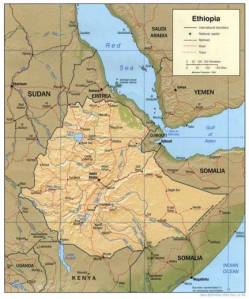
Such calm commitment is fairly typical of Ray and Effie, his wife of 55 years. In 1968, they and their four young children left a church ministry in Greenville, N.C., for the Ethiopian highlands, after being gradually convinced by the Holy Spirit, they say, to join a team from Indianapolis-based Christian Missionary Fellowship. First with the Oromo people and later with the Gumuz people in the lowlands, they offered general education, basic medical care, Bible teaching and leadership for the new congregations.

“The time I most delighted in was a village meeting at night,” said Ray, now 74. “I’d often walk about 20 miles and go into a smoke-filed house to have a meeting of eight to 12 people. I’d do that on a regular basis, week by week.”

They moved to Africa during the turbulent post-colonial period, when dozens of nations on the continent were gaining independence and the Cold War was at its height. Unlike most African nations, Ethiopia avoided colonial rule almost completely, but resentment of the West could cross borders. Politicians and war lords exploited suspicions about Western domination.

Ethiopia mapAll the missionaries in Ethiopia were evacuated when the Marxists took power in 1977. The Gileses briefly assisted with relief efforts during a 1985 famine. They finally returned in 1992, a year after the regime was pushed out, and stayed seven more years. When they retired in 2000, they settled in Johnson City, where they had connections through Milligan College and Emmanuel School of Religion.

“Our experience in Africa gave us an appreciation for the many different ways of life and of understanding reality,” Ray said. “As a visitor, you see the poor people and think how unfortunate they are. But you see more laughter there than in the U.S.”

They were also impressed by the ingenuity of the people and their ability “to live within the environment without changing the environment.” Ray and Effie’s dedication to a simple life was a gift from Africa.

 “People haven’t heard that being content with what you have is what you should pursue,” Ray said. “Family and friends are more important than things. Hospitality is important.”

He fondly recalled visits in homes, where drinking coffee – in the land where coffee was first cultivated – was a once- or twice-daily ritual that allowed time for long conversations.

“We have gained more than we have been given,” said Effie, 73. “We have been accepted by people even though we are so different, really in spite of our differences.”

Not that the Gileses idealize Ethiopia. Governmental corruption and a deep-seated culture of nepotism still cause problems, not to mention regular threats of drought, famine or regional conflicts.

But they look past those troubles. What motivated them, Effie said, was to see people transformed. In animistic societies, she explained, people will do almost anything to appease the spirits that control their lives, even sacrificing humans.

“It was exciting to see the change,” she said, “to see their freedom from fear.”

Their days are still full. There’s family: 11 grandchildren and 11 great-children (“with four more on the way,” Effie noted). There’s Lone Oak Christian Church, where Ray serves as an elder. They often teach in seminars and at colleges as guest lecturers. They are mentoring a new generation of missionaries, including some of their own children and grandchildren.

And as of July, there has been Ray’s cancer.

So that typically calm commitment, which has served them so well before, is being tested in a new way. That’s the story for next week.

First published in the Johnson City (Tenn.) Press, 14 Nov 2009.

A new road leading to Rome, via Canterbury

welcome matAccording to the Gospel of John, Jesus prayed intensely on the night before his crucifixion that his followers, present and future, would “be one.”

After 2,000 years, it’s obvious why he needed to pray like that. Unity is difficult, a stubborn fact reaffirmed last month when Pope Benedict XVI cleared a new path for Anglicans to enter the Roman Catholic Church.

The relationship between Rome and Canterbury has always been complex, to put it mildly.

The Anglican tradition was born 475 years ago when, in a messy mix of personal desire, European politics and theological disputes during the Protestant Reformation, King Henry VIII challenged the pope’s authority in England and, with the first Supremacy Act, the government in effect declared churchly independence. The monarch was deemed “the only supreme head on earth of the Church in England,” with the archbishop of Canterbury its primary leader.

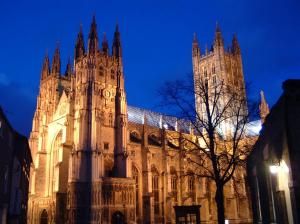
CanterburyCathedral
Canterbury Cathedral

That rough beginning has evolved into the global Anglican Communion, which today claims 77 million members, making it the world’s third largest church body, after the Roman Catholic and Orthodox churches.  Most Anglicans in the U.S. are in the Episcopal Church.

The dispute over papal authority turned out to be only the beginning. Inevitably, Catholics and Anglicans grew apart theologically as well as structurally. Among other issues, today they differ over women in ministry, over married clergy, and, depending on which part of the globe you’re in, over gay priests and bishops. (North American and British Anglicans tend to be more liberal about such things than their spiritual siblings in the southern hemisphere.)

Even so, many Anglicans and Catholics have long yearned for reconciliation, recognizing their churches’ special if strained relationship. Church leaders have constantly talked about cooperation for almost a half century, working together when theological differences weren’t at issue. There’s even been speculation about eventual reunification. Leaders in both churches regularly express a desire for unity.

But last month’s directive from the pope indicates how far apart the two churches remain.  Benedict will establish “personal ordinariates,” bodies similar to dioceses, to oversee the pastoral care of those who want to be received into the Catholic Church and bring elements of their Anglican identity with them. (The arrangement isn’t unique, even if the situation is. The Catholic Church already includes various groups with different rites, such as the Melkite and Maronite churches, living under similar structures.)

Vatican_City_St_Peters_Basilica_morning
St. Peter's Basilica, Vatican City

The Vatican

insists it still seeks unity, according to church leaders. Rather, the pope was responding to “many requests” submitted by individual Anglicans and Anglican groups, including “20 to 30 bishops,” asking to enter into full communion with the Catholic Church.

East Tennessee has not yet felt any impact. Neither the Roman Catholic Knoxville Diocese nor the Episcopal Diocese of East Tennessee knows of any Episcopalians seeking to join Catholic churches since the Vatican’s announcement.

“No one from the Episcopal Church has come at the parish level,” said Anietie Akata, head pastor at St. Mary’s Roman Catholic Church in Johnson City. “A few members have read what the Vatican issued, and there’s been only positive acceptance expressed to me.”

Hal Hutchison, rector of St. John’s Episcopal Church, doesn’t know of any members in that parish heading toward Rome. He doesn’t foresee a large migration at all.

“I don’t anticipate it being a significant number in any provinces of the Anglican community,” he said. “Part of the reason they like being Anglican is they don’t have a pope. Those who are unhappy with the Episcopal Church have sought to align themselves in other ways.”

The move may have other effects, however. While high-ranking Catholic and Anglican officials talk about their desire for unity, their words may sound like whistling in the dark.

Cardinal William J. Levada, who directs the Vatican’s chief body for overseeing theological consistency, has noted that with “recent changes” within many Anglican provinces – probably a reference to the ordination of an openly gay bishop in the U.S. and other controversies about sexuality – the prospect of full unity “seemed to recede.” So instead of holding out hope for full reconciliation, the Vatican opened a road to Rome for Anglicans who no longer feel at home with Canterbury. 

St. Mary’s parish continues to pray for the unity of the church, according to Pastor Akata, “which has always been the ambition and goal for the church.”

He’s right about that. Jesus himself prayed for such unity, probably knowing how difficult it would be.

First published in the Johnson City (Tenn.) Press, 7 Nov 2009.

A support group for Christian profs

This is the ETSU Buccaneer mascot. This is not a professor who is hostile to religion.
This is the East Tennessee State University Buccaneer mascot. This is not a professor who is hostile to religion.

Dr. Andrea Clements teaches psychology at East Tennessee State University. She is also an active member of Heritage Baptist Church, where she and her husband sponsor a group for college students and other young adults.

Sometimes her academic life and her religious life fit together well. Sometimes they don’t.

“When I’m teaching, I know my students have needs or crises, and I also know in my head there’s a better answer for them than the academic one,” she said this week in a phone conversation. “I don’t proselytize, but I want them to know what I think. It’s separating that out that can be challenging.”

For example, she recalls the first day of classes after the Sept. 11 attacks. Facing her students, she realized this was probably the biggest collective crisis they might ever face.

“I’m taking off my professor hat,” she told them. “I’m going to be a person, and I’m going to tell you how I’m dealing with this. Then I’ll put my professor’s hat back on.”

 Clements, who has taught at ETSU for 15 years, is always careful to distinguish between her professional role and her profession of faith in the classroom (“I’m good at being objective”), and she hasn’t encountered any serious criticism “for a lot of years.” A complaint from a colleague early in her career was resolved quickly and peacefully.

“I think everybody here knows what I believe,” she said. “It’s live and let live. I’m sure there are universities that are far worse.”

Andrea Clements
Andrea Clements

Even so, she doubts that professors who are atheists or agnostics feel similar pressure to detach their personal beliefs from their teaching, and students tell her that some faculty members are belittling of Christianity or even “downright hostile.”

“I think (Christians) are a minority on campus,” she said. “It tends to be largely secular. Most professors or staff keep their Christianity to themselves.”

That’s one reason she thinks a kind of support group on campus for Christian faculty members, administrators and staff is a good idea. She helped launch one at ETSU last spring.

Faculty Commons is part of Campus Crusade for Christ International, one of the world’s largest evangelical Christian organizations, and it is designed to help Christians working in higher education to meet and help each other. Faculty Commons groups are located on about 100 campuses around the nation, according to Rich McGee, the national director of development. He estimates about a thousand people are actively involved in the U.S.

Earle Chute, the local director for Faculty Commons, has worked full-time with Campus Crusade for 30 years, supervising the organization’s efforts among ETSU undergraduate students until last year, when he switched to faculty ministry.

“My love for college students hasn’t diminished,” he said, “but I see the strategic role that faculty can play. Students will come and go, but the tenure of faculty is much longer. They could have greater impact on the culture and climate of the campus. That’s why I changed.”

Faculty Commons at ETSU meets monthly at luncheons that usually feature guest speakers, focused discussions or long periods of prayer. (Last month, a psychology professor talked about handling stress.) The luncheons, which are open to any faculty or staff member, are attracting about 20 people each month so far. Smaller groups also meet every week for prayer.

A little history
A little history

As the group gets off the ground, the emphasis is on networking, service and support, but other kinds of work may be waiting. A university, after all, provides a crossroads for ideas, where any topic can be fodder for discussion and debate, including perennial hot-button issues that can divide Christians – sexuality, abortion, the nature of the family, evolution, war, economics – but this won’t be a debate club.

“It’s not that we’re ducking controversial issues,” Chute said. “There may be a good place for that in our lunchtime discussions, but our primary purposes are to strengthen each other and provide opportunities to share the love of Christ with others.”

Clements can imagine the group co-sponsoring events for the university in the future, such as film series or debates, but Faculty Commons has other priorities for now.

“As the Lord leads, we’ll come up with things we’re supposed to do,” she said. “But so far, the direction has been more how we can support Christian faculty and impact students, more of a way to be a Jesus presence on campus.”

Johnson City (Tenn.) Press, 24 Oct 2009.

A student prays. Can controversy be far behind?

Yes, that really is the name of the high school mascot.

It’s been a busy three weeks for Greg Ervin as principal of Gate City (Va.) High School. He’s been fielding phone calls almost every day from parents or the press about a church-state storm that unexpectedly boiled up after a student said a simple, heartfelt prayer at a football game.

“Somewhere lost in all this was the fact that a kid died,” Ervin said this week. “No one ever intended to sensationalize this. It was a simple act of kindness and respect.”

The story started on the night of Sept. 11, when the Sullivan South High School football team played at Gate City. Not only was it the eighth anniversary of the terrorist attacks, but the folks from Sullivan were still grieving the death of Jake Logue, one of their players who suddenly collapsed and died during a game in Knoxville on Aug. 21.

Before the game began at Gate City, a brief ceremony remembered the 9/11 victims and Logue, including a moment of silence. A student who was allowed to speak said a prayer, concluding “in Jesus’ name.”

At least one parent in the stands took offense and contacted the Virginia chapter of the American Civil Liberties Union. A few days later, Ervin received a letter from the organization, advising him that a “sectarian prayer delivered over the public address system” before a football game violated a U.S. Supreme Court ruling. Such prayers, the letter noted, carry “the impermissible endorsement of the school and coerce participation” in a religious exercise.

The ACLU had been told that Gate City regularly opened its games with prayers – but that is not the case.

Photo: Kingsport (Tenn.) Times-News Web site

Ervin shared the letter’s contents with teachers and the Scott County school board and then responded to the ACLU, describing what happened and correcting the wrong information.

In its reply to Ervin, the ACLU pronounced itself satisfied: Case closed.

The story could have ended there, if a little more patience and a little less readiness to be angry had ruled the day.

“We don’t go looking around for incidents,” said ACLU of Virginia Executive Director Kent Willis in a phone interview this week, “but when someone calls and says this is what they witnessed, we respond. We usually resolve these matters quietly. We write a letter, and the official writes back to explain or clarify. That’s OK. That’s our standard procedure.”

The ACLU did not make its first letter public, but apparently someone in Scott County was upset enough to notify the press about it. Reporters soon arrived, and as word about the ACLU’s concern spread, anger flared. People wrote furious letters to local newspapers and posted unfounded accusations on Web sites.

Photo: Ned Jilton II, Kingsport Times-News.

Some Gate City students printed about 1,000 T-shirts to hand out at their Oct. 2 football game, taking a swipe at the ACLU. “I still pray…” the shirt fronts read, and on the back: “In Jesus’ name.” When the Virginia ACLU heard about that protest, it publicly affirmed the students’ rights to distribute the shirts, saying they were only exercising their constitutional right to free speech and religious expression.

While the ACLU has a long record of controversial crusades and debatable pronouncements, Willis insists it is not “anti-religion.” Any list of religion-related cases that the ACLU has handled, he said, will include as many defending the free exercise of religion as those challenging unconstitutional “establishment” of religion.

Last week in Nashville, for example, the ACLU of Tennessee completed a successful negotiation on behalf of Christian students from Belmont, Middle Tennessee State and Tennessee Tech universities who were barred from holding worship services for homeless people in a city park. The Metro Board of Parks and Recreation had “unfairly blocked religious groups’ regular use of park space,” according the ACLU, and helped to revise the policy.

“We’re not the prayer police,” Willis said this week. “The original plan at Gate City (on Sept. 11) was for a moment of silence, and there’s no problem with that. We’re down to a really minor (legal) issue that happened one time. The principal was put on the spot. … This was something spontaneous. What was he supposed to do?”

What Principal Ervin wants to do now is move past the controversy and just “remember the spirit” when two communities shared a moment of sadness and sympathy and “a student reached out and spoke as best she knew how.”

Johnson City (Tenn.) Press, 17 Oct 2009.

200 years and counting: ‘Unity is not a luxury,’ but it is a process

250px-Declaration_and_Address_1809There’s an old joke about a man who dies and goes to heaven. As St. Peter escorts the new arrival down a golden street, he tells the man to be especially quiet as they pass a particular mansion.

“Why?” the man asks.

“That’s where (name any exclusive Christian sect) live,” Peter explains. “They think they’re the only ones here, and we don’t want to upset them.”

Thomas Campbell, were he still alive, would get the joke. He might even tell it, which would have scandalized many Christians two centuries ago.

Campbell was a Presbyterian minister who migrated from Ireland to the frontier of western Pennsylvania in the early 1800s. But he was frustrated by the divisions among Christians, some of which were absurdly transplanted from the old country. For example, his denomination might withhold communion from other Presbyterians over an obscure Irish political issue.

In response, he gathered a few dozen like-minded believers into a local nondenominational group, with cooperation on their minds.

To explain their actions and to encourage other Christians to take similar steps, the 46-year-old Campbell wrote a long essay in 1809, “The Declaration and Address.”

This early call to Christian unity was based on a simple but then-radical notion: that “the church of Christ on earth is essentially, intentionally, and constitutionally one.” (Note the present tense: “is.”)

Campbell didn’t offer a blueprint for a united church. Instead, he presented the New Testament as a “constitution” – a notable word, just 20 years after the U.S. Constitution went into effect, laying the groundwork for the nation but requiring ongoing interpretation.

“He knew unity was a process,” said Paul Blowers, professor of church history at Emmanuel School of Religion and a co-editor for The Encyclopedia of the Stone-Campbell Movement (Eerdmans). “The foundation of unity is identification with Jesus Christ, but what does that entail? How much of a common core do you need? The first-century church didn’t have it perfect. There will always be opinions. Theology is inevitable. The question is how unity works with diversity.”

Thomas Campbell (1763-1854)

Campbell said Scripture was the final authority for Christians. Beyond that, the creeds and rites were valuable for teaching or expressing a common faith, but not as tests of whether someone was a true Christian.

“Forbearance was one of his favorite words,” said Dennis Helsabeck Jr., associate professor emeritus of history at Milligan College and co-author of Renewal for Mission: A Concise History of Christian Churches and Churches of Christ (Abilene Christian University Press). “He puts a lot of emphasis on patience. There’s a sense of unity in that, not in that we all understand in the same way.”

But unity was not Campbell’s main objective.

“Campbell was interested foremost in the mission of the church,” Helsabeck said. “Reconciliation with God was the ultimate goal. He decries the terrible effects of disunity, which endangers the mission of the church.”

“The Declaration and Address” served as a starting point for what grew into the Stone-Campbell Movement, named for its early leaders: Campbell and his son Alexander, eventually the movement’s best-known voice, and Barton W. Stone, another unity-minded Presbyterian in Kentucky.

This “restoration movement” evolved into three major church bodies: The Christian Church (Disciples of Christ), the Christian Churches/Churches of Christ, and the Churches of Christ, sometimes called noninstrumental churches since they do not use musical instruments in worship. Together, these groups claim about 3.5 million members in the U.S. (Milligan College and Emmanuel School of Religion, both near Johnson City, Tenn., are affiliated with the Christian Churches/Churches of Christ, which is also my church heritage.)

Campbell would find it sadly ironic to know his reform efforts mutated into yet more church groups that would divide and divide again. But he would be heartened to know his spiritual descendants have taken steps to reconcile in recent decades.

One example will occur tomorrow. To mark the bicentennial of “The Declaration and Address,” Christians from all streams of the Stone-Campbell Movement will gather in regional communion services around the world, an event collectively called the Great Communion. One service will be held in Seeger Chapel at Milligan College at 4 p.m., and is open to all Christians.

“We are pushed to deal with people who differ from us,” Blowers said. “That’s part of Christian discipleship. Can I share communion at the table with people who believe differently? Everyone needs to be reminded that Christianity is bigger than us and our congregations. Unity is not a luxury.”

Johnson City (Tenn.) Press, 3 Oct 2009.

The URI tries on its Bible Belt

coexistPat Griggs of Johnson City, a self-described activist, traces her “call” to a quarter century of interfaith involvement.

In the early 1980s, she helped organize people of different faiths to protest nuclear arms. On the morning of Sept. 12, 2001, she sat in a school parking lot to make sure the children of Muslim friends made it to class without incident.

So joining the effort to re-launch a local chapter of the United Religions Initiative? No question.

The URI is a worldwide network designed to encourage cooperation among people of different faiths, whether Christian or Jewish or Muslim or Hindu or Buddhist or Wiccan or agnostic. The ultimate goal is world peace, based on the idea that before the world can find harmony, the religions of the world must learn to live together.

URI was born in 2000, the brainchild of Bill Swing, the Episcopal bishop of California, who dreamed of an organization that would serve as a kind of United Nations for religions. Today, URI claims more than one million people from 120 faith traditions are involved in more than 320 local self-governing organizations, or “cooperation circles,” in 60 nations. The U.S. and Canada comprise 44 circles, including the one in Johnson City, the only circle in Tennessee.

The local “CC” was formed in 2000, but small membership limited its efforts mainly to hosting an interfaith dinner each Thanksgiving.

Last spring, however, the Rev. Jacqueline Luck, who moved to the area in 2007 as the new minister of the Holston Valley Unitarian Universalist Church, gathered the few CC members for lunch, and they decided the time was right for a new start.

With Luck acting as coordinator, a dozen people from at least five faith traditions gathered at the Johnson City public library on Aug. 31 to gauge interest in interfaith cooperation and discuss what a revitalized CC might do.

“There was a lot of energy in developing a circle,” Luck said in a phone conversation this week. “The roots are already planted. We just need to nurture it a little bit.”

Since CCs are self-governing, there is not one model. Some emphasize environmental issues; others focus on educating about religions; still others work to help poor people. Whatever shape the local group takes, Luck thinks it can make a big impact.

“I think the main thing is learning to work together,” she said. “Anything to help with this community, to work on local issues that cut across faith boundaries. That’s why I think it’s a natural to do justice work. In this area, caring for the earth is a strong possibility too. It’s trying to love our neighbor in one way or another. That’s common ground too.”

URI logoThese goals sound praiseworthy, but the URI has been the object of criticism from its start. Various religious groups, including the Roman Catholic and Eastern Orthodox churches and several evangelical Christian bodies, keep the URI at arm’s length. (For examples, go here and here.)
They suspect that the URI is promoting a philosophy that artificially erases distinctions between faiths or dilutes doctrine to a hodge-podge of vague spiritual clichés. Many Christians, for example, find it hard to reconcile the URI’s goals with Scriptures that teach Jesus is “the only name under heaven by which we might be saved.” They point out that the URI’s charter is written with such broad strokes that it never even uses the word “god.”

But seeking common ground, say URI supporters, is not the same as asking believers to abandon their own faith.

“The URI is a bridge-building organization, encouraging mutual respect among all faiths, with domination by none,” according to Sandy Westin, technology and communications coordinator for the URI in North America. “It in no way encourages homogenization of religious belief, but rather encourages respect for the sacred wisdom of each religion, spiritual expression and indigenous tradition.” The URI charter, Westin pointed out, encourages members to deepen their roots in their own traditions.

“We’re trying to learn to communicate with each other, trust each other and work together toward this ideal of hoping all religions can exist together,” Luck said. “I’d like us to be visible in the community as an example of what’s possible, to be standard bearers for harmony among religious people.”

Johnson City (Tenn.) Press, 12 Sept 2009.

Pilgrimage, leap of faith or walk in the wilderness? Lutherans and gay ministers

elcaJames Nipper has his work cut out for him.

As senior pastor of Our Saviour Lutheran Church in Johnson City, Tenn., he must lead the congregation in a kind of figurative pilgrimage regarding sex and sexuality.

The church is traveling on a long and winding road with its denomination, the Evangelical Lutheran Church in America. The ELCA decided during last month’s Church Wide Assembly to permit people in same-sex relationships to enter its ordained ministry.

“Up until this time, it was accepted that these pastors could serve in the ELCA as long as these remained celibate,” Nipper explained in an e-mail this week. “This document now allows for pastors who are in committed relationships with people of the same gender to be reinstated to the clergy roster and/or allowed to receive a call to serve in the ELCA.”

“Pastor Jim” regards this new policy as “more of a process, a procedure, by which a congregation can choose to call a gay pastor.” No such process existed before.

About 60 members of the Our Saviour congregation attended an open forum on Sunday afternoon. The congregation has about 500 confirmed members and an average worship attendance of about 215.

“We had a lively discussion,” Nipper said. “We did not come to a consensus but we did have a like mind that we should stay together as a congregation.”

He could have said the same thing about the national body: there’s little consensus about blessing same-sex relationships or ordaining gays and lesbians for ministry, but hope to stay together. Last month’s convention, made up of clergy and laypeople who represent churches and regional synods, approved the main document by a vote of 676-338, exactly the minimum two-thirds majority required for passage.

castro-rainbow-flagTo its credit, the ELCA has not taken the easy path. If the denomination’s utmost concern was keeping membership up or maintaining some kind of superficial peace, it could have settled matters years ago. (The ELCA is by far the largest of several Lutheran bodies in the U.S., but like other mainline Protestant denominations, it has been shrinking for decades. The denomination reported 4.6 million baptized members in 2008, down from 5.25 million in 1988.)

As it is, the social statement, “Human Sexuality: Gift and Trust,” resulted from eight years of discussions, meetings, debates and votes. The ELCA has produced social statements on several issues, and they are considered teaching documents as well as policy statements.

This one is a broad, thoughtful statement of church teaching about sexuality and related issues, from abuse to economics to pornography, as well as marriage and, of course, same-sex relationships. As the title suggests, it emphasizes sexuality in its God-given nature as both a gift and matter of trust.

What grabbed headlines, of course, were the resolutions permitting people “in publicly accountable, lifelong, monogamous, same-gender relationships” to enter any of the church’s four formal levels of church ministry.

The resolutions are careful to provide for “structured flexibility,” allowing individuals and congregations to live by their “bound conscience.” In short, while the ELCA won’t forbid people in same-sex relationships to enter ministry, it won’t force the issue either.

But as serious as issues about homosexuality are, even more is at stake. By all accounts, these decisions raise questions about core beliefs, from biblical interpretation to the meaning of marriage to the validity of two millennia of Christian teaching.

Critics note all this, and more.

“The ELCA has formally left the Great Tradition (of confessing Christian churches) for liberal Protestantism,” Robert Benne wrote in a commentary on the Christianity Today Web site. Benne is the director of the Roanoke (Va.) College Center for Religion and Society and was a voting member at last month’s assembly. “A tectonic shift has taken place, and it wasn’t primarily about sex.”

Benne predicts “a profusion of different responses by congregations and individuals.” Besides those who approve the new policy, many will leave the denomination, he wrote. Some will wait to see how an organized renewal movement responds. Others will pull away from their involvement in the ELCA to live at the local level. Still others “will try to live on as if nothing has happened.”

The way ahead for Our Saviour Lutheran Church, according to Pastor Nipper, will include Bible-oriented studies, small group discussions and an effort to “help our people look positively to the future.”

Yes, he has his work cut out.

Johnson City (Tenn.) Press, 5 Sept 2009.

Rainbow & pot of gold 2

Kennedy: Perhaps another ‘man after God’s own heart’

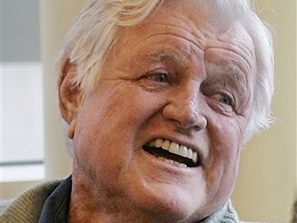
Edward Kennedy in 2008

Thinking about Sen. Edward Kennedy this week, I found my mind oddly drifting toward King David, that renowned ruler of old Israel.

Sunday school lessons highlight David’s heroics – his life as a simple shepherd, his showdown with Goliath, his psalms. But his political career and family intrigues actually resemble scenes from “The Godfather.”

As a warrior, David earned such a blood-soaked reputation that God refused to let him build a temple. His worst moment combined dereliction of duty, adultery, deception and murder, starting a chain of events that spiraled down to open rebellion by his oldest and favorite son and generations of trouble.

Even near the end of his long life, when he was feeble and perhaps senile, David gave more than the throne to his son Solomon. He also passed along a hit list. David spectacularly broke almost all of the Ten Commandments.

And yet God kept David in his pocket. He was, according to the Bible, “a man after God’s own heart.”

Perhaps that was because David ultimately threw himself before God, whether it was challenging giants or dancing nearly naked in the streets during a worship procession.

He composed psalms that questioned and railed at God in fear and frustration, cried to him for vengeance against enemies and gloated over their downfall. But knowing his sins, he invariably came pleading for mercy and forgiveness. He always praised God in the end, seeking him wherever he might find him – under the stars, below the mountains, in the temple, in his bedroom, through the valley of the shadow of death. Despite everything, this womanizing, scandalized, troubled chieftain could still write, “My help comes from the Lord.”

Maybe it was that relentless if imperfect pursuit that warmed God’s heart.

Culture and circumstance – not to mention 3,000 years – put a lot of distance between King David and Sen. Kennedy. Even so, elements in Kennedy’s life and career sound familiar.

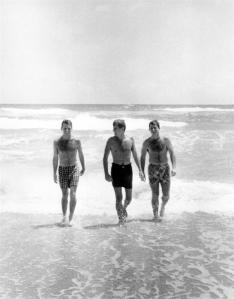
Bobby, Jack and Teddy: The Kennedy brothers in 1957.

The senator for years lived a kind of high-wire act, often played out in public, that tried to balance great personal gifts, high ambitions, deep flaws, terrible tragedies and a durable faith.

As one of the most effective legislators in American history, he likely made a more profound impact on the nation than his celebrated brothers. Along the way, he showed graciousness in an ungracious town, whether dealing with political allies or foes, junior staffers or people on the street.

The best-known and perhaps most powerful Roman Catholic politician in the country, Kennedy cited his faith as one of his central motivations in his commitment to helping ordinary people through education, higher wages and, above all, health care. In what was for him typical bipartisan fashion, he worked with Republican Sen. Orrin Hatch to pass the Religious Freedom Restoration Act of 1993, an effort to relieve governmental burdens on the exercise of religion.

But Kennedy didn’t walk lockstep with his church, and he put himself at odds with Roman Catholic teaching most severely with his support of abortion rights, an inconsistency that not even the famous Kennedy mystique could overcome. And despite the personal peace that his second marriage brought him, divorce and remarriage offended many fellow believers.

Kennedy was a flawed person, and he knew it. In a 1991 speech at the John F. Kennedy School of Government at Harvard, Kennedy openly addressed “the faults in the conduct” of his private life.

“I realize that I alone am responsible for them, and I am the one who must confront them,” he said.

Despite this – or possibly because of this – by all accounts he found strength and comfort in his faith, especially during his last years. The Cape Cod parish priest regularly visited the Kennedy home and held a private family Mass there every Sunday. Kennedy led his family in prayer after the death of his sister Eunice three weeks ago, and he spent his own last hours in prayer.

“He was a Rabelaisian figure in the Senate and in life, instantly recognizable,” wrote John Broder in The New York Times obituary this week. “He was a celebrity, sometimes a self-parody, a hearty friend, an implacable foe, a man of large faith and large flaws, a melancholy character who persevered, drank deeply and sang loudly.”

Something about Edward Kennedy makes me hope that, like King David, he was finally a man after God’s own heart.

Johnson City (Tenn.) Press, 29 Aug 2009.

So a church cancels its worship services to go serve, and then calls it worship. Confused yet?

work worshipA lot of organizations, from scouting troops to sororities, help their communities with service projects.

Congregations do so as well, but there’s a difference. Virtually every act carries some kind of theological meaning. It goes with the territory. Birds gotta fly, fish gotta swim, and religious bodies gotta make religious statements.

So last Sunday, when Grace Fellowship Church canceled its worship services so members could spend the morning painting, mowing, cooking, repairing and otherwise serving at 32 local nonprofit organizations and homes, it wasn’t just a work day. It was also a theological declaration.

“Most people think that Sunday mornings are about ‘going to a service,’” Lead Pastor Tom Oyler wrote to the congregation earlier this year. “But on this day, we remind ourselves that we exist to serve others as well.… For many people, seeing a sermon in action is more effective than hearing one.”

The community service, he wrote, would be “a sort of good demonstration of how the body of Christ is designed to work.” The results would extend beyond Sunday: “Bridges will be built. Seeds will be planted.…. Grace will happen. God will be pleased. That’s about as good as it gets!”

By all accounts, the day was a success and, as Sue Guinn Legg reported in the Johnson City Press on Monday, a real benefit to the organizations. When the event’s main organizer, Connections Coordinator Malia Grant, reviewed the sign-up sheets this week, she found 1,065 people had participated. The church typically draws about 1,200 people during the summer. The day went so well that church leaders are already thinking of turning it into an annual event.

 “Though it was different from a typical Sunday, we got great response,” Grant said. “We wanted to make sure as many people could participate as possible, of every age. It was just as important as any worship service they would attend.”

Even preschool children got involved at “Echo Village,” a display area at the church building where they could help with some task, such as filling small bags with laundry detergent for families at Interfaith Hospitality Network, a ministry for homeless people.

The idea for Echo Sunday came up early this year, when church leaders realized the construction on their new building might leave the congregation without a meeting place for one Sunday. Someone suggested going into the community to serve that Sunday, and the idea stuck, even when it later became clear the construction wouldn’t interfere with the schedule.

So if every action of a church makes some kind of theological statement, what did “Echo Sunday” say?

Christian teaching has always emphasized the need for believers to gather to praise and pray to God, to observe communion and other sacraments, and to hear from Scripture in some fashion. In short, “ministry of word and sacrament” has always been central to Christian worship.

That didn’t exactly happen at Grace Fellowship last Sunday.

 “I’d have a problem if we did this consistently,” Oyler said in a phone interview this week. “Gathering for worship is important, a priority of the church. But by doing this on Sunday, people could focus on service. Reaching into the community is not a side thing. We take this seriously.”

Their service was another form of worship, according to Oyler, saying it squared with Jesus’ words to strict Jewish teachers who criticized him for healing people on the Sabbath.

“In our theology, we would feel free to do this again,” Oyler said.

Besides, he noted, the church did gather on Sunday when members returned to the church building to share pizza, pray and talk about their experiences.

“Gathering was an important part of the day,” Oyler said. “For example, a group of 15 teenagers went to the Children’s Hospital. They took donuts to the nurses and talked with the children. (The teens) were blown away by the experience. The nurses called on Monday, to say how much the visit meant to them.”

Oyler and Grant were quick to point out other churches serve the community too. Grace isn’t unique, they said. Just this day was different.

“We’re trying to imbed this idea of servanthood and being engaged in the community,” Oyler said. “A lot of people expect Christians to gather away from them, but they’re encouraged by Christians going to them. And our people felt the impact of going into the community. Our church will remember this for a long time.”

Johnson City (Tenn.) Press, 1 August 2009.