American Ramadan

happy ramadanThe discipline of Ramadan is daunting: While the sun is up each day during Islam’s holiest month, Muslims will fast from food and water and sex and be extra careful about what they say and hear. It’s a time to purify the body, an avenue for purifying the soul.

It sounds stringent enough in a place with a temperate climate, like East Tennessee. But consider that most Muslims live in southern Asia, Indonesia and Africa, and that the lunar calendar nudges Ramadan into high summer every few years. Long days of triple-digit temperatures and not even a sip of water – it sounds like a recipe for misery.

On the contrary, Muslims say, Ramadan is the most wonderful time of the year.

I sat down with six members of the Muslim community at their masjid, or mosque, on Antioch Road this week, to talk about the holiday, which celebrates the revealing of the Koran, which Muslims regard as God’s word, to the prophet Muhammad.

Ramadan, the ninth month in the Arabic calendar, begins this weekend, the moment when the slightest sliver of the new crescent moon becomes visible. It will conclude at the end of the four-week lunar cycle, marked by Eid-al-Fitr, the feast of the breaking of the fast.

The group was full of anticipation. Although most of them have lived in the U.S. for decades and are American citizens, they recalled memories from their homelands.

“You feel different, and there is a liveliness during Ramadan,” said Ahmed Atyia, a pharmacist originally from Egypt. “Fasting is good for your body, to cleanse it and give it a rest. You feel sad after the month ends.”

It is a month not only to change habits, said Taneem Aziz, an engineer and the Muslim Community’s president, but also a month of extra blessing. The effect of good deeds is literally multiplied 10 times, the Koran says.

“All the senses are focused on worship,” said Aziz, who was born in Bangladesh. “With the discipline, it is God making it easy for us to feel good and celebrate.”

People are friendlier and try to be more patient during the month. Crime goes down. Homes open up to family, friends and strangers like no other time of the year.

“The community is one of the reasons we are excited,” said Aziz’s daughter, Imani, a 19-year-old student at East Tennessee State University and the only American-born Muslim in this conversation. “Every night, we worship together.”

Life slows down during the day in Muslim countries. Families rise long before dawn to eat together. People who go to work feel unhurried, but many businesses just shut down. The normal daily prayers continue, perhaps with greater attention and attendance at the mosques.

But when prayers are finished at sundown, communities spring to life in a different way. The Koran commands Muslims to break the fast as soon as they can each night, and they do it with gusto.

Food comes out from almost every house, spread on tables lining the streets or served under colorful, open-air tents. Festive tin lanterns with colored glass glow in windows. As people pass by, whether or not they are strangers or Muslims, they are likely to be invited to stop for food – and conversations and games and songs and prayers and extended readings from the Koran. The nightly celebrations can last almost until the early morning meal begins the daily round again.

“It’s like having Christmas for a month,” Natalia Suit, a Christian friend who lived in Cairo, told me later. “Ramadan really is the best time of the year there.”

The holiday, of course, takes on a different cast in the U.S., where Muslims are a minority in the same way Christians are a minority in Pakistan or Egypt. No one expressed any resentment or regret. They accept the differences.

“We don’t feel conflicted, living in America,” said Yusuf Gangat, a pharmacist originally from Pakistan. “The purpose is to worship God in everything. It’s a very easy life, once you accept it.”

Besides, they agreed, the times are changing, and non-Muslim Americans are growing more aware of Ramadan. They notice in ways both small and significant, from seeing their holidays printed on calendars to having employers provide time off.

Imani Aziz was smiling broadly during the entire conversation. She simply enjoyed thinking about the month to come, she explained.

“I’m just excited it’s almost here,” she said.

Johnson City (Tenn.) Press, 22 Aug 2009.

PS: The health-care debate, the UK and US

It's not quite like this anymore.
The trucks are newer, and so is the system.

I’ve been getting a lot of feedback (relatively speaking) to last Saturday’s column. Most of the comments have been complimentary, which is gratifying — but also a little worrying. When I shipped the column to the paper, I didn’t think it was particularly strong or insightful. Saying people should treat each other with civility? (Hey, let’s try the Golden Rule!) should be a no-brainer. But it apparently struck a nerve. As much as I’d like to believe otherwise, I’m pretty sure that says more about the state of the debate — and maybe the culture — than about my acumen.

NPR’s Morning Edition ran an interesting segment today, an interview with Lord Ara Darzi, a surgeon and British government adviser, about Britain’s National Health Service, which you can read or listen to here. Darzi was debunking misinformation being circulated about the NHS by Sen. Charles Grassley of Iowa and the Club for Growth, a conservative group, among others. PolitiFact, which, as its name implies, tries to sort out political truth from fiction — and has a pretty good track record –  labeled the CFG ad “misleading.”

My family and I lived in England for five years in the 1980s, working in a church in the north of the country, near Manchester and Liverpool. This was during Maggie Thatcher’s years as prime minister, long before the reforms that took hold in the last decade. The NHS certainly had serious problems at the time. A woman in our church, for instance, waited three years for knee surgery.

Mrs. Thatcher, a Conservative (or “Tory,” in the jargon) set about “reforming” the system (along with other major industries and the whole economy), and there’s little doubt the NHS needed fixing. It was hemorraging money. There was a brain drain, with physicians leaving the country for better paying positions — in the U.S., for instance.

One of the loud social debates at the time was whether it was morally defensible for people to buy private supplementary insurance, which was just becoming commercially available at the time. Such coverage wouldn’t replace NHS coverage, but it was intended to help policyholders avoid situations like three-year waits for knee surgery. The question was whether we wanted a society where people could get better medical care just because they had enough money to pay for private insurance. It didn’t seem right to many people, including the majority in my part of the country, which was dominated by the Labour Party.

Even so, no major voices seriously proposed killing the NHS. Reform it, rebuild it — yes. Eliminate it — no way. It was a national institution, a social contract.

And I must say that, despite the problems even then — which I believe were much more serious than they are now — the NHS was a good service. Both our daughters were born there, and the prenatal (“antenatal”) care was superb and comprehensive, as was the care in the hospital and in the weeks following the births, with midwives and home health aides and even our GP (general practioner, our family doctor) visiting the new mother and babies at our home. Ordinary care, including dental, was at least as good as anything we experienced in the U.S.

We had no forms to fill out, after registering with the local health care authority. On our first few visits to the doctor or dentist, I’d offer to pay. We were guests, I reasoned, and not even asked to pay taxes to Her Majesty’s Inland Revenue. But I’d get strange looks from the receptionists. The first time I offered to pay at our dentist’s office, the woman behind the counter waved me off. “You live here,” was all she said.

Even in the worst days of the NHS while we were there, when I was a minister who performed almost three dozen funerals in less than five years and made more hospital and sick calls than I can recall — most of them on elderly people — I never once got a whiff of any NHS version of “death panels” or suggestions that we should “pull the plug on Grandma.” It’s just not part of the equation.

I don’t know what the American health care system should look like. (The status quo isn’t working well for far too many people.) Britain’s model may not be the right one for us. But at the very least, I hope we stop using the British system as a red herring, particularly since the fearful scenes painted by Grassley and the Club for Growth resemble the fiction of Stephen King more than reality.

Critical condition: The health-care debate isn’t too healthy right now

Anyone paying attention to the news this week knows that Sen. Arlen Specter of Pennsylvania got shouted down in a town-hall meeting about health care, as did some citizens who just wanted to ask a few questions.

When President Barack Obama spoke in New Hampshire, protesters outside compared him to Adolf Hitler, repeating the stupidity of left-wingers who compared George W. Bush to Hitler a few years ago. (Note to activists: The fastest way to get reasonable people to stop listening to you is to compare someone to Hitler.)

All this followed a few weeks when national leaders, including former Alaska governor and vice-presidential candidate Sarah Palin and Sen. Charles Grassley of Iowa, repeated scary lies about what was being proposed in the health-care plans.

Several weeks earlier, Sen. Jim DeMint, a Republican from South Carolina, was a little too frank for his own good when he approached health care more as a political weapon than a problem for his constituents. “If we’re able to stop Obama on this, it will be his Waterloo,” he said. “It will break him.”

Watching these videos and listening to these reports, I thought, “This isn’t good for the nation’s soul.”

I usually don’t think of the nation literally having a “soul.” I take it as a metaphor, a poetic way of talking about our society’s values. But however we think about it, something corrosive and discouraging and damaging is going on.

It’s not the issue itself. Health care and insurance is perhaps the most important domestic question of our generation and we need to have a good, open debate about it.

But that’s the problem: Right now, the debate, or at least the part that is getting the most attention, is neither good nor open. Not when political leaders are blatantly more interested in making partisan gains than in addressing national problems. Not when a fellow citizen can’t ask an honest question in a public meeting without getting screamed at. Not when talk-show hosts like Glenn Beck and Rush Limbaugh joke about killing Speaker of the House Nancy Pelosi. Not when people carry concealed weapons to town-hall meetings, as happened in Arizona last week.

Angry reactions are predictable. Log in to a left-wing blog or the comments section of any big news organization, and you’ll find plenty of broad-brushed insults labeling conservatives as kooks, idiots and threats to the nation.

Even some conservatives are getting concerned.

“The guns are coming out. The risks are real,” wrote David Frum this week in his New Majority blog. “It’s not enough for conservatives to repudiate violence, as some are belatedly beginning to do. We have to tone down the militant and accusatory rhetoric. If Barack Obama really were a fascist, really were a Nazi, really did plan death panels to kill the old and infirm, really did contemplate overthrowing the American constitutional republic—if he were those things, somebody should shoot him.

“But he is not. He is an ambitious, liberal president who is spending too much money and emitting too much debt. His health-care ideas are too over-reaching and his climate plans are too interventionist. The president can be met and bested on the field of reason—but only by people who are themselves reasonable.”

Some people in the self-styled “mob” who disrupt town-hall meetings claim the American Revolution as their inspiration. They should remember that the revolution was framed by appeals to reason and defended with lengthy argument, and that a declaration of independence – which didn’t pass with a unanimous vote – emerged from the Continental Congress, where formal rules of order allowed representatives to debate passionately, speak honestly and produce something of value.

The health-care issue calls for our best efforts, our best thinking and our best examples of citizenship. Lives are literally at stake.

Today we’re not at our best. The strident and sometimes threatening town-hall rants, the lies and the distortions – all tactics closer to “fascism” than anything Obama has ever suggested – are distracting us from actual issues and getting in the way of potential solutions.

Since I’m not even sure we can talk about the nation having a soul, it might be a stretch to think that some simple scriptural words might help carry on an emotional debate: Do to others what you would have them do to you.

Maybe the Golden Rule even sounds naïve. But it’s a start.

Johnson City (Tenn.) Press, 15 August 2009.

We do believe in spooks. We do. We do. We do.

 Ghost poster

Spooky.

That’s the word in pop culture. It’s hard to keep up with the revolving doors of TV programming, but the primetime schedule is well populated with psychics (“Medium”), ghosts (“Ghost Whisperer”), vampires (“True Blood”), demons (“Supernatural”) and other paranormal wonders (“Heroes,” “Lost,” etc.). That’s not even counting the movies, the books and the blogs.

Some observers wonder if this fascination with things that go bump in the night indicates a rising interest in so-called alternative realities.

A rising interest? It’s already high. Gallup polls consistently find that about 75 percent of Americans hold some form of belief in the paranormal, including extrasensory perception, ghosts, telepathy, clairvoyance, astrology, communicating with the dead, witches, reincarnation or channeling.

This is old news in East Tennessee, which has long offered fertile ground for supernatural stories – and little wonder, with its hills and hollers, its spiritual fervor and its long heritage of early Native American and Scots-Irish settlers (who brought tales from the old countries).

It’s all familiar territory for Nancy Hamblen Acuff, a well-known researcher into alternative realities for three decades, about as long as she taught developmental psychology at ETSU before retiring in 1993. As the official historian for her native Sullivan County, she dug into local folklore – and that led her to ghost hunting.

“I started to collect these stories and began to realize there’s more to this than folklore,” she explained in a phone interview. “With my background in psychology, I had to say this is not just someone’s fantasy or mental illness. This is something else.”

She started to research what that something else might be, including investigating reports of unexplainable events.

“When someone calls me about a problem, I follow it almost as a detective would,” Acuff said. “What kind of occurrence is this? How often does it occur? What was the person’s religious and ethnic background? There are hundreds of questions.”

She recalled a sighting in Johnson City, where a woman who bought an old home kept seeing a man in a World War I army uniform carrying an umbrella. She also heard children’s voices and a barking dog.

Acuff discovered that a minister lived there around 1920, and he was so proud of his wartime service as a chaplain that he often wore his uniform around the property. His family owned a dog.

“I think he was simply captured in time, a true ghost,” Acuff said. “Sounds and images are frozen in time … like a shadow or part of a photograph left in a place. It may diffuse over time. But you’re hearing that puppy from 1920.”

Acuff, who earned a Ph.D. at Ohio State University, also believes in what she calls spirits, “the essence of the person, an entity that can move even in places where they didn’t live in their lifetime.”

The 1990 hit movie Ghost was “one of the more sensitively and accurately done” portrayals of that phenomenon, she said. She thinks the movie may have been a turning point in American acceptance of supernatural phenomena.

Acuff, who was reared as a Christian and now considers herself a “real unitarian, who believes Jesus is the messiah,” believes that acceptance is a good thing.

 “We do not handle death well in this society,” she said. “We are just now moving into a state when we’re beginning to recognize our mortality.”

Acuff suspects more traditional societies, such as those of Native Americans, held a better grasp on death than more complex ones.

“They accepted death as an integral part of the life cycle,” she said. “More complex societies run into so much denial.”

In other words, people in a more modern society find it easier to believe we’re able to keep death at bay with technology, whether it’s chemotherapy or cryogenics or cloning.

But Acuff thinks American views about life, death and afterlife – including how they think about ghosts and spirits – are growing up.

“I think we’re coming into a time of great spiritual maturity,” she said.

That maturity, according to Acuff, understands that life exists in different dimensions, even though we live in only one of them. The mysterious events that stretch the limits of belief – those are strange and rare openings into alternative dimensions.

 “And that’s all right,” she said. “Maybe we’re not supposed to know about the other dimensions. Maybe it’s only by accident that we do know.”

Johnson City (Tenn.) Press, 8 Aug. 2009. (Parts of this column were first published on 29 Oct. 2005.)

Cowardly lion

So a church cancels its worship services to go serve, and then calls it worship. Confused yet?

work worshipA lot of organizations, from scouting troops to sororities, help their communities with service projects.

Congregations do so as well, but there’s a difference. Virtually every act carries some kind of theological meaning. It goes with the territory. Birds gotta fly, fish gotta swim, and religious bodies gotta make religious statements.

So last Sunday, when Grace Fellowship Church canceled its worship services so members could spend the morning painting, mowing, cooking, repairing and otherwise serving at 32 local nonprofit organizations and homes, it wasn’t just a work day. It was also a theological declaration.

“Most people think that Sunday mornings are about ‘going to a service,’” Lead Pastor Tom Oyler wrote to the congregation earlier this year. “But on this day, we remind ourselves that we exist to serve others as well.… For many people, seeing a sermon in action is more effective than hearing one.”

The community service, he wrote, would be “a sort of good demonstration of how the body of Christ is designed to work.” The results would extend beyond Sunday: “Bridges will be built. Seeds will be planted.…. Grace will happen. God will be pleased. That’s about as good as it gets!”

By all accounts, the day was a success and, as Sue Guinn Legg reported in the Johnson City Press on Monday, a real benefit to the organizations. When the event’s main organizer, Connections Coordinator Malia Grant, reviewed the sign-up sheets this week, she found 1,065 people had participated. The church typically draws about 1,200 people during the summer. The day went so well that church leaders are already thinking of turning it into an annual event.

 “Though it was different from a typical Sunday, we got great response,” Grant said. “We wanted to make sure as many people could participate as possible, of every age. It was just as important as any worship service they would attend.”

Even preschool children got involved at “Echo Village,” a display area at the church building where they could help with some task, such as filling small bags with laundry detergent for families at Interfaith Hospitality Network, a ministry for homeless people.

The idea for Echo Sunday came up early this year, when church leaders realized the construction on their new building might leave the congregation without a meeting place for one Sunday. Someone suggested going into the community to serve that Sunday, and the idea stuck, even when it later became clear the construction wouldn’t interfere with the schedule.

So if every action of a church makes some kind of theological statement, what did “Echo Sunday” say?

Christian teaching has always emphasized the need for believers to gather to praise and pray to God, to observe communion and other sacraments, and to hear from Scripture in some fashion. In short, “ministry of word and sacrament” has always been central to Christian worship.

That didn’t exactly happen at Grace Fellowship last Sunday.

 “I’d have a problem if we did this consistently,” Oyler said in a phone interview this week. “Gathering for worship is important, a priority of the church. But by doing this on Sunday, people could focus on service. Reaching into the community is not a side thing. We take this seriously.”

Their service was another form of worship, according to Oyler, saying it squared with Jesus’ words to strict Jewish teachers who criticized him for healing people on the Sabbath.

“In our theology, we would feel free to do this again,” Oyler said.

Besides, he noted, the church did gather on Sunday when members returned to the church building to share pizza, pray and talk about their experiences.

“Gathering was an important part of the day,” Oyler said. “For example, a group of 15 teenagers went to the Children’s Hospital. They took donuts to the nurses and talked with the children. (The teens) were blown away by the experience. The nurses called on Monday, to say how much the visit meant to them.”

Oyler and Grant were quick to point out other churches serve the community too. Grace isn’t unique, they said. Just this day was different.

“We’re trying to imbed this idea of servanthood and being engaged in the community,” Oyler said. “A lot of people expect Christians to gather away from them, but they’re encouraged by Christians going to them. And our people felt the impact of going into the community. Our church will remember this for a long time.”

Johnson City (Tenn.) Press, 1 August 2009.

Science, religion and the NIH

Francis Collins: MD, PhD, Christian, guitar player, NIH director designate

It should come as no surprise that applause mostly greeted President Obama’s nomination of Dr. Francis Collins as the new director of the National Institutes of Health last week.

Collins, almost certain to be confirmed in the post, cemented his reputation as a first-rate scientist when he led the NIH-based effort to map the human genetic code, an achievement that’s been compared to the Apollo space program. Collins’ lab also found the genetic keys for several diseases, such as Parkinson’s and Huntington’s, providing essential breakthroughs to develop cures.

He also happens to be a Christian – famously so as the author of The Language of God: A Scientist Presents Evidence for Belief, a 2006 bestseller in which he described his conversion from atheism as a graduate student and his belief in a “wonderful harmony in the complementary truths of science and faith.”

Language book cover“I am a scientist and a believer, and I find no conflict between those world views,” he summarized for a commentary on CNN.com. “As a believer, I see DNA, the information molecule of all living things, as God’s language, and the elegance and complexity of our own bodies and the rest of nature as a reflection of God’s plan.”
Some scientists have a problem with that kind of thinking. “You clearly can be a scientist and have religious beliefs,” wrote Peter Atkins, a high-profile chemist at Oxford University. “But I don’t think you can be a real scientist in the deepest sense of the word because they (religion and science) are such alien categories of knowledge.”

Dr. Gene Rudd, executive vice president of the Bristol-based Christian Medical and Dental Associations, thinks such views are “biased” and “shameful.”

“A generation or so ago, a scientist’s faith would have been an asset,” he said. “Historically, science has prospered in cultures that understood there was a god who created an order of things, and people tried to understand that order. You will find some anti-science thinking among a minority of people in the Christian faith, but science historically flourished among Christianity and Islam.”

Time, 1996
Time, 2006

On the other hand, not all Christians are thrilled with Collins. His views on hot-button science issues – evolution, abortion, stem-cell research – run counter to typical conservative Christian positions. For example, he accepts Darwinian evolution as fact, and while he opposes abortion in most cases, he doesn’t explicitly rule it out.

Also, while he opposes producing embryos for research, he believes it is morally defensible to use embryos that had been created for fertilization but would otherwise remain unused.

“In the process of in vitro fertilization, you almost invariably end up with more embryos than you can reimplant safely,” he explained in a 2006 interview with Salon. “Is it more ethical to leave them in those freezers forever or throw them away? Or is it more ethical to come up with some sort of use for those embryos that could help people?”

Rudd realizes that Collins’ positions will “irritate” many Christians, and his organization “will have discussions” with Collins about embryonic stem-cell research. Still, he sounded optimistic about Collins.

“He is routinely accepted as an exceptional scientist, and he’s proven to be an exceptional administrator, which can be a rare combination,” Rudd said.

Dr. William Duncan, vice provost of research at East Tennessee State University, agrees with that assessment. Collins, he said, is a “world-class scientist,” and his faith is a non-issue for Duncan.

“Religious beliefs are very private, personal decisions for all individuals,” said Duncan, an immunologist who worked at the NIH from 1987 to 2004. “I’ve known many scientists who were religious, and religion never prevented any of them from pursuing their research. Each scientist needs to balance their religious beliefs and moral values with their career objectives and daily choices.”

The stakes are high: The NIH, the world’s most significant source of research money, will distribute about $37 billion in research grants over the next 14 months. The priority is to gain good data, according to Duncan, and he thinks the institutes’ review and decision-making process is “very transparent.”

“The NIH and the funding agencies in this country are primarily based on not on what your belief is but what is your proposal, the data, your plans,” Duncan said. “Scientists pursue knowledge, and the best science is done in an unbiased fashion. It’s really evidence-based data that drives the good science.”

Johnson City (Tenn.) Press, 25 July 2009.

Christian retailing: Buyer beware

Xn retailThousands of Christians gathered out West this week, making decisions that could affect millions of believers, with the potential both to strengthen their faith and to ruin it.
I’m not talking about the triennial General Convention of the Episcopal Church, which met in Anaheim, Calif.

Instead I’m referring to the International Christian Retail Show, which drew thousands of religious retailers to Denver for a kind of commercial pilgrimage. The convention is “the largest annual gathering in the world of anyone and everyone involved in the creation and distribution of Christian products,” according to CBA, the world’s foremost trade association for Christian stores and the event organizer.

Every year retailers roam among displays of more than 235 publishers, music producers, church-supply distributors, jewelry designers, clothing manufacturers and game makers, looking for new merchandise to feed their customers’ faith. Last year’s convention in Orlando, Fla., attracted almost 7,500 people, representing more than 1,700 stores, from small, independent shops to large chains owned by denominations or multinational corporations.

shoes_focusedslipon_200
These shoes are made for walkin' with Jesus: A "witness wear" sample

Christian retail is big business. Sales of Christian products by CBA suppliers totaled $4.63 billion in 2006, and one-third of all Americans made at least one purchase in a Christian bookstore during 2005, according to a Baylor University survey.

But I have never met anyone who works in a Christian store mainly for the money. People who work at local stores say they want to help customers find a book, a CD or something that might provide fresh insight or offer personal help. They use words like “ministry” and talk about “making a difference.” Years ago an independent store owner told me his business was “just another wrench in God’s toolbox.”

Like any human endeavor that holds heavenly ambitions, however, Christian retailing comes with its own special, sometimes subtle dangers, besides the temptations that usually follow the money. Selling a Bible is not like selling a novel, much less a hot dog. Advertising slogans become theological statements, for better or worse.

Jim Street, pastor of North River Church, a small congregation in the Atlanta suburbs, and a former psychology professor at Milligan College, is sensitive to the issue of marketing among Christians. A dozen years ago, he and Milligan theology professor Phil Kenneson co-wrote a book with the self-explanatory title of Selling Out the Church: The Dangers of Church Marketing. Their target was not marketing per se but the problems that come when the church, the mystical body of Christ, is treated like a commodity.

This isn’t an abstract concern to Street. More than 100 other congregations are located within five miles of his church building, he told me in a phone conversation this week, and he’s watched several families depart for churches that offer more goods and services.

“The issue … is not our commitment to one another and to Christ, but ‘what are my needs and desires and which of these buildings can I go to have them met?’” he explained. “I understand the pressures. As the economy gets worse, the temptation to marketing will increase.”

He thinks selling religious merchandise to Christians carries similar risks.

“The fundamental problem with marketing the church and the business surrounding the church is the elevation of the consumer,” he said. “Selling Christian products puts the consumer at the center of attention. We try to understand him and then shape products to meet his needs. There has to be some amount of consumption to be production, but we’ve elevated the consumer to be a kind of idol in and of himself. The consumer is very much in the driver’s seat.”

That may not be a problem when selling cars, but it can be if someone is trying to walk with God. It’s always been easy enough to let social trends, politics, economics, or just the passing “vanity fair” distort Christian messages (and not just Christian ones). Add the power of modern retail marketing and we can end up with merchandise that creates a house of mirrors more than a window into heaven.

“The story of God is about God, and the Bible is about the works of God,” Street said. “We’re participants in the story of God. But marketing looks at consumers and says we have to shape this to fit what we think they need. Marketing wants to make the consumer into a god. That turns the whole biblical narrative on its head.”

Let the buyer beware. Amen.

Johnson City (Tenn.) Press, 18 July 2009.

The 1,600-year-old online Bible

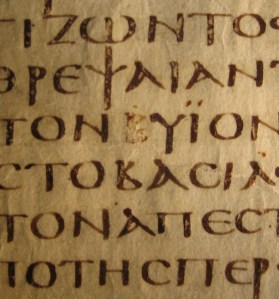
  1. from I Maccabees 6, Codex Sinaiticus. Note the faint erasure mark.
  2. from I Maccabees 6, Codex Sinaiticus. Note the erasure on the third line. 

Robert Hull, professor of New Testament at Emmanuel School of Religion, has spent much of his three-decade academic career studying ancient biblical texts, how they were first written down and how they changed from copy to copy. What was added? What was deleted? Maybe most important: why?

Such work, formally known as text criticism, might seem like an obscure exercise in eggheadism, but the findings trickle down to the Bibles people read and even to what they believe.

“Studying the early texts presumably gives us a better idea of what the original text said,” Hull said as we sat in the Emmanuel library this week, looking at facsimiles of ancient Bibles. “It also gives us an insight into the early church’s handling and thinking about the texts.”

Scholars like Hull, whose doctoral work at Princeton specialized in text criticism, were given a new tool this week when a Web site was launched that presents the entire text of one of the most important ancient Bibles.

The Codex Sinaiticus – literally “the book of Sinai” – dates from about the year 350 and contains the earliest complete copy of the New Testament as well as most of the Old Testament. About 800 pages of the original 1,400 pages remain, all handwritten in Greek.

The book got its name from its earliest home, the Orthodox monastery of St. Catherine’s, at the base of Mount Sinai in Egypt. The manuscript came to the world’s attention 150 years ago when a Russian scholar named Constantine Tischendorf obtained pages from the monastery and had them published. While some pages remained in the monastery, most eventually landed at institutions in Russia, Germany and England.

So until now, scholars wanting to study the text had to undertake long and difficult travels, perhaps to all four locations and with no way to directly compare passages housed in different countries.

But in 2005, the four institutions agreed to put the entire text online, digitally reuniting the book. That project was unveiled last week (www.codex-sinaiticus.net/en/).

A Codex Sinaiticus manuscript displayed at the British Library in 2007.

The site not only includes detailed photos of the pages, but transcriptions of the text, translations into four languages, including English, a search engine, and even different types of lighting, which allows viewers see page textures, faint notations or flaws – all hints about the history of the text.

The site is a boon to scholars, letting them see details they may have missed before, if they ever had a chance to see them at all.

“Remember that until now, when someone looked at a lot of these pages, they were limited to using natural light or candles,” Hull said. “With digitizing (Sinaiticus) on the Web, paleographers (scholars of ancient texts) possibly can confirm a reading that was dubious or challenge something we thought was established. It will give us a clue about the history of the passage.”

No absolutely original texts of the Bible, or autographs, are known to exist, only copies of copies, and just a few of them the size and scope of Sinaiticus. Many fragments are the size of a postage stamp.

While some pieces date from close to the originals, with each copy scribes could mistakenly introduce an error, or someone might add comments that worked their way into the text.

Scholars estimate that the Greek New Testament as we now have it contains about 300,000 variations. About 90 percent of them are trivial, Hull said, such as misspelled names or grammatical errors.

But that still leaves thousands of more substantial differences. Variant readings in the story of Jesus’ last supper with his disciples, for instance, can affect the theological overtones of the Christian communion service. Does it matter that the earliest copies of Revelation say the number of the mysterious beast is 616, not 666?

Is the Christian message compromised because the earliest texts of the Gospel of Mark, including Sinaiticus, end with the women who visit Jesus’ empty tomb “afraid”? (Scholars are convinced the familiar final dozen verses were added later, perhaps to harmonize with the later books of Matthew and Luke.)

Not at all, according to Hull.

“No single variation by itself would overturn Christian doctrine,” Hull said. “The Gospel of Mark still has Jesus raised from the dead.”

But studying the ancient texts – a task made immensely easier with the online Sinaiticus – can help clarify Christian history and thought, and perhaps even help believers better understand what is essential to their faith.

Johnson City (Tenn.) Press, 11 July 2009.

Worth a look: Stanley Fish on Palin and Sanford

Go ahead and insert the perfunctory “I don’t always agree with …” disclaimer, because it’s true with Stanley Fish, who regularly writes/blogs (wrogs? blites?) for the New York Times. But I find myself nodding agreeably fairly often. And today he’s posted a thoughtful piece about why Sarah Palin and Mark Sanford said what they said: Maybe they were being genuine.

What Fish is actually writing about is — to use Palin’s words — the “‘superficial political blood–sport’ politics has become,” and particularly the pundits who join in the game by speculating about every explanation except the ones offered by Palin and Sanford.

Like Fish, I didn’t vote for Palin in November. I don’t know enough about Sanford’s politics to know how I’d feel about him if I lived in South Carolina. But maybe it’s true that they’re human beings first and politicians second. You just never know.

Take a moment to read Fish’s piece.

George and Martha and Adam and Eve … and other problems with a patriotic Bible

adam_and_eve_2george-and-martha-washington_small

Thanks to a marketing video that compares George and Martha Washington to Adam and Eve, I’m trying not to think about the nation’s first First Lady walking around a garden without her petticoats.

But what really sets my teeth on edge is how the advertisement equates Jesus and his disciples with the Continental Congress as “founding fathers,” with its closing line: “Sometimes history does repeat itself.”

The ad is for the American Patriot’s Bible, released last month by Thomas Nelson, with Atlanta megachurch pastor Richard G. Lee serving as general editor. Nelson won’t disclose sales figures, but it is already preparing for a second printing of the hefty, colorful book.

AmericanPatriots_Bible8
“You will find a great volume of both information and inspiration revealing the ‘strong cord’ of the Bible’s influence that runs through the colorful fabric of our nation’s past and present,” Lee wrote in the introduction. “Joining with the sacred text are stories of American heroes, quotations from many of America’s greatest thinkers, and beautiful illustrations that present the rich heritage and tremendous future of our nation. If you love America and the Scriptures, you will treasure this Bible.”

Maybe so, but I mostly just felt annoyed. It’s not the emphasis on the role of religion in the American story, particularly a certain strain of Christianity. That’s old news.

It’s true, after all, that the majority of revolutionary leaders were Christians of some kind and many were motivated by their religious convictions, often arguing from the Bible against tyranny. There’s no question that the nation’s founders, not to mention later leaders, were shaped by their beliefs, which of course influenced their ideas and actions.

Even unorthodox deists like John Adams, Thomas Paine and Thomas Jefferson (who literally cut the miracles out of his Bible) used religious rhetoric and biblical imagery.

But then there’s the matter of what is often called civil religion, a kind of ecumenical devotion to the ideal of the United States. The nation itself becomes the object of veneration and Uncle Sam is dressed in priestly garments.

It’s a common impulse. People throughout history have considered their kingdoms on earth to be special outposts of heaven: Italy, Poland, Spain, England, France, Japan – the list goes on.

Many Americans can keep their belief in their country distinct from their religious faith. We can love the U.S., they say, and we can love God and remember the two are different.

But others forget the distinction, entwining American ideals so tightly with a Christian identity that they become confused, usually with bad results. That is the trap where the American Patriot’s Bible falls.

John Quincy Adams thought Christmas and American Independence were "indissolubly linked."

A full-page sidebar uses a story from Abraham’s life to illustrate … the right to bear arms? That seems like a stretch. John Quincy Adams is quoted saying that “in the chain of human events, the birthday of the nation is indissolubly linked with the birthday of the Savior” – and that notion isn’t challenged?

Then there’s the irritating historical revisionism that comes from leaving out uncomfortable details. Adams, Jefferson and Paine are all favorably quoted, for instance, but the details of their beliefs – or lack of beliefs – are glossed over. It would be easy to make the mistake of thinking they were Christians.

Likewise, the book frequently presents wartime sacrifice as supreme examples of Christlikeness, but ignores the significant tradition of Christian pacifism.

Then there is the two-page essay that rightly discusses how Christians led in the women’s suffrage and civil rights movements, but does not explain how other Christians opposed those rights, quoting Scripture to justify sexism, segregation and slavery.

"Declaration of Independence," by John Trumbull, 1817

Such myopia isn’t only annoying. It’s unnecessary. Honest historians know that biblical ideas (along with Greek philosophy, rationalism and other worldviews circulating in the 18th century) helped the founders craft the Declaration of Independence and the Constitution. It’s no secret that men and women of faith are among this nation’s chief architects.

We can admire leaders like George Washington and Abraham Lincoln without confusing them with Adam, Moses or Jesus (much less imagining Martha Washington as a new Eve). I can believe the U.S. fills a distinct role in the world without casting it as God’s singular chosen nation.

And today I can certainly celebrate what the nation’s founders did without believing their sacrifices repeated the history of Christ’s sacrifice. Believing that wouldn’t make me a patriot. It might only make me a heretic.

Johnson City (Tenn.) Press, 4 July 2009.