The politics of conscience and health care

I’m trying to imagine what it would be like to walk into a pharmacy with a prescription for, say, a contraceptive and be refused because the pharmacist believes contraception is morally wrong. In most areas I would be just inconvenienced because I could speak to another pharmacist or take my business elsewhere. In some places, however, I might be standing in the only drug store in town, and then what?

I’m also trying to imagine what it would be like to be a pharmacist whose faith or church teaching opposes artificial contraception – which would lead me into acting unethically if I filled that prescription. Even referring the customer to another pharmacist could be considered a disguised form of cooperation. And then what?

Last fall the Bush Administration started a process that resulted in a rule that protects health workers, particularly those who receive Medicare or Medicaid funding, if they refuse to provide treatment that goes against their consciences. The new rule took effect on Jan. 20, the day Bush left office.

Six weeks later, the new Obama administration declared its intention to reverse that rule, opening a 30-day public comment period that ended April 9. Now the Department of Health and Human Services is reviewing the comments and, come June or July, is likely to rescind the “conscience rule.”

The debate, in effect, pits the rights of patients against the rights of care providers, especially when it comes to birth control, abortion and end-of-life treatment.

“There are two schools of thought,” according to Walter Fitzgerald, adjunct professor of pharmacy practice who teaches law and ethics at the Gatton College of Pharmacy at East Tennessee State University. “One says that (providers) should not be forced to do something in conflict to their religious or personal moral values. Another says that if you are given a license by the state and in essence have sworn an oath to serve fellow man, then you don’t have the right to object any longer, because of your professional obligation.”

Opponents of the Bush rule say it limits access for care to patients. Supporters of the rule say it safeguards the freedom of conscience for doctors, nurses, pharmacists and other healthcare professionals that dates back to the Hippocratic Oath and the First Amendment.

Opponents say that laws enacted during the 1970s (soon after Roe v. Wade legalized abortion nationwide), which allow providers to refuse treatment as long as they provide information and access by other means, have worked just fine.

Supporters of the conscience rule, such as David Stevens, executive director of the Bristol-based Christian Medical and Dental Association, say those laws are toothless, opening the door to a kind of “ethical cleansing” in the medical field, aimed at practitioners who oppose abortion.

“There’s a lot of discrimination going on,” he said in a phone interview last week. A recent survey found that almost one-fourth of the CMDA’s 15,000 members said they had been “discriminated against” because of their opposition to abortion. “They’ve been fired from jobs or failed to get a promotion or weren’t able to get into an educational program,” he said.

But no lawsuits are pending, according to Stevens, because the laws don’t provide for legal action.

Tennessee, like most states, has a conscience clause, allowing health workers to refuse treatment as long as patients can get treatment elsewhere. So far, Fitzgerald said, the matter of conscience hasn’t been a problem, at least not for pharmacists. That’s not the case in some other states. In Illinois, for instance, pharmacists must dispense.

“There, it’s mandated. You don’t really have a choice,” Fitzgerald explained. “We don’t have anything nearly that strong in Tennessee.”

He isn’t sure yet how rescinding the federal rule would affect Tennessee.

“Giving information or referral is not required by law (in Tennessee), but from an ethical standpoint, that would be expected,” Fitzgerald said. “If a pharmacist refuses to dispense RU-486, someone could make an argument that it’s contrary to state Board of Pharmacy rule, especially if it’s medically necessitated or in case of rape.”

But that leaves a very complex, sometimes messy scene.

“Even if the federal law says that you have to honor freedom of choice, we have to balance that against our (professional) rules,” he said. “We don’t have a clear-cut answer.”

That pretty well sums up the whole debate.

Johnson City (Tenn.) Press, 25 April 2009.

After the tea parties

With taxation on American minds this week – what with income taxes due and the so-called tea parties protesting government spending – I looked through some old notes and came across a column from Sept. 29, 2007.

I couldn’t help noticing how the voices in this column spoke mainly about fairness and justice for poor people, not about safeguarding their own pocketbooks.

If Tennessee were ever to inaugurate an income tax, Lee Davis, a tax attorney in Johnson City, knows he’d pay more to the state than he does now.

But that prospect doesn’t bother him.

“I don’t mind paying my fair share,” he said in a phone interview. “I think our system would be better with an income tax. Too many laws are written to benefit those of great wealth.”

This is more a matter of faith than finances for Davis, who describes himself as “a lifelong Republican who believes in capitalism and free enterprise.”

A member of Central Church of Christ, Davis points to an incident in the New Testament when two very different groups tried to corner Jesus with a tax question: the Herodians, who supported the local king, a puppet of the Roman Empire, and the Pharisees, Jewish purists who thought cooperating with secular authorities meant flirting with heresy.

“Is it lawful to pay taxes to the emperor, or not?” they asked, figuring that any answer would land Jesus in trouble.

But he frustrated their trap – and confounded future commentators – with a deceptively simple reply: “Give to the emperor what is the emperor’s, and to God the things that are God’s” (Matthew 22:21).

People have tried to translate those words into good practice ever since.

But whatever Jesus meant, Tennessee’s tax system isn’t it.

“There’s a connection with all the social-justice aspects of the Old and New Testaments,” said Bill Howell, the Middle Tennessee organizer for Tennesseans for Fair Taxation, a statewide coalition for tax reform. “There’s a general preference for the poor expressed in the Bible.”

But the Tennessee tax system works exactly opposite, taking the proportionally biggest bites from its poorest citizens. At 11.7 percent, the total state tax burden on the poorest families, who earn less than $14,000 a year, is nearly four times the rate as for the wealthiest Tennesseans. This is according to a 2003 report from the Institute on Taxation and Economic Policy, a nonprofit, nonpartisan organization based in Washington, D.C.

The main culprit is the sales tax, among the highest in the nation overall and the highest for groceries (even after recent changes). A loaf of bread, for instance, costs the same whether someone earns $14,000 or $140,000, and so high-income households spend only about four percent of their budgets on groceries. Low-income households, by contrast, spend about 21 percent.

The stark bottom line: In proportion to their income, the poorest citizens get hit hardest by taxes while the richest get away easiest.

“It isn’t morally fair,” Davis said. “We have a regressive tax system.”

On many issues, Davis sits on the opposite end of the political spectrum from the Rev. Don Beisswenger of Nashville, a Presbyterian minister, retired Vanderbilt Divinity School theologian and left-leaning activist who once spent six months in federal prison for staging a nonviolent protest at an Army base.

But they agree about the inequities of the Tennessee tax system.

“The Bible strongly accents the importance of compassion and care for the poor,” Beisswenger said this week. “The Jewish law had harvesters not take all the grain from the fields, so poor people could get what was left. Jesus identified with the poor, spoke for them. I think he was killed (partly) because he advocated for the poor against the religious and economic powers.”

In his eyes, the tax debates reflect two competing “myths” in American society.

“One is the Horatio Alger myth – work hard and do your own thing,” he said, referring to the 19th-century author whose stories promoted self-reliance as the key to financial success.

The other storyline emphasizes “community connections (and) a responsibility to care for people who are unable to take care of themselves.” He believes that view is more consistent with biblical teaching.

 “Jesus said his mission was to bring good news to the poor,” Beisswenger said. “The gap between the wealthy and poor needs to be dealt with. That’s a necessary condition for the celebration of Jubilee, for the reign of God.”

Johnson City (Tenn.) Press, 18 April 2009.

Evangelicals, housing prices and pure contempt

The NY Times Economix blog posted a piece summarizing some research suggesting that evangelical Christians — a term not defined very precisely — may weather housing bubbles better than most Americans at least in part because their beliefs encourage them to avoid excessive spending and that sort of thing. You can read it here. It’s an intriguing study, surely open to debate about any economic-theological correlation. (Will anyone mention possible analogies with the old Protestant work ethic and its impact on colonial American economic growth?)

But I was struck — no, shocked is a better word — by the tone in several of the comments so far: pure, unabashed contempt served with generous portions of stereotypes and cliches. Even the commenters who raised valid questions about the  study’s conclusions  were obviously holding their noses.

Insert a long sigh of frustration here. Beyond that, no comment.

AIG meets the Golden Rule. (No, really.)

aig-logo-skyscraper

Is anyone not upset with AIG?

In case you missed it, after receiving $170 billion from the federal government to keep from collapsing, American International Group, the world’s largest insurer, paid $165 million in bonuses to 73 executives.

Whether the AIG executives were callous or just stupid, they look absolutely greedy, especially as tens of thousands of Americans are losing jobs and houses each week. This isn’t how we want our money to be used. So the president publicly scolded the company and Congress voted to tax 90 percent of big bonuses at any firm receiving more than $5 billion in bailout funds.

Bill Greer, an economics professor and vice president for institutional advancement at Milligan College (where I also teach), thinks we have good reason to be angry with AIG. Even so, he doesn’t assume that the lumbering giant is the only side of Wall Street.

“I genuinely believe that the vast majority of people who work in financial institutions are good, honest people,” Greer said this week. “I don’t think the majority are Bernie Madoff,” referring to the trader recently caught as the mastermind of the largest Ponzi-style pyramid scheme in history.

But Greer knows that, as in any profession, over time “a little bit of tunnel vision can develop.” It can happen to anyone. As the old saying goes, if you swing a hammer long enough, the whole world starts to look like a nail.

But the stakes are especially risky in the offices of high finance, where individuals and firms have their fingers on world economic triggers and they deal with other people’s money. When they stop asking too many questions and start making too many assumptions, bad decisions and big trouble won’t be far behind.

“People become numbers,” Greer said. “If I’m working at an investment firm, the fact that I may be managing hundreds of portfolios means I don’t see those faces any longer. There’s an anonymity that lets people make poor decisions with less fear of consequence.”

On the other hand, we can’t separate Wall Street and Main Street. Our decisions shape financial markets just as much as the markets shape us, and Wall Street’s problems aren’t Wall Street’s alone.

“In some ways, it has trickled out to the rest of America,” Greer said. “A lot of people on Wall Street saw an opportunity, but that same door was opened to us. We fed on each other, with our greed. We can gauge it by how little we have saved and how much we have spent over the past several years. We’ve become accustomed to having what we want, when we want it.”

But Greer, who has written and taught on business ethics, sees a silver lining.

“I think this economic downturn is forcing people to rethink their values,” he said. “Too many of us for too long lived beyond our means, did not save money, ran up large levels of consumer debt, and simply lived for today. Now there’s a sudden trend toward saving money. We’re getting our financial houses in order.”

He understands the so-called paradox of thrift – that if Americans save too much, the national economy can suffer – but he thinks it’s time for tightening belts. He’s convinced that living within our means and making money by making real, tangible products instead of trading in wispy financial deals will literally pay off in the long run.

He also thinks it’s time to bring back other ideals – on Main Street as well as Wall Street.

“I’m speaking as someone who teaches at a Christian college, but Christian or not, honesty and integrity are universal values,” he said. “What we do for people ought to be driven by care and compassion for individuals. That would make better decisions.”

He points to Adam Smith, who wrote The Wealth of Nations, the 18th-century book that laid the theoretical foundation for free-market capitalism. Smith realized that a free-market economy is driven by self interest, but he also knew the market works only when we also have the interests of others in mind.

“Somehow, we need to embrace more and more the fact we make decisions every day that affect other people,” Greer said. “In a lot of ways, the Golden Rule applies very well to the free-market economic system. Treat others as you want to be treated. You go out of business if you don’t.”

Johnson City (Tenn.) Press, 21 March 2009.

Prayer, politics and those pesky hot-button issues

Rep. Phil Roe (R-TN1)

Phil Roe enjoys his new job. The U.S. Representative from Tennessee’s First District, a retired physician, wanted to join the debates in Washington over health care, and here he is. And if politics were baseball, he just moved to the major leagues.

But Thursdays are good days because that’s when he gets out of the Capitol Hill routine. In the evenings he usually flies home to Johnson City for the weekend. Before that, in the mornings, he joins other House members for an hour-long nonpartisan prayer breakfast.

“We all check our politics at the door,” Roe said during a phone conversation this week. “I really try to guard that time. We meet and get our week straightened out.”

Roe came away inspired from last month’s National Prayer Breakfast. President Obama spoke, but Roe was most impressed by former British Prime Minister Tony Blair, who converted to Roman Catholicism soon after leaving office in 2007.

“I had never heard him share his faith,” Roe said. “That was the best event I’ve attended (in Washington) so far. I left with my jaw hanging down.”

While his own faith is important — he and his wife, Pam, are members of Munsey Memorial United Methodist Church — Roe favors the language of “values” and “morals” when discussing his work in Congress, perhaps sensing that too much religious vocabulary is easily misunderstood or potentially divisive.

In political office, “you rely on the values you grew up with, (such as) just telling the truth,” he said. “You look at that in the totality of your lifetime.”

But it seems inevitable that such conversations will turn to hot-button topics such as abortion, which Roe adamantly opposes. That issue marked one of his first big Beltway moments.

He delivered a brief anti-abortion speech in the House on Jan. 21, the day between the presidential inauguration and the anniversary of Roe v. Wade, the 1973 Supreme Court decision legalizing abortion. Afterwards, he was asked to “say a few words to a group of people” the following day. Expecting a relatively small gathering, he found himself addressing more than 200,000 people in the National Mall for the annual pro-life rally.

As an ob-gyn specialist Dr. Roe delivered thousands of babies, and he would like to see abortion debated and put to an up-or-down vote in Congress, but doubts that will happen in the wake of Supreme Court decisions.

He was troubled by last week’s order by President Obama to lift former President Bush’s ban on federal funding for embryonic stem-cell research. Roe considers the research unnecessary and the surrounding political drama a distraction. He chooses his words carefully.

“A human embryo is how life begins, and that comes back to one of those core basic values: Do you consider this a human life or not?” he said. “That’s an argument that personally took it off the table for me. Where do you stop on the slippery slope?”

Obama set limits when he signed the federal funding order – prohibiting cloning embryos, for example – but Roe still thinks the president needlessly re-opened a door.

“To show you how creative people are, all the great breakthroughs have occurred with adult or umbilical-cord stem cells,” he said. “Science came right along and made breakthroughs. People feel strongly about the issue, and we didn’t need this.”

Given the current economic crisis and his own conservative politics, it’s no surprise that Roe talks about taxes and government spending in moral terms. He calls his belief in “smaller, leaner, more accountable government” one of his core values. (“My head is spinning with all the spending that goes on here.”)

A member of the House Veteran Affairs Committee, he considers it “a moral obligation to take care of the people who make us free.” Low taxes, he said, attract businesses to the state, which ultimately provide new jobs that can help people get out of poverty. And “the worst thing you can do” to people living on a fixed incomes – including the growing numbers of retirees in Northeast Tennessee – is to raise their taxes.

“I can’t do that to them,” he said. “When I was practicing medicine, I knew people who watched their spouses die and struggle to make payments. I would get afghans and apple butter. I have to look these people in the eye.”

Johnson City Press, 14 March 2009.

Squeezed: Ministries may need to do more with less money

foodpantryopen-webFreddi Birdwell’s wake-up call to the new economy came partly in the form of a young single mother at a transitional housing program in Knoxville run by the Catholic Charities of East Tennessee.
The woman and her young child had fled an abusive home, and she was trying to get on her feet, training for a new job and learning to run a household. She was in the final six months of a two-year program.

“She had a job and was doing great,” Birdwell recalled last week. “Then she was laid off and now she can’t find another job. I can only imagine the stress of that, with a child to take care of. We make sure she’s getting food on the table … just trying to Band-Aid it until we can help her with a more permanent solution.”

Stories like this have grown familiar in the past 12 to 18 months, said Birdwell, the community relations and development director for CCET, which is based in Knoxville but has offices in Chattanooga and Jonesborough.

As Northeast Tennessee feels more of the global economic downturn, people who normally walk on financial tightropes are falling into full-blown crisis, and others who were getting by are starting to stagger.

“We’ve absolutely seen a steady increase in the number of individuals and families who face some kind of housing crisis, who are homeless, who need assistance with utilities or food,” Birdwell said. “It was a slow increase for a while, but now that’s starting to pick up.”

Churches, faith-based groups and other charities are scrambling to keep up with the needs. CCET helped more than 17,000 people in the past year, about 15 percent more than the previous year.

“A lot of the people who’ve historically helped are on the edge themselves,” Birdwell said. “People who donated items to our thrift stores and pantries (in the past) now are coming to our stores. They’re one crisis, one job loss, one illness from putting them over the edge.”

Doug Miller, director of missions and media at Munsey Memorial United Methodist Church in downtown Johnson City, sees a similar trend.

“What we’re finding in the last eight to 12 months is that those on the (brink) of poverty are slipping over, and those already in the poverty level are losing the grip they had,” Miller said. “People who were not homeless before are living in their cars now.”

Munsey provides space for the Melting Pot, a ministry of Good Samaritan Ministries that offers free meals to people in need. The number of meals served has mushroomed in the last year, Miller said, from about 150 people per day at the end of the month to more than 200, a 33 percent increase. (More people come at month’s end, presumably when wages or benefits are running low.) Munsey’s own Wednesday-night dinners also attract more people now.

“We’re seeing people who normally don’t come,” Miller said. “A lot have jobs, but if they can get one more meal per week paid for – that’s another $5 or $6. That will pay for gas to get them to work for a week.”

The economic stresses are starting to show in other ways. CCET workers at shelters in Knoxville are reporting more incidents of child and elder abuse and neglect. Birdwell blames the financial uncertainty.

“It’s an on-the-edge kind of thing,” she said, “causing people such stress that they take it out on those around them.”

Despite such accounts, Birdwell and Miller sound optimistic. Miller said the number of volunteers at Munsey and the congregation’s donations for “compassion ministries,” which has expenses as high as $50,000 per year, are holding steady.

Birdwell reported that the CCET fundraising campaign during the last holiday season was more successful than the previous year. CCET operates 22 programs with an annual budget of almost $5 million, supplied by gifts from individuals and organizations, funding from the East Tennessee Diocese and government grants.

But churches, charities and other organizations that offer a safety net to people in need know they face a tough dilemma: The same conditions that make their services more crucial are hitting donors’ wallets too. No one knows how hard the economy will bite into giving, and these ministries may soon be trying to provide more while receiving less.

“We may not want to think about (more poverty),” Miller said, “but we can’t ignore it.”

 (Johnson City, Tenn., Press, 7 March 2009)

Entering Lent, secular and sacred

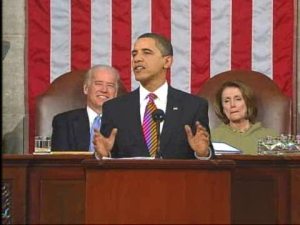
It was a just a coincidence that President Obama delivered his not-State-of-the-Union speech on Mardi Gras. Probably.
It was a just a coincidence that President Obama delivered his not-State-of-the-Union speech on Mardi Gras. Probably

All eyes were on Washington this week, when President Barack Obama spoke before Congress, mainly about the economy.

Surely it was a coincidence that his speech fell on Mardi Gras. I doubt the president scheduled the event with the Christian calendar in mind. Even so, the timing seems appropriate.

Our collective financial Mardi Gras is over. Now it’s time for some discipline. Figuratively speaking, the nation has entered a kind of secular Lenten season.

This is not necessarily a bad thing. Now and then we need to be reminded that it’s not healthy to always get what we want, when we want it. Grown-ups understand the joys of delayed gratification.

The actual Mardi Gras, “Fat Tuesday,” is the day before Ash Wednesday, the start of that 40-day season of fasting known as Lent. Mardi Gras originated as a practical ritual of cleaning out cupboards before fasting began but, human nature being what it is, the day evolved into an excuse for a blow-out party. People are funny that way.

Ash Wednesday was established 15 centuries ago by Pope Gregory the Great. As repentant believers entered the cathedral, he would mark their foreheads with ashes and remind them of the biblical symbol of repentance, sackcloth and ashes, and of their mortality, quoting the book of Genesis: “You are dust, and to dust you will return.”

Irony is at work here. While Christians have their foreheads ritually smeared with soot, they might recall these words from Jesus himself: “When you fast, do not look dismal, like the hypocrites, for they disfigure their faces that their fasting may be seen by men. … But when you fast, anoint your head and wash your face, that your fasting may not be seen by men but by your Father who is in secret” (Matthew 6:16-18).

That’s why many Christians refuse to observe Ash Wednesday.

Someone must know a good explanation for a church practice that apparently flies in the face of Jesus’ teaching. I heard one minister explain it by saying the act is itself a reminder to Christians that they are imperfect even when they try to obey Christ. We’re laughing at ourselves, he said.

As with many other practices, not all Christians observe Lent or do so in the same way. It’s more common among the mainline denominations, such as the Roman Catholic, Episcopal and Lutheran churches. But it’s an ancient Christian tradition, dating back at least to the second century.

Specific practices have changed over the centuries, but the purpose has remained constant: self-examination and repentance for sins, expressed by self-denial and other disciplines. It leads to Easter, so Lent also carries a strong sense of preparation and anticipation. (Lent began this week in the Western church calendar; the Eastern Orthodox season starts next week.)

The name, by the way, is derived from the same word as “lengthen” – that is, Lent comes when the days are getting longer. (Now there’s a good idea. If people want to change their lives, they probably stand a better chance when days grow brighter and warmer than in the depressing dead of winter, on New Year’s Day.)

The 40-day period recalls the length of Jesus’ temptations in the wilderness, but the number is associated with other dramatic (and traumatic) biblical events, such as the 40 days and nights of rain during Noah’s flood and 40 years of Israel’s wandering in the wilderness.

But Lent is not about punishment. It’s about discipline, about the shaping of souls. It is about facing up to the ways we’ve gone off track and doing what we can to recover what we’ve lost or repair what we’ve damaged. It’s about reflecting on what is really important and lasting.

In a word, observing Lent is about turning and returning to God.

And it’s about anticipation, knowing that self-discipline and sacrifice today can make tomorrow that much sweeter. Again, the joys of delayed gratification. Lent leads to Easter.

(Johnson City, Tenn., Press, 28 Feb 2009)