Rumors that just won’t die

Zombies_Ahead_610x479The rumors still sound ominous.

Atheists, inspired by the now-deceased Madalyn Murray O’Hair, are pushing the Federal Communications Commission to ban all religious broadcasting. If this request – petition RM-2493 – succeeds, then we can say good-bye to church services on the radio, televangelists and all religious programming.

If you want an example of what might happen, consider the fate of that popular CBS-TV series, “Touched by an Angel.” It was taken off the air because it mentioned God in every episode.

Christians can stop the atheists, however, by adding their names to a petition that would force the FCC to keep its big government paws off their broadcasts. The goal is to collect one million names. James Dobson of Focus on the Family endorses this effort to stop RM-2493.

But wait, there’s more!

Redesigned dollar coins and Lincoln pennies omit the words “In God We Trust”!

Jesus will be portrayed as a homosexual in an upcoming film!

Steak ‘N’ Shake restaurants won’t allow its customers to pray in public!

And of course, Barack Obama is secretly a Muslim!

One problem: Not one of these rumors is true. Not one.

According to Snopes.com, one of several Web sites devoted to researching and unraveling rumors and so-called urban legends, more than 40 religion-based rumors are currently blowing around cyberspace. Only a handful of them, however, are emphatically true. The vast majority are bogus in whole or part.

That FCC rumor about removing religious broadcasting? Various versions have circulated for more than 30 years, by chain letter before the days of Internet. It started after two men filed a petition, the infamous RM-2493, asking the FCC to investigate the operating practices of stations licensed to religious organizations and not to grant new licenses for new noncommercial educational broadcast stations until the investigation was complete.

The FCC denied their petition in 1975. O’Hair had nothing to do with it, but her name got attached because she was then America’s most famous atheist.

But the story just won’t die. The FCC still gets mail and phone calls.

 “Such rumors are false,” the FCC Web site bluntly states. “The FCC has responded to numerous inquiries about these rumors and advised the public of their falsehood. There is no federal law that gives the FCC the authority to prohibit radio and television stations from broadcasting religious programs.”

For their part, Dobson and Focus on the Family have never been involved in any controversy over RM-2493, except for efforts to distance themselves from it.

The “Touched by an Angel” Web site also set the record straight in 2001, just after it was renewed for a seventh season: “A chain email has been floating around the internet and our message board stating that the FCC is forcing CBS to take ‘Touched By An Angel’ off the air because we mention the word ‘God. … This is a new variation of an old hoax. If you are a recipient of this email, please ignore it.”

The series ran a total of nine seasons, a long and successful lifespan for any program, and the scripts mentioned God from the first episode. The show ended for the same reason most do: it no longer appealed to the audience advertisers wanted.

Ironically, the same Internet that makes it so easy to spread rumors makes the truth more accessible than ever. Viewers can check out sources directly, such as the FCC, or locate information on sites such as Snopes and About.com: Urban Legends.

That being the case, then why do such stories persist, some for decades? Why don’t people check for themselves?

Maybe they don’t know how. Maybe the stories confirm what we already believe or what we want to be true. Maybe it’s a reaction of fear and insecurity, prompts for people who feel threatened by the world around them.

Whatever.

For now, let’s just take the pledge to check the facts and find the truth before we risk passing along a lie.

Johnson City (Tenn.) Press, 2 May 2009. (This column is an updated version of one that was published on April 29, 2006.)

Image: i-hacked.com. (http://news.cnet.com).

What’s next? Give up blogging for Lent?

In case you missed, the Vatican has urged Roman Catholics to give up high-tech for Lent. Call it a digital fast.

So if most Catholics follow this lead, and the Roman Catholic is the largest single denomination in the world and in the U.S., what would be the cultural and economic impact? And we can only speculate what kind of church-state tensions may surface among elected officials who happen to be Roman Catholic. If they follow the Vatican’s lead, their constituents may be out of touch in today’s environment.

But seriously, folks, there’s a serious point being made here. As the Associated Press story reports:

The Church is trying to balance an increasing appreciation of modern communication with a wariness of new media.

In January, the Vatican launched its own YouTube channel, with Pope Benedict XVI welcoming viewers to this ”great family that knows no borders.”

Benedict praised social networking sites such as Facebook and MySpace for forging friendships and understanding, but cautioned that online networking could isolate people from real social interaction.

The pope has also warned about what he has called the tendency of entertainment media to trivialize sex and promote violence.

It’s comforting to know the Vatican takes seriously the relationships and implications that rise with the varieties of digital media. If a 40-day fast from high-tech gadgets can jumpstart that conversation among believers, then so be it.

Rocky Mountain News closes, digital train rolls on

rmn-finalfrontpage_t600

Yesterday saw the last day for the Rocky Mountain News, which published in Denver for 150 years (149 years, 311 days to be precise). I wasn’t very familar with the paper except for the three years our family lived in Colorado Springs, but I know it as a unique and lively paper that built a solid reputation (multiple Pulitzer Prizes in the last decade) and enjoyed a colorful history, to put it mildly. It’s a paper that people will miss, and we should.

This is the latest casualty in the newspaper revolution, but it won’t be the last. More than 15,000 newspaper jobs were lost around the country in 2008. Denver is now a one-paper town (the Post survives), and other major cities have faced or are facing (San Francisco, Seattle) the same prospect. But the demise of the RMN seems to have struck a deep nerve among those who pay attention to the news business.

Visit the RMN site to read and view the coverage of its own death. Watch the online video on the front page. It’s a 21-minute primer on the current upheaval in the news business, focused through the story of the RMN’s final months. Slightly self-serving, maybe, but when someone’s going down for the last time, we can cut some slack. Mostly, the video presents an informative and sometimes poignant story.

Coincidentally (or not), Hearst Publishing announced on the same day that it’s developing a digital reader for periodicals — like Amazon’s Kindle device, but for magazines instead of books. Note how this particular digital train is moving from less periodicity to more: books … magazines … next stop: newspapers?

What movies can do

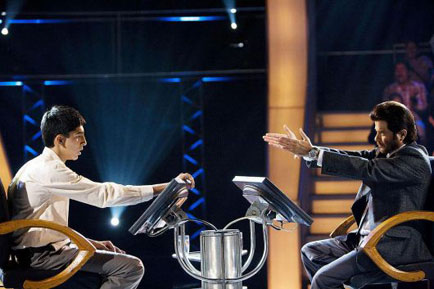
Jamal (Dev Patel, left) rises
Slumdog Jamal (Dev Patel, left) rises


Five years ago the big news in movies was The Passion of the Christ, Mel Gibson’s ambitious, gory, controversial and hugely successful portrayal of Jesus’ last 12 hours before his crucifixion. That project was the talk of the town.

Gibson has since slipped off the movie-business radar. His next project after Passion was Apocalypto, an ambitious, gory, controversial and mildly successful portrayal of the passing of ancient South America. After that? Not a lot.

 The Passion of the Christ has followed the typical movie route into DVD rentals, except that some churches, in the weeks before Easter, pull their copy off the library shelf for special showings. But the bold predictions when it first appeared – dire warnings of how the film would fuel anti-Semitism with its portrayal of Jewish complicity in Jesus’ execution, as well as glowing promises among some Christians that the movie would lead people to embrace their faith – did not come to pass.

Is there a lesson here? Maybe just that while well-made movies can move us to think or prompt us to talk about the most important issues in our lives, by themselves they don’t have the power to convert individuals or shift society. Mass media are powerful but not all powerful.

The story line and expectations aren’t so grand for this year’s leading contenders for Best Picture award, The Curious Case of Benjamin Button and Slumdog Millionaire. Yet, these fables have still set people talking about Big Questions.

Button is the sprawling epic of a New Orleans man born with an old man’s body who ages backwards. As his body “youthens” and his mind (and spirit?) matures, we follow his life through his adventures, some of them literally sea-going, and his one great love.

Slumdog follows Jamal Malik (Dev Patel), a barely educated chai wallah, or tea server, at a customer service call center who has a shot at winning the grand jackpot on the Indian version of “Who Wants to be a Millionaire?” Through flashbacks, we discover that he can answer the questions because of his harrowing upbringing in the Mumbai slums.

They are very different movies, of course: set on different continents, in different times, with entirely different approaches to the storytelling. But they also share much. At their core they are touching love stories, portraying relationships in which “love endures all things,” to use a biblical phrase.

Both also deal with the role of fate or destiny, but their answers are sharply different and surprising.

Benjamin Button (Brad Pitt) youthens

The destiny of Benjamin Button (Brad Pitt) is sealed by a biological quirk, and a clock is literally ticking in this story. We watch to see what Mr. Button does with his time. Despite happy interludes, high adventure and passionate love, his story turns out to be ultimately tragic.

By contrast, Slumdog Millionaire is a story of choices and possibilities, even though Jamal’s destiny seems to be written from the start. Despite the squalor, heartache and brutality played out on the screen, this movie is actually a comedy in the classic sense. As a few reviewers have noted, underneath the skin of this Bollywood-inspired tale beats the heart of a classic rags-to-riches, feel-good – some say, American Hollywood – story.

Here’s the paradox: Who would have expected that the movie set in bright, exciting 20th century America would turn out to be the sadder story in the end? Slumdog Millionaire hits the moviegoer from the first scene with searing pain and seemingly endless despair. Modern India’s tensions serve both as backdrop and as focal point. The contrast between terrible poverty and unimaginable wealth is only the start. (It’s no accident that the main characters are Muslims making their way in a Hindu-dominated society.)

Yet it is Slumdog that ends with triumph, optimism and a very cool dance number. In fact, that joyful release at the end (memories of college dredge up the word “catharsis”) wouldn’t feel nearly as powerful or even make sense without the high-stakes story of loss and struggle that came before. Tears stay for a time, the movie says, but joy comes in the morning.

A trip to the multiplex probably isn’t going change anyone’s life, but as far as movies go, that’s not a bad idea to walk out with. It’s worth an eight-buck ticket.

This week I’m working on …

smillionaire

… a column just in time for the Academy Awards. I’m playing with the idea of fate, particularly as that notion is portrayed in two of the leading Best Picture contenders: Slumdog Millionaire and The Curious Case of Benjamin Button.

Both are modern fables, both deal with Big Topics, including fate or destiny. There’s the interesting contrast, too, that comes from one being set in 20th century Western culture and the other in early 21st century Indian (Eastern) culture. Religion isn’t explicit, but it’s there in the cultural backgrounds, especially with SM. (What my friend Terry Mattingly calls a religion “ghost” in what seems to be a nonreligious story.)

Any thoughts?

Multimedia gets religion … or vice versa: A Poynter-eye view

Imagine a pair of American teenage girls talking about what to wear on their first day in high school. Nothing unusual there, except they are Muslims and are debating whether to wear traditional head coverings.


Or maybe it’s another group of teens from various religious groups who are on the brink of rejecting their family’s faith.


Or a middle-aged minister struggling over his disagreement with his denomination’s official stance about abortion. Or a priest who must announce to church members next week that the denomination is closing their small, tight-knit parish.


Now imagine watching any of these scenes through a camera lens.


Those kinds of stories – high in human interest and rich in meaning – seem tailor-made for the quickly evolving media mix appearing every day on the Internet as text, video, sound, graphics and photographs.


So says Kelly McBride, leader of the Ethics Group at the Poynter Institute for Media Studies, a school for journalists based in St. Petersburg, Fla.


“I can see kick-ass religion stories using multimedia tools,” McBride told me on Wednesday. “Religion as a topic should fare well if someone leads the way.”


I was attending a Poynter seminar designed to help college educators use and teach multimedia journalism more effectively, and that gave me an opportunity to sit down with McBride and talk about the connection of multimedia and religion reporting.


McBride, who covered religion for eight years before joining the Poynter faculty, thinks the new technology allows journalists to add layers of understanding to complex issues since it can present both compelling human stories and immense amounts of information and data.


“For instance, in a trend story, good storytelling will find people who play out the issues,” she explained. “A journalist could highlight theologies in different denominations or tell the tale of someone who is gay and Christian. A journalist can look for people at varying points of their journeys.”


A reporter can then use computer-based tools, she said, to produce dynamic images that illustrate a trend’s regional impact, for example, or create a data map to track, say, changing seminary enrollment.


But she rarely sees such in-depth coverage on the religion beat. One reason is money. Reporting is expensive work, and newsrooms around the nation are trimming (sometimes slashing) budgets and reporting staffs, and religion is often first to the chopping block. Even the Dallas Morning News, which produced what many observers considered the nation’s best religion news section, carved its treatment to the bone last year.


 “Newspapers can’t even cover the school board,” McBride said, “and religion is the low man on the totem pole.”


But tough financial decisions, McBride said, are made easier by readers’ lack of interest in religion as a news topic.


“I don’t hear anyone complaining anymore about lack of religion in the news or about the media who don’t understand religion,” she said. “For instance, religion was one of the subtexts of the election, covered badly and sporadically, but very few people complained.”


Some specialists keep their eyes on mainstream media’s religion coverage, such as the Get Religion Web site and a new book critiquing religion news, “Blind Spot: When Journalists Don’t Get Religion” (Oxford, 2008). But McBride thinks they are the exception.


 “Nobody seems to care anymore,” she said. “I don’t know if that’s because so many newspapers can’t do it, but religion is not clearing the expectation bar.”


 Just a decade ago audiences wanted robust religion coverage. What happened?


“Clearly an engine in the 1990s was the sense that people of faith felt alienated from the mainstream,” McBride said. “But as a society we got over that. I don’t believe they feel alienated, not more than 30 percent of the population. Now anyone can find a forum and can be heard.”


But a more immediate problem, she said, is that religion stories can be … well, boring.


“No one reads them,” she said. “Text can allow you to get away with a lame story. Not every story is worth telling.”


That’s where multimedia comes in, since it requires telling a real story to work well. Few readers will thrill to policy reports or announcements, but most will attend to the narrative of a person’s life.


“Religion lends itself to multimedia,” McBride said. “But you can’t sit at the desk and talk to wonks all day. You have to ask, ‘What does our audience want?’ They have so many choices. It’s a brutal reality for editors to deal with.”


First published 14 Feb 2009 in the Johnson City Press.