Leaping from tall poles in a single bound and other tales of Christian camp

superman-shieldThis week in a cove near Elizabethton, Tenn., some kid is going to jump off a 30-foot utility pole and live to tell about it.

No need to be alarmed. It’s a safety-harnessed gut check for youngsters (and the occasional adult). They put on a safety helmet, tie on a harness with an assistant holding the other end of the rope, and climb to the top of the pole. As they stand there, teetering, a trapeze bar hangs about six feet away.

The goal is simple: To launch themselves into the air and grab the bar. The hard part, the first time, comes just before jumping. Will the rope hold? Will the guy holding the rope do his job? Will I look stupid if I miss the bar? The answer to all is yes.

LeapOfFaithWeb
The leap of faith (but this one isn't at Doe River Gorge)

But why do it? The name of the activity offers a clue: the Leap of Faith. It’s one of the outdoorsy and out-of-the-ordinary activities featured at Doe River Gorge, a Christian ministry center.

“Our goal is to bring young people to maturity in their character, in their skills, in their understanding of God,” according to Director Terry Maughon. “We get kids who come for fun and adventure, but we want to expose them to Christ in a positive way, and we gear our programming to that.”

That kind of mission is shared by at least 10 Christian camping and conference centers within a 50-mile radius of Johnson City and hundreds more nationwide. The Christian Camp and Conference Association claims about 1,000 member facilities. (There are also about 300 Jewish camps, a dozen Muslim camps and a handful of other religious camps nationwide.)

Camps have changed from their heyday in the 1950s, ‘60s and ‘70s, when they were rustic and simple in every respect, from sleeping quarters (bunk beds in barracks-like dorms) to food (hot dogs and Tater Tots were typical) to programming (Bible classes, chapel, swimming and softball). These days, a camper is likely to find air-conditioned housing, salad bars, and options like high ropes challenge courses and wilderness expeditions.

“People want the experience of the woods, but require more stuff for that to happen,” said Jason Onks, executive director of Buffalo Mountain Camp and Retreat Center. It’s a challenge, he said, “to balance meeting those needs but not take away the experience of being outside. It’s partly the result of changes in expectations from campers, but mostly from parents.”

Faced with a different culture and shifting expectations, camps and conference centers need to be more creative than ever, said Mike Staires, director of communications and marketing services at the Christian Camp and Conference Association. While some facilities are thriving, average nationwide attendance is shrinking. CCCA members report about 6.5 million participants every year, down from 8 million earlier this decade.

Ramsey5
Ramsey Falls, at Buffalo Mountain Camp. Photo by Mark Peacock.

The campers themselves are changing too. More kids than ever grow up around cities, live with electronics and participate in organized activities, and so fewer feel at ease living close to nature. (“Our staff jokes about kids having ‘nature deficit disorder,’” Onks said.) Camp leaders see more spiritual diversity too.

 “Most kids who came 20 or 30 years ago didn’t question the Bible,” according to Brett Forney, promotions and development director at Appalachian Christian Camp in Unicoi. “But for the generation now, that’s not the thing. We’re not assuming they believe. A good number don’t go to church. Their parents just want them out of the house, and Christian camp is a safe, relatively economical option. So we’re getting back to basics, including more evangelistic aspects with some of them.”

Even so, she and other camp leaders say the constants of the camp setting make a unique impact on children and teens. It’s not about air conditioning or water slides.

“Kids may come the first time because of the toys,” Staires said, “but when they leave they say the most important part was talking with their counselors, meeting friends – those relational kinds of things.”

Camp provides a kind of “greenhouse environment,” he said. “Kids are in the Bible, having some quiet time, playing hard, spending the day together, not distracted by TV. But through the heat and exhaustion they are pushed together, faced with how to figure out how God fits in all this. They’re able to stop and think. It’s like someone pushes a pause button.”

Except when they jump off a very tall pole.

Johnson City (Tenn.) Press, 27 June 2009.

Southern Baptists in Louisville: Listening for a call. Maybe.

ear_guards_ear_plugs_33691Earplugs are available at the Believers Church, in case the band plays too loud.
The seven-year-old congregation, which attracts about 150 worshippers weekly, meets in a rented building, a former gymnastics studio at 213 E. Springbrook Drive, using an intentionally broad-brush name.

At first glance, you’d never guess this is a Southern Baptist congregation. That’s by design, according to Lead Pastor Mike Friday.

“We’re not running from who we are, but at the same time, Southern Baptists are not all the same,” he said in a phone conversation this week. “We don’t push the denomination. We push Jesus.”

He insisted that it doesn’t take long for visitors to discover the Southern Baptist connection, and he discusses it in the required membership class. But while he values the cooperation of the denomination, his time is limited, with him being the one full-time staff member.

“It’s not a lack of interest (in the denomination) as such,” he said, “but it’s hard to give that time.”

Even so, when Friday and his wife launched the church in 2002, they gave it a name and took an approach to ministry that would fly under the radar of people who may have been soured on church in the past. The phrase “Southern Baptist” is nowhere to be found on any of the church’s signs or on its Web site.

“There have been a lot of people hurt in the past from various denominations, unintentionally,” he explained. “We wanted to take out that hurdle for someone looking to get back in.”

The church has been growing, he said, with new members joining regularly since moving to its new location last November. That fact alone makes the Believers Church unusual among the 42,000 Southern Baptist congregations in the U.S.

Membership is shrinking in the nation’s largest Protestant denomination, which claims more than 16 million members. The number of baptisms has sunk to a 20-year low. Giving is down. More than a few leaders wonder about the overall health of the SBC.

Danny Akin, president of Southeastern Baptist Theological Seminary, recently wrote that Southern Baptists “are fractured and factionalizing. … We have tragically devolved into ‘a giant movement now in decline,’” quoting a professor at his school.

These concerns will be high on the agenda next week during the annual denominational meeting, the literal Southern Baptist Convention, when thousands of SBC leaders and “messengers,” delegates from congregations, area associations and state conventions, gather in Louisville, Ky.

In advance of the convention, Johnny Hunt, a pastor from Woodstock, Ga., who is completing his first one-year term as SBC president, published a 10-point declaration titled “Great Commission Resurgence” in April. (The title refers to the last words of Jesus in the Gospel of Matthew, directing his followers to “go into all the world, making disciples.”)

The document mostly reaffirms historic Southern Baptist beliefs and values, particularly their concern for evangelism. But it also addresses some thorny issues, such as the denomination’s racist past. Hunt would like to see the convention vote to adopt the document next week and set up a task force to study how to implement it. So far, more than 3,700 church members, including seminary presidents and past SBC presidents, have signed in support.

But one section, which calls for an examination of the structure and workings of the denomination “at every level,” set off alarm bells among other leaders. Some read it as an implied but unjust criticism of state conventions and other organizations. Others wonder if it opens the door to merging two of the SBC’s most important institutions, the North American Mission Board and the International Mission Board.

In a rare moment of public disagreement among top denominational leaders, Morris Chapman, president of the SBC executive committee, issued a statement to explain why he opposes the resolution as long as it contains the offending section, calling it “distracting” and “divisive.”

Mike Friday of the Believers Church certainly cares about the outcome of the convention. He’s served in Southern Baptist churches more than half his 46 years. He has paid attention, as best he can, to the discussions surrounding the Great Commission Resurgence, which could steer the denomination for a generation.

But he also has a congregation to lead, with studies and sermons to prepare and people to visit. Vacation Bible School starts on Monday. And no doubt someone will need to check the supply of earplugs.

Johnson City (Tenn.) Press, 20 June 2009.

Jesus wept, and so can we

By the time Alan Wolfelt was 15, his best friend and two of his grandparents had died. He remembers hearing familiar advice about coping with loss: You’ll get over it. Time heals all wounds. Keep your chin up.

But the conventional wisdom didn’t help.

“What people were saying just didn’t make much sense,” he said in a phone interview this week.

By age 16, Wolfelt had written a mission statement for his life: to launch a center to help people deal with loss, a place where they could learn to mourn. Out of his wounds, he said, he found his calling.

Wolfelt, now 54, fulfilled his adolescent vision, earning a doctoral degree as a clinical psychologist and then opening the Center for Loss and Life Transition in 1983. He’s written at least two dozen books about bereavement and grieving. Besides the counseling and teaching he offers at his center in Colorado, he spends up to 75 days a year presenting workshops and seminars across North America.

He comes to Johnson City next week (16-17 June 2009) for two sessions at the Millennium Center, hosted by Tetrick Funeral Services. Tuesday night’s seminar, “Understanding Your Grief: Touchstones for Hope and Healing,” is designed for anyone facing bereavement or caring for those who do. A workshop for caregivers, “The Art of ‘Companioning’ the Mourner,” will be held Wednesday.

Some fundamental facts about grief are easily missed – or dismissed – in our “mourning-avoidance culture,” according to Wolfelt.

For one, the loss of a loved one, particularly a close family member or friend, is a transitional event: there’s no going back. A significant loss takes us to a “new normal.”

“So well-meaning clichés about ‘getting over it’ aren’t that helpful,” he said. “It’s not about resolution or ‘getting back to normal.’ It’s about reconciliation … integrating the new reality with our lives.”

Grieving and mourning are essential parts of that process.

“If we give and receive love, it’s natural to grieve,” Wolfelt said. “It sounds corny, but it’s true: you have to feel it to heal it. When you have a loss, you can’t avoid grief. You have to go through it.”

Mourning, which he defines simply as “grieving made public,” is also an instinctive response, a need to tell and listen to the stories and share in other ways about the people we’ve lost. He goes so far as to say it is impossible for anyone to mourn alone.

Central to Wolfelt’s work is the idea that we need companions to help us grieve. He’s even coined a verb, “companioning,” to describe the task.

“My role as a fellow human being is to help someone feel safe enough to be open in their mourning,” he said. “I can create conditions to help the mourner” by listening, by simply sitting with a grieving person – in short, by acting as a friend rather than a therapist “trying to drag them back to their old normal.”

While his work is not specifically religious, Wolfelt calls grief an inherently spiritual journey, one that forces even the most secular person to ask profound questions about the meaning of life, or about why one person gets cancer and another doesn’t, or about the nature of God.

Wolfelt said he has integrated his clinical expertise and an interest in Eastern philosophy with his Methodist faith to shape his ideas about death and mourning.

People who are spiritual or religious need to “guard against the idea that we don’t need to mourn, or that to do so shows a lack of faith,” he said. “You can have profound faith but still miss the person. But I see a number of people who are shaming themselves” because they think they shouldn’t be sad.

As he pointed out, Jesus himself wept over the death of a friend.

Grief forces hard questions, and Wolfelt encourages them.

“We all have a world view, and then loss flips your world upside down,” he said. “Now you’re faced with questions, some directed at God.”

A good companion, according to Wolfelt, allows mourners to ask the hard questions and search for meaning in the loss.

“If you say ‘Don’t ask why,’ you’re inhibiting one of the instinctive needs to find meaning,” he said. “The very nature of grief leads to searching. But those who do not search, do not find.”

 Johnson City (Tenn.) Press, 13 June 2009.

The mixed history of Cherokees and Christians

Tobacco was a sacrament in the old Cherokee religion, the smoke a messenger carrying prayers to the spirit world.

Wine is part of a sacrament in the Christian tradition, signifying the blood of Jesus.

Dr. R. Michael Abram sees a rich irony here. Abram and his wife, Susan, are the owners and curators of the Cherokee Heritage Museum and Gallery in Cherokee, N.C. He is a keynote speaker at the Native American Festival at Sycamore Shoals State Park in Elizabethton this weekend.

“Take those two items and put them in each other’s culture with no religious meaning,” he said in a phone interview, “and both get into trouble.”

Millions of American Indians have struggled with alcoholism, and millions of other Americans – descendents of Europeans who brought Christianity – became addicted to tobacco.

That’s not a bad metaphor for the uneasy history between whites and Indians, which has been punctuated by conflict, ignorance and suspicion.

When he teaches about Cherokee heritage, Abram finds that religion is a popular topic.

The Cherokee belief system embraced a complex collection of legends, rituals, symbolic colors and numerology. While scholars can identify several common ideas, such as a reverence for fire and water, other specifics are hard to pin down. Scholars disagree, for example, on Cherokee thinking about a single, ultimate creator.

“It depends what century you’re talking about,” Abram said. “It was always evolving.”

But one constant was how Cherokee beliefs saturated daily life.

“You can’t just tease apart Cherokee culture and the old religion,” he said. “The religion is interwoven with daily life – medicine, government, all aspects of Cherokee life. I like to think of Cherokee life as a basket, with all the strands woven with one another.”

The Cherokee culture, once spread over thousands of miles in the Southeast, started changing dramatically as European settlers pushed westward in the 1700s. Christian missionaries, notably from the Moravian Church, lived and worked among the Cherokee and were strong advocates for their rights. The first conversions to Christianity came before the American Revolution, and by the early 1800s a number of prominent leaders were devout Christians.

But there was a dark side as well: European settlers, often misreading or ignoring the teachings of their Christian faith, systematically and violently drove out the Indians.

To this day, many Cherokee revile President Andrew Jackson because of his removal policies, which Abram compared to the Nazi Holocaust. Even faced with fierce opposition from other white leaders, including Davy Crockett, Jackson rammed through his policies bent on Cherokee removal.

According to Abram, Jackson used the Cherokees’ trust of clergymen against them, appointing the Rev. John F. Schermerhorn as his treaty commissioner to settle the now-infamous 1835 New Echota Treaty, which led to the expulsion of the Cherokee nation from the eastern United States. In 1838, the remaining 17,000 Cherokee people were force-marched over 1,200 miles to what is now Oklahoma. Starvation, sickness and exhaustion on this “Trail of Tears” took between 4,000 and 8,000 lives.

Today, few Cherokee practice the traditional religion. Many are fervent Christians who consider the old ways “pagan.” Others are what Abram calls “mixers,” combining ideas from Cherokee religion with Christian teachings.

Despite obvious differences, the two religions echo each other at certain points. The “going-to-water ceremony,” an important Cherokee initiation rite, is reminiscent of baptism, for instance. Then there’s Stone Coat, a central figure in Cherokee mythology, who sacrificed himself for his people and is “certainly a Christ-like figure,” according to Abram.

Abram, who grew up as a Pentecostal and is still a Christian, has “absolutely no qualms about that mixing.” In fact, he thinks white Christians could learn a few lessons from the Cherokee religion.

“The old religion followed ways of nature and emphasized preservation and balance. It was practiced in every aspect of life all the time,” Abram said. “The idea of establishing balance – that’s what really stands out in the old Cherokee religion.”

Johnson City (Tenn.) Press, 6 June 2009. (Parts of this column were first published on 4 June 2005.)

Changing presidents at a local seminary

In his 15 years as president of Emmanuel School of Religion, Robert Wetzel saw how seminary education must include more than simply learning theology, history and ministry methods in a classroom.

Intellectual rigor and academic discipline are crucial to Wetzel, but the education must “make it more than that. It must be head and heart.”

Wetzel retired this week after a five-decade academic career. On Monday the seminary, perched on a bluff above Milligan Highway, will have a new president, Michael Sweeney.

Sweeney worked in Papua New Guinea as a Bible translator for 15 years before coming to Emmanuel three years ago to teach courses in world mission and New Testament. He is the fifth president in 44-year history of the seminary, which mainly serves Christian churches and churches of Christ. (Wetzel also served on the mission field, leading a new theological college in England for 11 years.)

“What we do best is prepare people for ministry in community, and so we want to model what it means to be the church,” Wetzel said. “The early days of Emmanuel were very ‘heady,’ influenced by the Enlightenment. It’s not that we’ve abandoned that, but we put more emphasis now on helping students create and experience a sense of community.”

Perhaps the most visible symbol of that emphasis, and the most tangible legacy of Wetzel’s presidency, is the Emmanuel Village. The student-housing project was designed to emulate a small English village – complete with stone “cottages,” winding streets and a community center – not because Wetzel is an Anglophile, but to nurture a community that would be absent in cookie-cutter apartments.

There’s literally a price to be paid, however, particularly when seminary enrollment nationwide was stagnant. Emmanuel, with a $3.5 million annual operating budget, carries an $8 million debt, mostly in a $7.5 million, 20-year bond program that funded the last phase of the village and other projects. The past year’s economic downturn took a toll as well. Although no faculty members were released, several staff members were laid off. The actions were painful, Wetzel said, but the school has kept its strong donor base and holds $24 million in assets.

Sweeney knows he takes office during difficult financial times and a changing church atmosphere.

“Colleges and seminaries aren’t as influential as they once were,” Sweeney said. “The most influential leaders now are ministers of large churches. In (many congregations), degrees don’t mean as much as they once did. A lot of people just want to take a class or two. So we must relate more closely to the churches and be aware of issues they contend with and help the ministers develop the gifts they have.”

The school launched the Emmanuel Institutes in 2005 to do just that, offering workshops in local churches or engaging them in research projects on topics ranging from church finances to studying the effects of marketing. Emmanuel will also increase its online offerings.

While the school will aim to increase its traditional enrollment – Sweeney thinks Emmanuel’s headcount can grow by 100, to about 250 – its job description is expanding.

“Our biggest challenge is to revamp what and how we teach, to serve churches in their situations,” Sweeney said. “There’s a role for seminaries to fill.”

Both men are convinced that seminaries like Emmanuel, even as they reinvent themselves, are vital for the health of churches they serve and, by extension, the society where they operate. Wetzel and Sweeney are disturbed, for example, about theological shallowness among large numbers of churchgoers and even entire congregations.

“Americans assume success is a fundamental value that is generally unquestioned,” Wetzel said. “So I’m concerned that churches are going on models of success: They do what they do to bring in crowds. They’ll say, ‘We’re trying to meet the culture where it is.’ We can thank God there are churches with thousands of people, but there’s a tension in providing better solid biblical teaching.”

Sweeney agreed and then pointed to a silver lining.

“There’s a lack of depth, but it’s an opening for seminaries, to address that need (for theological teaching),” he said. “We’re in a cultural shift. People aren’t asking the same questions in seminary as I was. Much of my seminary experience was about engaging in fun, intellectual discussions. It’s not that anymore. Theology needs to be a way of thinking how I carry on my life. If it’s not, people aren’t interested.”

Johnson City (Tenn.) Press, 30 May 2009.

Christian colleges, commencements, controversy

Notre Dame, the nation’s most prestigious Roman Catholic university, walked a fine line last week when President Barack Obama, who favors abortion rights, delivered the commencement address. Critics said the school crossed a line just by inviting him. Even more complained about granting him an honorary degree.

At least two dozen graduating seniors boycotted the ceremony. At least three dozen protesters were arrested on the campus.

Starting with Dwight Eisenhower, Notre Dame has invited most presidents to speak at commencement. (One notable exception: Bill Clinton.) But this year, the invitation to Obama upset the delicate balance between Notre Dame’s Roman Catholic teaching, which strongly opposes abortion, and its academic freedom.

A 2004 statement from the U.S. Conference of Catholic Bishops is straightforward: “The Catholic community and Catholic institutions should not honor those who act in defiance of our fundamental moral principles. They should not be given awards, honors or platforms which would suggest support for their actions.”

On the other hand, as a leading university Notre Dame is obligated to academic freedom.

While not as high profile, the dozens of church-related colleges and universities in this region struggle with the same tensions, often played out at their big, public events.

Formal criteria for choosing commencement speakers are few and far between. Generally, colleges select people of accomplishment, who are likely to present a worthwhile message, and who have contributed significantly to society or to the institution. Most church-related colleges also want their speakers to be people of faith.

 “I try to find a speaker whom I think will be challenging,” said Don Jeanes, president of Milligan College, affiliated with Christian churches and churches of Christ (and where I teach). “Secondly, we want it to be a person of strong Christian commitment … someone who is consistent with the majority of where our constituency would be in theological persuasion.”

King College in Bristol, Tenn., affiliated with the Presbyterian Church USA, considers its commencement address as part of the academic program, according to Tracy Parkinson, assistant dean of the faculty.

“Commencement is special because of the nature of the school,” Parkinson said. “At the same time, if you’re going to bring folks from a wide variety of perspectives, as we do during the year, there will be people on campus who agree and some don’t. It’s an important part of what we consider the academic integrity of what we do.”

Parkinson said that considering the college’s normal criteria for commencement speakers – “a professing Christian, who’s accomplished in his or her field” – then Obama would be “a reasonable candidate” as a speaker, as would people “on the other side of any number of political or social issues.”

Public figures by definition are engaged in public issues, which can make it difficult to avoid controversy, according to Dirk Moore, director of public relations at Emory and Henry College, a United Methodist school in Emory, Va.

“Often what you want to bring to a commencement address is someone who’s been engaged in public service and so has had to take certain positions,” he said. “It can be hard not to be lightning rods.”

But part of the learning process is hearing from people who have different points of views, Moore said, and that process doesn’t end at commencement.

“Ultimately what you have here is a learning opportunity,” Moore said. “It would be unwise for any educational institution to keep them out simply because we may disagree with them on particular issues. We’re here to serve and educate students, open their perspectives on the world.”

Moore thinks the Notre Dame administrators were correct to invite Obama – not in spite of the controversy but because of it.

“Controversy is never pleasant for colleges and universities, but that’s kind of expected, to have voices expressing opinions,” he said. “What are you going to do, ridicule them for having firm beliefs?”

That’s one reason Moore was impressed with the Notre Dame students who protested Obama’s presence.

“A university is doing its job,” he said, “when it’s having students who come out with convictions that are important in their lives.”

Johnson City (Tenn.) Press, 23 May 2009.

Still troubled after all these years: The messy history of Israel and Palestine

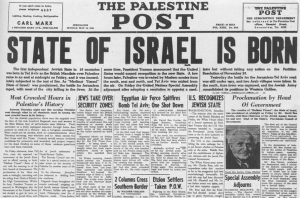
israel-born-in-a-day
A Jerusalem newspaper on May 14, 1948, announcing the modern state of Israel.

Israel was a nation full of heroes.

That’s what I concluded as a teenager when I nurtured a fascination with the new nation of Israel. The nation seemed to be a modern miracle brought into existence by faith, ingenuity and courage.

A lot of history has passed since then. May 15 was the anniversary of the nation’s founding in 1948, when Britain ended its post-World War I “mandate” as Middle East caretaker, in theory leaving Arabs and Israelis to sort out their own problems. It hasn’t worked very well.

Israel through adolescent eyes

My interest in Israel sprang partly from family: my father was Jewish. But long after my parents divorced and I had converted to Christianity, I clung to a thin claim to Judaism. As the Yom Kippur War raged in 1973, my brother and I even discussed the merits of fighting for Israel, should the war last several more years. (Our Israel-loving pastor assured me that we could be good Christians if we fought for love of Israel, but not if we hated Arabs.)

My early adolescent eyes saw an idealized story, enhanced by biblical quotations: A long struggle to gain a Jewish homeland, historically justified after the Holocaust. A bold underdog fighting for survival against the surrounding Arab foes. A new community carved from a sliver of land, finding a noble form in the kibbutz. The new Israel was transforming Palestine from a chaotic, barren desert into a fertile, blossoming society.

This straightforward reading was inspiring to a sort-of-Jewish boy whose own country was militarily and morally bogged down in Vietnam.

Winners get to write history

But as the cliché says, the winners get to write the history, and my lopsided view of Israel omitted the plight of the Palestinians. I was reminded of this a couple of weeks ago, during a conversation with Hanna Massad, pastor of Gaza Baptist Church. (See last week’s column.)

Massad’s parents were Palestinian, living in Jaffa in 1948. Overnight they became refugees, forced from their homes along with 700,000 other Gazans, including more than 50,000 Christians. Many of their ancestors had lived in the same places a thousand years earlier. Masses of displaced people scattered around the region, landing in camps in Syria, Jordan, the West Bank or beyond.

All this was part of a maze of political dealing and double dealing that started as the old Ottoman Empire, which had controlled the region for centuries, was defeated by the Allies during World War I.

During the next 30 years, declarations and agreements among European powers, Arab leaders and Zionist organizations – Jewish groups committed to establishing a national homeland in Palestine – tried to balance their various interests. Religion, ethnicity, economics and property claims only complicated matters, as both Jews and Muslims cited Scripture and history.

The British, given control of the region in 1922, sometimes favored Arab interests, sometimes Zionist. Zionists and Arabs occasionally appealed to their common heritage and tried to cooperate and make room for each other. But those times grew less frequent as time passed, as frustrations grew and as sometimes deadly violence flared among both Palestinians and Zionists, usually in reaction to changes in British policy.

By 1947, when the British government referred the matter to the newly formed United Nations, reconciliation seemed impossible. The UN finally recommended forming two states, Arab and Israeli, with Jerusalem designated as an international city.

After the British left on May 14, 1948 – a day earlier than scheduled, which caused chaos – the tensions erupted into war. But Israel secured its foothold and took over most of Palestine. The 61 years since have spiraled into bigotry, terror and vengeance, occasionally punctuated by hopeful attempts at peace.

No one is clean

My first inclination still is to sympathize with Israel. Given the history of the Jews – repeatedly driven from place to place over three thousand years – it’s easy to understand their sense of insecurity even as they established a modern homeland.

But if I take a step back, I can begin to see more of the Palestinian complaints, how their own claims to law, history and religion were set aside 61 years ago. I can see past the stereotypes and meet real people in this story, such as Hanna Massad and his family.

I can see that my adolescent view, with its easy heroism and uncomplicated morality, isn’t adequate. I can see, as the Scripture says, that no one is clean. No, not one.

 Johnson City (Tenn.) Press, 16 May 2009.

Palestinian Christians stand ‘between two fires’

gaza_strip_may_2005

Here’s one measure of just how heated the subject of Israel and Palestine can be. When the Christianity Today Web site reported in January that the Palestinian Bible Society, located in Gaza City, may have been hit by an Israeli missile during the brief but intense winter war, some readers were anything but sensitive.

“And my response is … so what?” wrote one. “Lots of buildings have been hit. Is this an attempt to move Christian sympathy for Hamas?”

“If I choose to live among the enemies of freedom,” added another, “I shouldn’t be surprised that I might be destroyed when the friends of freedom respond to threats.”

One reader took offense at this remark, calling it “sickening” because it ignored the fact that Palestinian Christians were living in their own homes. No one said “amen.” When another commenter criticized Israel, however, others piled on.

“Your what happens when dumb liberals think they understand Christanity,” one grammar-challenged reader replied.

No matter what someone thinks about the Israel-Palestine morass, this wasn’t a high-water mark for Christian solidarity.

Hanna Massad (center) with members of the Gaza Baptist Church (date unknown).

Hanna Massad was not part of that discussion – it’s doubtful he’d want to be – but he knows Gaza better than any of those readers. Gaza is his home.

Massad is the pastor of Gaza Baptist Church, the region’s only evangelical congregation. His wife managed the Palestinian Bible Society – that is, until they, their two young daughters and several extended family members left Gaza for the West Bank in 2007.

They departed literally to save their lives, thinking they would be gone for a matter of weeks instead of almost two years.

The Bible Society building was firebombed at least twice, a repeated target of Palestinian extremists. The worst moment came in October 2007, when a close friend and colleague, 29-year-old Rami Ayyad, who managed the Bible Society bookstore, was kidnapped in broad daylight and later shot to death. Gazan authorities condemned the murder and promised an investigation, but without results.

Massad and his family came to the U.S. last August for a one-year sabbatical, so he could study at the Overseas Ministries Study Center in Connecticut. He visited East Tennessee last week, speaking at Milligan College and Emmanuel School of Religion.

Massad, who received a Ph.D. in theology from Fuller Theological Seminary in California, chooses his words carefully as he describes life for Palestinian Christians. His voice is sad, not angry.

“We are caught between two fires,” Massad said last week during a lull in his speaking schedule. “On one hand there’s the fire of the Israel occupation. Then there’s the fire of militant Muslims, who are not happy with us.” Massad, 49, is a master of understatement.

Since the Hamas party gained control of Gaza in the 2006 elections, the already stressed Christian community has become a more frequent target of Muslim extremists. Hamas officials condemn attacks but take no effective action. The entire Christian population of Gaza has dwindled to about 2,000 believers, living among a population of 1.5 million.

For its part, Israel doesn’t seem interested in a real solution, Massad said. The infamous 432-mile security wall, severe travel restrictions (which separated Massad and his wife for almost a year), the continuing construction of settlements – all stir up Palestinian resentments. Last winter’s conflict cost 13 Israeli lives, compared to 1,300 Palestinians, most of them civilians.

Against that backdrop, Massad stands in an awkward and dangerous place. As a Palestinian, he is suspect to the Israelis. As a pastor, he makes himself a target for Palestinian extremists who hate Christians and think he may be aligned with the U.S. because the word “Baptist” is on the church building and he won’t call Israel his enemy.

“Humanly speaking, it’s easy to be depressed,” he said. “There are militants on both sides. But you cannot live without hope. With good intentions, all things are possible.”

When Massad and his family return to Gaza this summer, he anticipates “a lot of rebuilding of souls” in the congregation and community. They plan to restart the library and school, and to open a health clinic. The role of the church, he said, is to help create a culture of peace.

“We’ll do work to reflect God’s love,” he explained. “We can continue to have love for Israel and for the Palestinians. Love for one should not make you hate the other.”

Johnson City (Tenn.) Press, 9 May 2009.

Rumors that just won’t die

Zombies_Ahead_610x479The rumors still sound ominous.

Atheists, inspired by the now-deceased Madalyn Murray O’Hair, are pushing the Federal Communications Commission to ban all religious broadcasting. If this request – petition RM-2493 – succeeds, then we can say good-bye to church services on the radio, televangelists and all religious programming.

If you want an example of what might happen, consider the fate of that popular CBS-TV series, “Touched by an Angel.” It was taken off the air because it mentioned God in every episode.

Christians can stop the atheists, however, by adding their names to a petition that would force the FCC to keep its big government paws off their broadcasts. The goal is to collect one million names. James Dobson of Focus on the Family endorses this effort to stop RM-2493.

But wait, there’s more!

Redesigned dollar coins and Lincoln pennies omit the words “In God We Trust”!

Jesus will be portrayed as a homosexual in an upcoming film!

Steak ‘N’ Shake restaurants won’t allow its customers to pray in public!

And of course, Barack Obama is secretly a Muslim!

One problem: Not one of these rumors is true. Not one.

According to Snopes.com, one of several Web sites devoted to researching and unraveling rumors and so-called urban legends, more than 40 religion-based rumors are currently blowing around cyberspace. Only a handful of them, however, are emphatically true. The vast majority are bogus in whole or part.

That FCC rumor about removing religious broadcasting? Various versions have circulated for more than 30 years, by chain letter before the days of Internet. It started after two men filed a petition, the infamous RM-2493, asking the FCC to investigate the operating practices of stations licensed to religious organizations and not to grant new licenses for new noncommercial educational broadcast stations until the investigation was complete.

The FCC denied their petition in 1975. O’Hair had nothing to do with it, but her name got attached because she was then America’s most famous atheist.

But the story just won’t die. The FCC still gets mail and phone calls.

 “Such rumors are false,” the FCC Web site bluntly states. “The FCC has responded to numerous inquiries about these rumors and advised the public of their falsehood. There is no federal law that gives the FCC the authority to prohibit radio and television stations from broadcasting religious programs.”

For their part, Dobson and Focus on the Family have never been involved in any controversy over RM-2493, except for efforts to distance themselves from it.

The “Touched by an Angel” Web site also set the record straight in 2001, just after it was renewed for a seventh season: “A chain email has been floating around the internet and our message board stating that the FCC is forcing CBS to take ‘Touched By An Angel’ off the air because we mention the word ‘God. … This is a new variation of an old hoax. If you are a recipient of this email, please ignore it.”

The series ran a total of nine seasons, a long and successful lifespan for any program, and the scripts mentioned God from the first episode. The show ended for the same reason most do: it no longer appealed to the audience advertisers wanted.

Ironically, the same Internet that makes it so easy to spread rumors makes the truth more accessible than ever. Viewers can check out sources directly, such as the FCC, or locate information on sites such as Snopes and About.com: Urban Legends.

That being the case, then why do such stories persist, some for decades? Why don’t people check for themselves?

Maybe they don’t know how. Maybe the stories confirm what we already believe or what we want to be true. Maybe it’s a reaction of fear and insecurity, prompts for people who feel threatened by the world around them.

Whatever.

For now, let’s just take the pledge to check the facts and find the truth before we risk passing along a lie.

Johnson City (Tenn.) Press, 2 May 2009. (This column is an updated version of one that was published on April 29, 2006.)

Image: i-hacked.com. (http://news.cnet.com).

The politics of conscience and health care

I’m trying to imagine what it would be like to walk into a pharmacy with a prescription for, say, a contraceptive and be refused because the pharmacist believes contraception is morally wrong. In most areas I would be just inconvenienced because I could speak to another pharmacist or take my business elsewhere. In some places, however, I might be standing in the only drug store in town, and then what?

I’m also trying to imagine what it would be like to be a pharmacist whose faith or church teaching opposes artificial contraception – which would lead me into acting unethically if I filled that prescription. Even referring the customer to another pharmacist could be considered a disguised form of cooperation. And then what?

Last fall the Bush Administration started a process that resulted in a rule that protects health workers, particularly those who receive Medicare or Medicaid funding, if they refuse to provide treatment that goes against their consciences. The new rule took effect on Jan. 20, the day Bush left office.

Six weeks later, the new Obama administration declared its intention to reverse that rule, opening a 30-day public comment period that ended April 9. Now the Department of Health and Human Services is reviewing the comments and, come June or July, is likely to rescind the “conscience rule.”

The debate, in effect, pits the rights of patients against the rights of care providers, especially when it comes to birth control, abortion and end-of-life treatment.

“There are two schools of thought,” according to Walter Fitzgerald, adjunct professor of pharmacy practice who teaches law and ethics at the Gatton College of Pharmacy at East Tennessee State University. “One says that (providers) should not be forced to do something in conflict to their religious or personal moral values. Another says that if you are given a license by the state and in essence have sworn an oath to serve fellow man, then you don’t have the right to object any longer, because of your professional obligation.”

Opponents of the Bush rule say it limits access for care to patients. Supporters of the rule say it safeguards the freedom of conscience for doctors, nurses, pharmacists and other healthcare professionals that dates back to the Hippocratic Oath and the First Amendment.

Opponents say that laws enacted during the 1970s (soon after Roe v. Wade legalized abortion nationwide), which allow providers to refuse treatment as long as they provide information and access by other means, have worked just fine.

Supporters of the conscience rule, such as David Stevens, executive director of the Bristol-based Christian Medical and Dental Association, say those laws are toothless, opening the door to a kind of “ethical cleansing” in the medical field, aimed at practitioners who oppose abortion.

“There’s a lot of discrimination going on,” he said in a phone interview last week. A recent survey found that almost one-fourth of the CMDA’s 15,000 members said they had been “discriminated against” because of their opposition to abortion. “They’ve been fired from jobs or failed to get a promotion or weren’t able to get into an educational program,” he said.

But no lawsuits are pending, according to Stevens, because the laws don’t provide for legal action.

Tennessee, like most states, has a conscience clause, allowing health workers to refuse treatment as long as patients can get treatment elsewhere. So far, Fitzgerald said, the matter of conscience hasn’t been a problem, at least not for pharmacists. That’s not the case in some other states. In Illinois, for instance, pharmacists must dispense.

“There, it’s mandated. You don’t really have a choice,” Fitzgerald explained. “We don’t have anything nearly that strong in Tennessee.”

He isn’t sure yet how rescinding the federal rule would affect Tennessee.

“Giving information or referral is not required by law (in Tennessee), but from an ethical standpoint, that would be expected,” Fitzgerald said. “If a pharmacist refuses to dispense RU-486, someone could make an argument that it’s contrary to state Board of Pharmacy rule, especially if it’s medically necessitated or in case of rape.”

But that leaves a very complex, sometimes messy scene.

“Even if the federal law says that you have to honor freedom of choice, we have to balance that against our (professional) rules,” he said. “We don’t have a clear-cut answer.”

That pretty well sums up the whole debate.

Johnson City (Tenn.) Press, 25 April 2009.